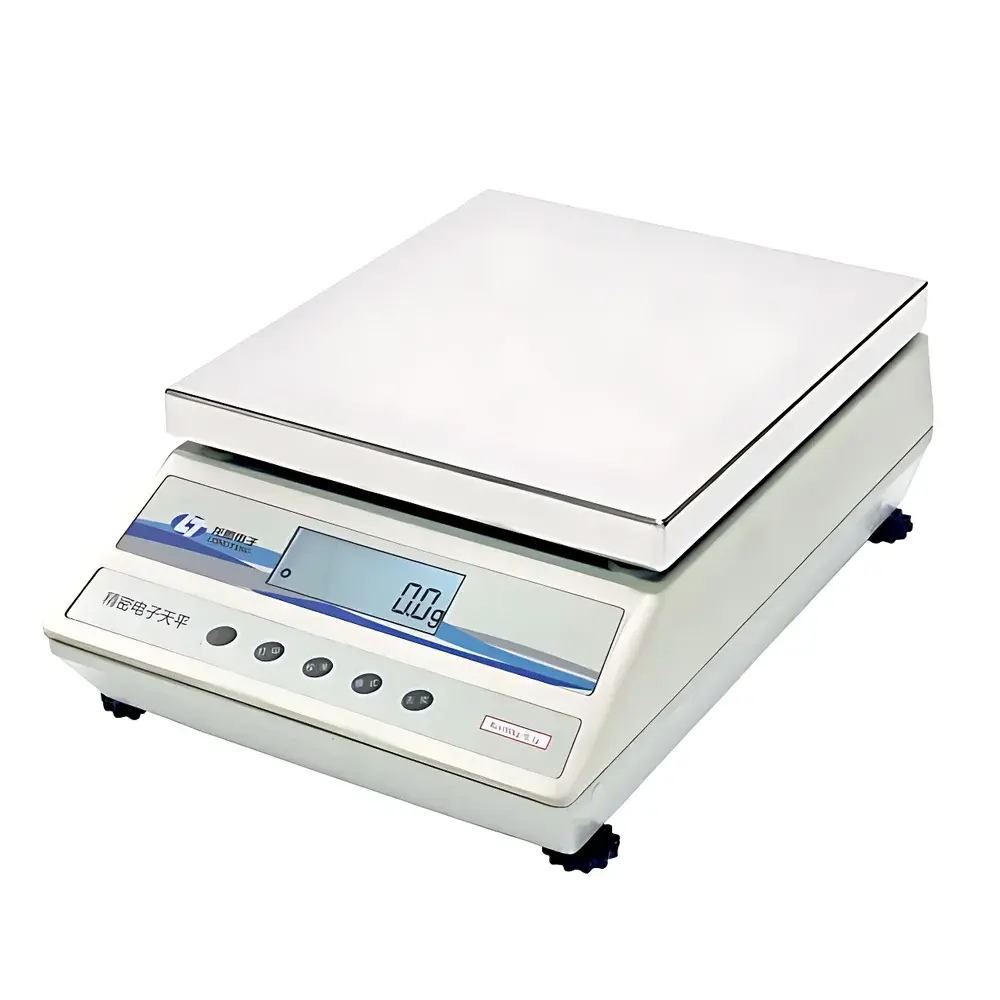
Longteng ES20K-2D Precision Electronic Balance
| Brand | Longteng |
|---|---|
| Origin | Liaoning, China |
| Model | ES20K-2D |
| Maximum Capacity | 20 kg |
| Readability | 0.01 g |
| Repeatability | ±0.02 g |
| Linearity Error | ±0.04 g |
| Pan Size | 340 × 300 mm |
| Display | Backlit LCD |
| Calibration | Internal Automatic Calibration |
| Connectivity | RS232 interface |
| Units | g, ct, oz, %, pcs, etc. |
| Functions | Counting, Percentage Weighing, Accumulation, Tare, Over/Under Load Alert, Temperature Compensation, Full-Range Tare |
Overview
The Longteng ES20K-2D Precision Electronic Balance is an industrial-grade analytical balance engineered for high-mass weighing tasks requiring sub-centigram resolution and metrological reliability. Utilizing electromagnetic force compensation (EMFC) sensor technology, it delivers stable, drift-resistant measurements across its full 20 kg capacity range. Unlike conventional load-cell-based scales, the EMFC principle ensures linear response, minimal hysteresis, and immunity to mechanical wear—critical for applications demanding long-term calibration stability and traceable measurement integrity. Designed for laboratory, QC, and production environments where both large sample mass and fine resolution are required—such as alloy density verification, cast iron weight certification, or raw material batch reconciliation—the ES20K-2D bridges the performance gap between standard platform scales and high-end analytical balances.
Key Features
- Electromagnetic force compensation (EMFC) transducer with active temperature compensation for consistent accuracy across ambient fluctuations (10–30 °C).
- Stainless steel weighing pan (340 × 300 mm) optimized for oversized or irregularly shaped samples—compatible with container tare, hanging hook accessories (optional), and multi-part weighing workflows.
- Backlit LCD display with adjustable contrast and auto-brightness adaptation—ensures legibility under low-light lab conditions or bright factory floor lighting without eye strain.
- Internal automatic calibration system with built-in reference mass; initiates calibration on power-up, after significant temperature shifts (>2 °C), or at user-defined intervals—fully compliant with ISO 9001 and GLP documentation requirements.
- Real-time overload/underload detection with audible and visual alerts, preventing sensor saturation and preserving long-term repeatability.
- Full-range tare function, accumulation (summing multiple weighings), net/gross switching, and programmable auto-zero tracking for dynamic process weighing.
Sample Compatibility & Compliance
The ES20K-2D accommodates diverse sample forms—including bulk powders in stainless steel containers, machined metal components up to 20 kg, calibration weights, and composite materials used in aerospace or foundry QA. Its 340 × 300 mm pan supports ASTM E1222-compliant sampling protocols for heterogeneous solids. The balance meets OIML R76-1 Class II accuracy specifications for non-automatic weighing instruments and conforms to ISO/IEC 17025:2017 clause 6.4.3 for measurement equipment suitability. All firmware operations—including calibration logs, tare history, and error flags—are timestamped and stored locally, supporting audit readiness per FDA 21 CFR Part 11 when integrated into validated systems.
Software & Data Management
Equipped with a standard RS232 serial interface (38400 baud, 8N1), the ES20K-2D enables seamless integration with LIMS, MES, or custom data acquisition software. It outputs ASCII-formatted weight strings with configurable prefixes (e.g., “W:”, “T:”) and termination characters (CR/LF), compatible with LabVIEW, MATLAB, and industry-standard SCADA platforms. Optional Windows-based Longteng Balance Manager software provides real-time graphing, statistical process control (SPC) charts (X̄–R, Cp/Cpk), and automated report generation in PDF or CSV. All communication events—including calibration triggers, unit changes, and error codes—are logged with UTC timestamps, fulfilling ALCOA+ data integrity criteria.
Applications
- Verification of certified reference weights (e.g., cast iron, stainless steel, or brass test masses) per ASTM E456 and ISO 17025 calibration procedures.
- Batch-to-batch consistency checks in metallurgical processing—measuring alloy ingot mass prior to melting, or finished casting mass against nominal tolerance bands.
- Pharmaceutical excipient dispensing validation, where gross mass of primary containers must be verified before volumetric filling.
- Education and vocational training labs—supporting student experiments in density determination, stoichiometric ratio analysis, and gravimetric titration preparation.
- Quality assurance of automotive brake rotors, turbine blades, and other safety-critical components where dimensional tolerances correlate directly with mass thresholds.
FAQ
What is the recommended calibration frequency for routine use?
For GLP-compliant operation, internal calibration should be performed daily before first use and after any environmental shift exceeding ±2 °C. External verification using traceable Class M1 or better weights is advised weekly.
Does the ES20K-2D support GLP/GMP audit trails?
Yes—when connected via RS232 to compliant software, all calibrations, tare actions, and error events are time-stamped and exportable as immutable records meeting FDA 21 CFR Part 11 electronic signature requirements.
Can the balance perform piece counting without manual sample size input?
No—it requires initial count calibration (e.g., 10–50 pieces) to compute average piece weight; however, the system stores up to 20 preset item profiles with unique identifiers and unit weights.
Is the RS232 interface optically isolated?
No—RS232 is electrically isolated via onboard transient voltage suppression (TVS) diodes but does not include galvanic isolation; for noisy industrial environments, use a shielded cable and ground-loop mitigation best practices.
What environmental conditions affect repeatability most significantly?
Air currents (≥0.2 m/s), static charge buildup on non-conductive samples, and thermal gradients across the pan surface—mitigated by using draft shields (optional), anti-static brushes, and allowing samples to equilibrate to lab temperature prior to weighing.