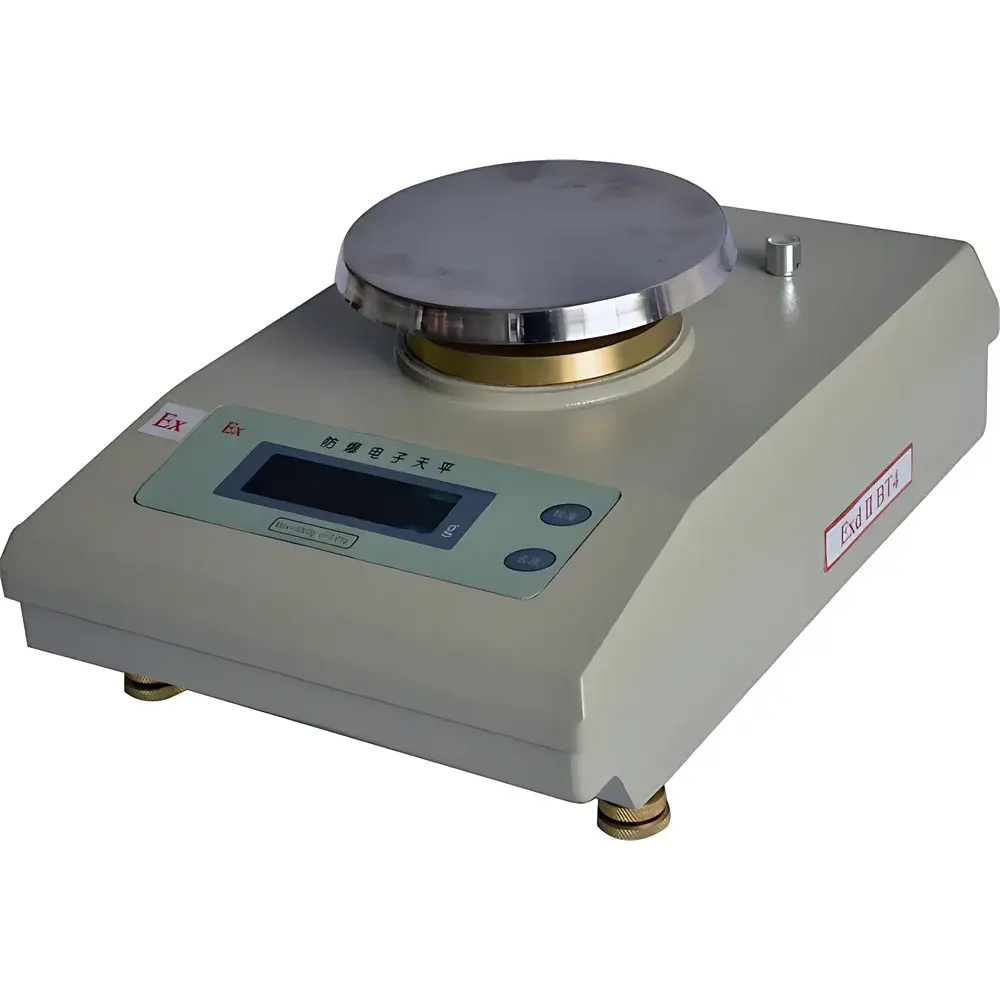
Longteng FBA-2000-2 Explosion-Proof Precision Balance
| Brand | Longteng |
|---|---|
| Origin | Liaoning, China |
| Manufacturer Type | Authorized Distributor |
| Country of Origin | China |
| Model | FBA-2000-2 |
| Instrument Type | Precision Balance |
| Maximum Capacity | 2000 g |
| Readability | 0.01 g |
| Repeatability | ±0.01 g |
| Calibration Method | Automatic |
| Compliance | Ex dII BT4 |
| Hazardous Area Classification | Zone 1 & Zone 2 (IIA/IIB, T4) |
Overview
The Longteng FBA-2000-2 Explosion-Proof Precision Balance is an intrinsically safe weighing instrument engineered for high-reliability operation in hazardous environments where flammable gases, vapors, or dusts may be present. It operates on the principle of electromagnetic force compensation (EMFC), a widely accepted method in precision metrology that delivers stable, drift-free measurements by balancing the gravitational force of the sample against a precisely controlled electromagnetic counterforce. This architecture ensures long-term stability, minimal thermal drift, and high reproducibility—critical attributes for applications governed by strict quality assurance protocols in defense, aerospace, and energetic materials manufacturing. Certified to the Ex dII BT4 explosion protection standard per GB 3836.1–2010 and IEC 60079-0/1, the FBA-2000-2 is designed for use in Zone 1 and Zone 2 classified areas, corresponding to locations where explosive gas-air mixtures are likely to occur occasionally (Zone 1) or unlikely but possible under abnormal conditions (Zone 2). Its robust cast-aluminum housing, sealed load cell cavity, and flameproof enclosure prevent internal ignition from propagating to the surrounding atmosphere.
Key Features
- Explosion-proof certification compliant with Ex dII BT4 (Group IIA/IIB, Temperature Class T4), meeting international hazardous location requirements aligned with ATEX Directive 2014/34/EU and IECEx system equivalency.
- Electromagnetic force compensation (EMFC) sensor technology delivering 0.01 g readability and ±0.01 g repeatability at full 2000 g capacity.
- Automatic internal calibration with motor-driven weight actuation—eliminates manual intervention and ensures traceable, time-stamped calibration events.
- Stainless steel weighing pan (200 × 180 mm) with anti-static coating and optional draft shield compatibility for ISO 17025-compliant mass measurement workflows.
- Ruggedized industrial enclosure rated IP54 for resistance to dust ingress and water splashes during routine cleaning and maintenance.
- RS232 and optional USB interfaces supporting bidirectional communication with LIMS, MES, or ERP systems under 21 CFR Part 11-compliant data capture configurations.
Sample Compatibility & Compliance
The FBA-2000-2 is validated for direct weighing of solid propellants, pyrotechnic compositions, detonators, and inert munition components in accordance with MIL-STD-1337B, NATO AEP-97, and GB/T 21334–2008 (Explosives — Safety Requirements for Weighing Equipment). Its design accommodates samples up to 2000 g without requiring external tare containers, minimizing handling risk in sensitive operations. All electrical connections utilize certified flameproof conduit entries, and internal circuitry conforms to GB 3836.4–2010 (intrinsic safety requirements). The balance is suitable for GLP/GMP-regulated environments when integrated with audit-trail-enabled software and documented calibration procedures traceable to national standards (e.g., NIM, CNAS-accredited labs).
Software & Data Management
Equipped with embedded firmware supporting configurable data logging (time, date, gross/net/tare mass, operator ID, calibration status), the FBA-2000-2 enables seamless integration into regulated laboratory informatics ecosystems. Optional PC software provides real-time graphing, statistical process control (SPC) charts (X̄-R, Cpk), and automated report generation compliant with ISO/IEC 17025:2017 clause 7.7 (result reporting). Audit trails record all critical events—including calibration, zeroing, parameter changes, and user logins—with immutable timestamps and operator authentication. When deployed with networked validation packages, the system supports FDA 21 CFR Part 11 electronic signature and record retention requirements.
Applications
- Precision formulation and batch verification of explosive charges, propellant grains, and pyrotechnic delay compositions in ordnance manufacturing facilities.
- Final assembly inspection of guided munitions, rocket motor segments, and warhead subassemblies requiring mass tolerance ≤ ±0.02 g.
- Research-scale synthesis and characterization of novel energetic materials in university and government defense laboratories.
- Quality control of commercial blasting agents, detonating cord, and seismic charge assemblies in mining and civil engineering sectors.
- Calibration transfer and reference mass verification within metrology labs operating under ISO/IEC 17025 accreditation scope.
FAQ
What does Ex dII BT4 mean for operational safety?
It indicates flameproof enclosure protection (‘d’) for use in explosive gas atmospheres classified as Group IIA/IIB (propane/ethylene) and temperature class T4 (surface temperature ≤ 135°C), permitting deployment in Zone 1 and Zone 2 hazardous locations.
Is the FBA-2000-2 suitable for use in cleanrooms?
Yes—when equipped with optional HEPA-filtered air purge and static-dissipative accessories, it meets ISO 14644-1 Class 7 (10,000) cleanroom compatibility requirements.
Can the balance be calibrated using external weights traceable to NIST?
Yes—external calibration mode supports Class E2 or better砝码 (certified weights) with documented uncertainty budgets; internal calibration remains available for routine verification between formal calibrations.
Does the device support multi-language UI for international deployment?
The firmware includes English, Chinese, Russian, and Arabic language options, configurable via front-panel menu or remote software interface.
How is traceability maintained during routine maintenance?
All service interventions—including sensor replacement, firmware updates, and mechanical adjustments—are logged with unique event IDs, technician credentials, and pre/post-adjustment verification data stored in non-volatile memory.