
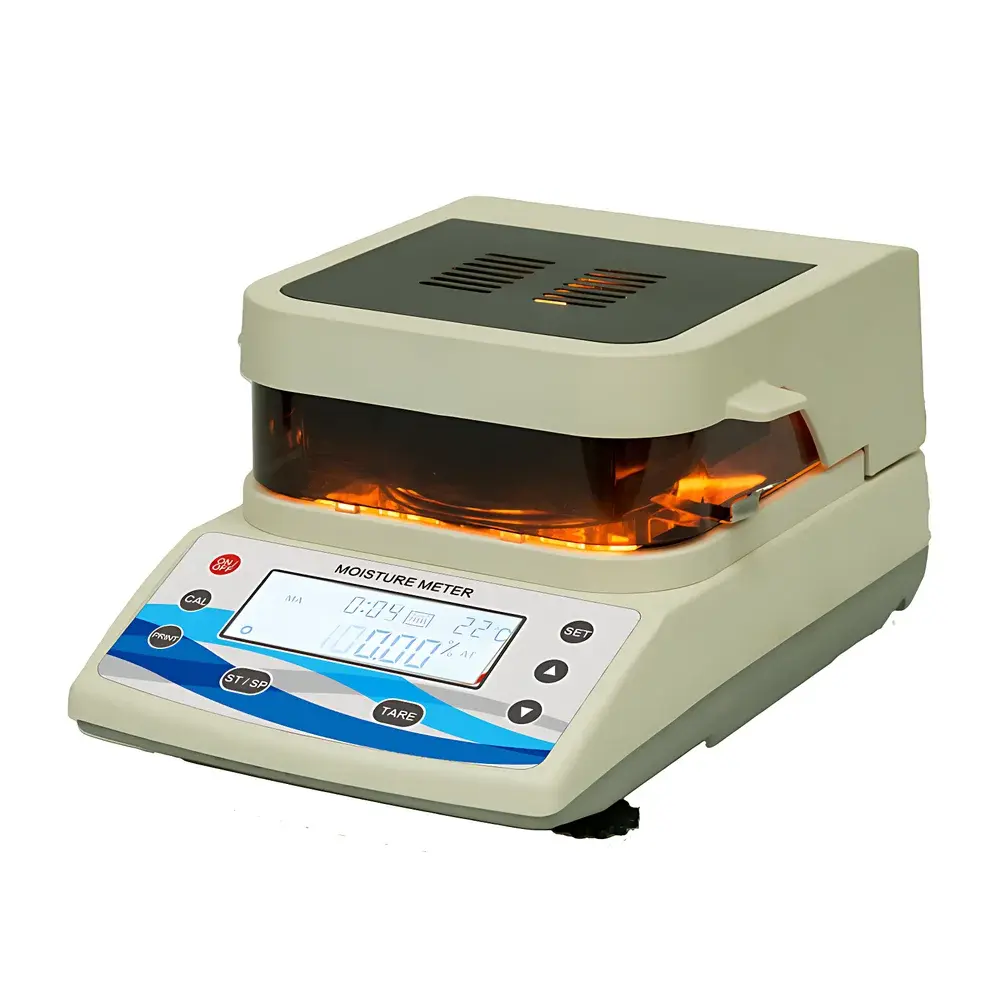
Longteng LSC-60A Coulometric Moisture Analyzer
| Brand | Longteng |
|---|---|
| Origin | Liaoning, China |
| Manufacturer Type | Authorized Distributor |
| Country of Origin | China |
| Model | LSC-60A |
| Price | Upon Request |
| Weighing Range | 60 g |
| Minimum Readability | 0.001 g |
| Heating Source | 500 W Annular Halogen Lamp |
| Temperature Range | 60–200 °C (1 °C increments) |
| Repeatability (≥5 g sample) | ±0.1% |
| Display | Backlit LCD |
| Measurement Modes | Automatic, Timed, Manual |
| Interface | RS-232 |
| Pan Diameter | Φ90 mm |
| Dimensions (W×D×H) | 330 × 200 × 155 mm |
| Weight | 5.5 kg |
| Power Supply | AC 220 V, 50 Hz |
| Environmental Operating Range | 10–40 °C |
| Tare Capacity | Full Scale |
| Drying Programs | Standard Ramp-and-Hold |
| Standard Accessories | 10 Sample Pans, Calibration Weight, Power Cord, User Manual |
Overview
The Longteng LSC-60A Coulometric Moisture Analyzer is a precision laboratory instrument engineered for rapid, gravimetric determination of moisture content in solid, semi-solid, and powdered samples via thermogravimetric loss-on-drying (LOD) methodology. While classified within the broader category of coulometric moisture testers—devices that quantify water through electrochemical titration—the LSC-60A implements a robust halogen-heating + electromagnetic force sensor architecture optimized for routine QC/QA workflows in pharmaceutical, chemical, food, and polymer laboratories. It does not perform Karl Fischer coulometric titration; rather, its designation as a “coulometric moisture tester” in Chinese market nomenclature reflects regional classification conventions for high-precision moisture analyzers with digital calibration traceability. The instrument operates on the principle of controlled thermal dehydration: a precisely regulated 500 W annular halogen lamp delivers uniform radiant heat across the sample surface, while an integrated downward-mounted electromagnetic force compensation sensor continuously monitors mass loss with 0.001 g resolution. Real-time data processing employs adaptive convergence algorithms to detect endpoint stability, ensuring reproducible results aligned with ASTM E1868 and ISO 5351 standards for moisture analysis by thermogravimetry.
Key Features
- Downward-mounted electromagnetic force compensation sensor for high linearity, minimal drift, and fast stabilization (<3 seconds typical response time)
- Annular 500 W halogen heating system with mirror-polished stainless-steel reflector chamber—ensures homogeneous thermal distribution and eliminates hot-spot bias
- Programmable temperature control from 60 °C to 200 °C in 1 °C increments, supporting method development for thermally sensitive or refractory matrices
- Triple measurement mode architecture: Automatic (endpoint detection based on Δm/Δt threshold), Timed (user-defined duration from 1–99 minutes), and Manual (operator-initiated stop)
- Backlit LCD display with adjustable brightness—optimized for both ambient-lit labs and low-light cleanroom environments
- Full-scale tare function and built-in calibration routine using supplied stainless-steel reference weight (certified to Class M2 tolerance)
- RS-232 serial interface compliant with EIA/TIA-232-F specifications for bidirectional communication with external printers or LIMS-hosted data acquisition systems
Sample Compatibility & Compliance
The LSC-60A accommodates samples up to 60 g across a Φ90 mm stainless-steel weighing pan, supporting granular solids (e.g., APIs, excipients), hygroscopic powders (e.g., silica gel, lithium salts), and viscous pastes (e.g., battery electrode slurries). Its open-chamber design permits rapid sample loading and visual monitoring during drying. The instrument meets mechanical and electrical safety requirements per GB 4793.1–2019 (equivalent to IEC 61010-1) and complies with electromagnetic compatibility (EMC) directives per GB/T 18268.1–2010. While not intrinsically certified for hazardous locations, it is routinely deployed in GLP-compliant environments where audit trails, operator authentication, and method version control are enforced via external software integration. Data integrity aligns with ALCOA+ principles when paired with validated RS-232 logging protocols.
Software & Data Management
The LSC-60A operates as a standalone unit with embedded firmware managing all measurement logic, calibration routines, and display rendering. No proprietary PC software is bundled; however, its RS-232 interface supports ASCII-based command/response protocol (9600 bps, 8N1), enabling seamless integration into third-party platforms—including LabWare LIMS, Thermo Fisher SampleManager, and custom Python/Node-RED automation scripts. All measurements record timestamp, final moisture %, drying time, peak temperature, and mass loss curve metadata. When connected to a serial-to-USB adapter and configured with terminal emulation (e.g., PuTTY), raw output can be redirected to CSV for statistical process control (SPC) analysis. Audit-ready documentation is achievable via printer output (ESC/P-compatible) or automated file capture with time-stamped filenames.
Applications
- Pharmaceutical: Residual solvent quantification in lyophilized powders per USP , moisture verification of tablet blends prior to compression
- Chemicals: Water content validation in catalyst carriers (e.g., alumina, zeolites), quality release testing of inorganic salts (e.g., Na₂SO₄, CaCl₂)
- Food & Agriculture: Moisture profiling in cereal grains, dairy powders, and pet food pellets per AOAC 950.46
- Electronics Materials: Moisture assessment in solder pastes, conductive adhesives, and battery cathode precursors where H₂O-induced degradation compromises performance
- Plastics & Polymers: Pre-drying verification of engineering resins (e.g., PA6, PET) prior to injection molding to prevent hydrolysis
FAQ
Does the LSC-60A perform Karl Fischer coulometric titration?
No. It is a thermogravimetric moisture analyzer utilizing halogen heating and electromagnetic force sensing. True coulometric KF instruments require reagent-filled cells, platinum electrodes, and iodine generation circuitry—none of which are present in this model.
What is the recommended calibration frequency?
Daily verification with the supplied 20 g M2-class weight is advised before first use and after major environmental shifts. Full internal calibration should follow manufacturer-specified procedures every 30 days or per lab SOP.
Can the instrument be used for volatile organic compound (VOC) analysis?
Not reliably. The LSC-60A measures total volatile loss—not water-specific loss. For VOC-selective quantification, GC-MS or headspace-GC is required.
Is GLP-compliant electronic record storage supported?
The device itself does not store historical data internally. Compliance requires external logging via RS-232 with time-synced, write-protected storage and user-access controls implemented at the host system level.
What maintenance is required for the halogen lamp assembly?
Lamp replacement is recommended every 5,000 operating hours. Avoid touching the quartz envelope with bare hands; use lint-free gloves to prevent oil residue-induced thermal fracture.
Related Products





