
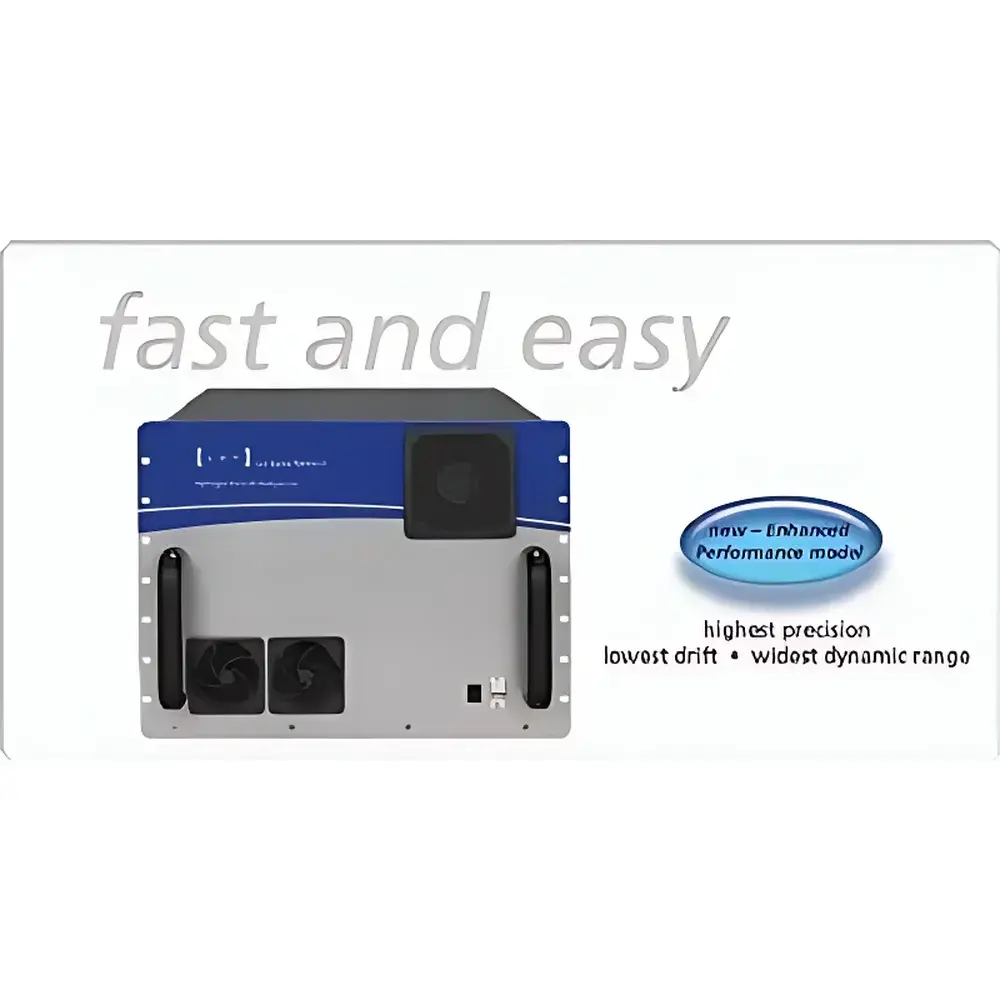
Los Gatos Research HF-907/911/915 Series HF and H₂O Analyzer
| Origin | USA |
|---|---|
| Manufacturer Type | Authorized Distributor |
| Origin Category | Imported |
| Model Numbers | 907-0017 (Standard Rackmount), 911-0017 (Enhanced Precision), 915-0017 (Ultra-Portable) |
| Detection Principle | Off-Axis Integrated Cavity Output Spectroscopy (OA-ICOS) |
| Measurement Target | Hydrogen Fluoride (HF) and Water Vapor (H₂O) |
| Detection Limit | 0.1 ppb (1σ, 100 s) |
| Precision | 1 ppb (1σ, 1 s) / 0.1 ppb (1σ, 100 s) |
| Drift | ≤0.1 ppb (24 h, EP model, STP, 15-min avg) |
| Measurement Range | 0.1–2000 ppb (standard) |
| Response Time | <10 s (with optional external pump) |
| Data Output | RS-232, Analog, Ethernet, USB |
| Power | 115/230 VAC, 50/60 Hz or 12 VDC |
| Power Consumption | 100 W (Standard), 150 W (EP), 70 W (Ultra-Portable) |
| Operating Temperature | 0–45 °C |
| Sample Temperature | 0–50 °C |
| Relative Humidity | 0–100% RH (non-condensing) |
| Dimensions & Weight | Standard: 22.2 × 48.3 × 61 cm, 29 kg |
| EP | 35.6 × 48.3 × 61 cm, 40 kg |
| Ultra-Portable | 17.8 × 47 × 35.6 cm, 19 kg |
Overview
The Los Gatos Research HF-907/911/915 Series HF and H₂O Analyzer is a high-performance, field-deployable trace gas analyzer engineered for simultaneous, real-time quantification of hydrogen fluoride (HF) and water vapor (H₂O) in ambient air and industrial process streams. Leveraging Los Gatos Research’s proprietary Off-Axis Integrated Cavity Output Spectroscopy (OA-ICOS) technology, this instrument overcomes fundamental limitations inherent in conventional Cavity Ring-Down Spectroscopy (CRDS), including stringent laser-cavity alignment requirements, active wavelength stabilization subsystems, and thermally induced cavity length drift. OA-ICOS achieves robust optical coupling without continuous active feedback control—enabling stable, high-fidelity absorption spectroscopy under variable environmental conditions. The analyzer delivers sub-second temporal resolution with measurement precision down to 0.1 ppb (1σ, 100 s averaging) and long-term stability characterized by <0.1 ppb drift over 24 hours (EP model, STP). Its dual-species capability eliminates the need for separate analyzers or complex calibration cross-talk corrections, supporting regulatory-grade monitoring in compliance with EPA Method TO-15, ISO 16000-32, and ASTM D6348.
Key Features
- Simultaneous, independent quantification of HF and H₂O with no spectral interference from CO₂, CH₄, NH₃, NO₂, SO₂, or common hydrocarbons
- Real-time, high-resolution absorption spectra displayed via embedded Linux interface—enabling on-the-fly spectral validation and diagnostic assessment
- Zero-drift thermal management architecture: patented temperature-controlled optical cavity minimizes thermal expansion effects, ensuring <0.1 ppb 24-hour baseline stability
- Low-power operation (as low as 70 W for ultra-portable configuration) optimized for solar-battery-powered remote deployments and mobile platforms
- Modular hardware design with three form factors: rackmount standard (907-0017), enhanced-precision (911-0017), and ultra-portable (915-0017) for rapid site installation (<5 minutes)
- Fully integrated data acquisition: onboard Linux OS enables continuous timestamped storage, automated file rotation, and configurable logging intervals (10 ms–1 h)
Sample Compatibility & Compliance
The analyzer accepts sample gas at flow rates of 0.1–1.5 L/min and accommodates inlet pressures from 50–105 kPa without active pressure regulation. It operates reliably across full ambient humidity (0–100% RH, non-condensing) and temperature ranges (0–50 °C sample, 0–45 °C instrument enclosure), making it suitable for stack monitoring, fenceline surveillance, and atmospheric boundary-layer studies. All models meet IEC 61326-1 (EMC for laboratory and industrial use) and UL/CSA 61010-1 safety standards. Data integrity complies with FDA 21 CFR Part 11 requirements when used with optional audit-trail-enabled software (e.g., LGR Data Acquisition Suite v4.2+), supporting GLP/GMP workflows. Calibration traceability is maintained to NIST-traceable HF reference standards (SRM 2691a/b) and certified moisture generators (e.g., MBW 373).
Software & Data Management
The embedded Linux-based controller provides local web interface access (HTTPS) for real-time spectrum visualization, parameter adjustment, and system diagnostics. Remote operation is supported via secure SSH or RESTful API endpoints, enabling integration into SCADA, EMS, or cloud-based environmental data platforms (e.g., AWS IoT Core, Azure IoT Hub). Data export formats include CSV, NetCDF-4 (with CF-1.8 metadata conventions), and binary HDF5—facilitating interoperability with Python (xarray, pandas), MATLAB, and R-based QA/QC pipelines. Optional LGR Data Acquisition Software (P/N 904-0002) synchronizes multi-instrument time series (e.g., co-located wind sensors, GPS, particulate monitors) with microsecond-level timestamp accuracy using PTPv2 (IEEE 1588).
Applications
- Ambient air quality monitoring networks targeting HF emissions from aluminum smelters, semiconductor fabrication facilities, and fluoropolymer manufacturing plants
- Industrial hygiene assessments in chemical production units handling HF, F₂, or fluorinated intermediates
- Atmospheric chemistry research: HF/H₂O isotopic ratio studies (when coupled with isotopically enriched calibration gases), boundary-layer transport modeling, and dry deposition flux estimation
- Regulatory compliance reporting per EPA 40 CFR Part 60 Subpart AA/BB and EU Directive 2010/75/EU (IED)
- Mobile monitoring campaigns using vehicle-mounted or drone-deployable ultra-portable configurations (915-0017)
FAQ
Does the analyzer require routine laser alignment or cavity re-tuning?
No. OA-ICOS eliminates the need for active cavity-length matching or laser wavelength locking—no manual or automated alignment procedures are required during normal operation.
Can the instrument operate unattended for extended periods in remote locations?
Yes. With optional battery/solar power conditioning and cellular telemetry (e.g., LTE-M or NB-IoT modem), the analyzer supports fully autonomous 30-day deployments with health monitoring, automatic zero/span checks, and alarm-triggered data upload.
Is cross-sensitivity to HCl or other halogen acids compensated for?
The OA-ICOS spectral fitting algorithm uses multi-line, multi-isotopologue absorption modeling (including 1H19F, 2H19F, and H218O) to deconvolve overlapping features. HCl exhibits negligible overlap at the selected HF Q-branch transitions near 1.27 µm, resulting in <0.05% relative interference at 100 ppm HCl.
What maintenance is required for long-term operational reliability?
Annual verification of optical window transmission and inlet filter replacement (part number 902-0005) are the only scheduled maintenance tasks. No consumables (e.g., scrubbers, membranes, or electrochemical cells) are used in the optical detection path.







