
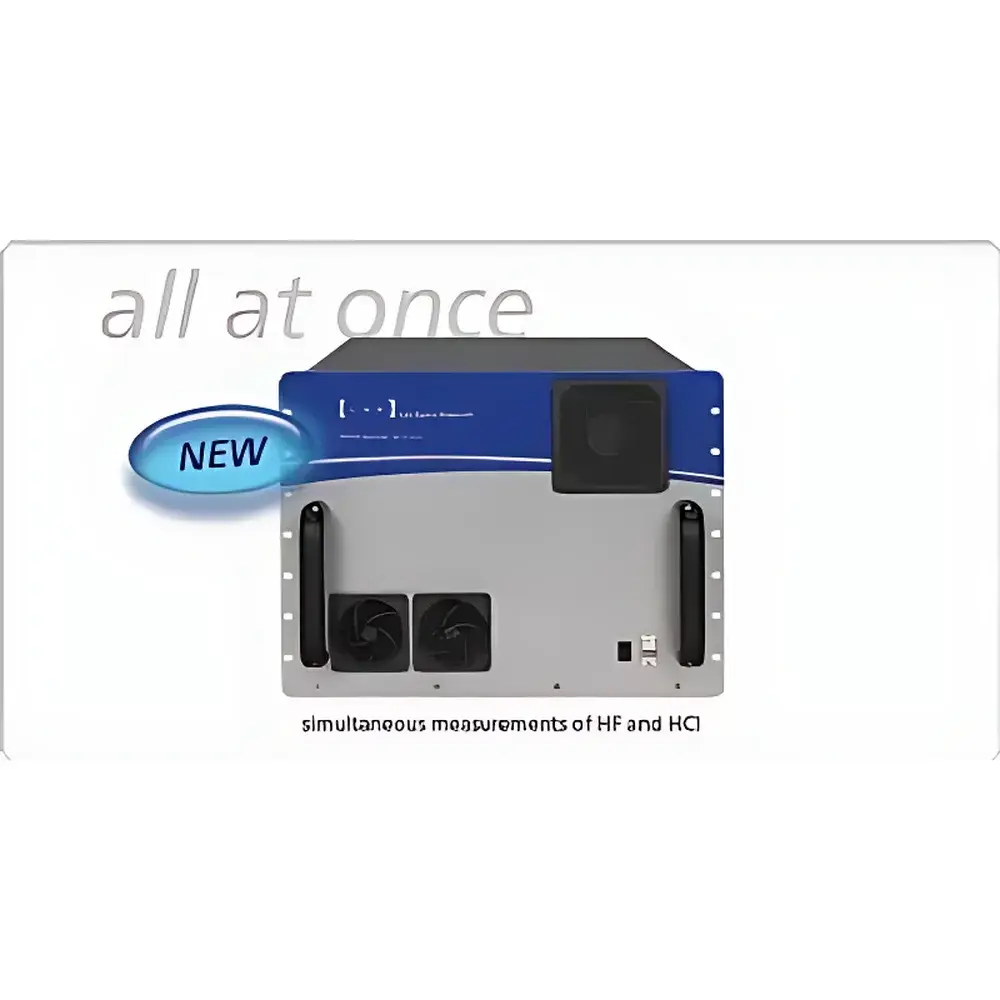
Los Gatos Research Model 907-0038 / 911-0038 / 915-0038 HCl/HF Analyzer
| Origin | USA |
|---|---|
| Manufacturer Type | Authorized Distributor |
| Origin Category | Imported |
| Model Numbers | 907-0038 (Standard Rackmount), 911-0038 (Enhanced Precision EP), 915-0038 (Ultra-Portable) |
| Measurement Principle | Off-Axis Integrated Cavity Output Spectroscopy (OA-ICOS) |
| Detection Limits | 0.2 ppb (HCl & HF, 1σ, 100 s) |
| Precision (1σ) | 2 ppb (5 s), 0.2 ppb (100 s) |
| Drift (24 h, STP, EP model) | ≤1 ppb |
| Measurement Range (full-spec) | 0.2–2000 ppb |
| Optional Extended Range | 0–10 ppm |
| Response Time (flow-limited) | <6 s |
| Data Output | RS-232, Analog, Ethernet, USB |
| Power | 115/230 VAC, 50/60 Hz or 12 VDC |
| Power Consumption | 100 W (Standard), 150 W (EP) |
| Operating Temperature | 0–45 °C |
| Sample Temperature Range | –10 to +80 °C |
| Relative Humidity | 0–100 % RH (non-condensing) |
| Dimensions & Weight | Standard: 22.2 × 48.3 × 61 cm, 29.5 kg |
| EP | 35.6 × 48.3 × 61 cm, 40.8 kg |
| Ultra-Portable | 17.8 × 47 × 35.6 cm, 19 kg |
Overview
The Los Gatos Research (LGR) HCl/HF Analyzer is a high-performance, field-deployable trace gas analyzer engineered for simultaneous, quantitative measurement of hydrogen chloride (HCl) and hydrogen fluoride (HF) in ambient air, stack emissions, and industrial process streams. It employs Off-Axis Integrated Cavity Output Spectroscopy (OA-ICOS), a robust laser absorption technique that eliminates the wavelength-locking complexity inherent in conventional Cavity Ring-Down Spectroscopy (CRDS). Unlike CRDS systems requiring active cavity-length stabilization and continuous laser-frequency tuning, OA-ICOS utilizes off-axis laser injection into a high-finesse optical cavity, enabling stable, high-signal-to-noise ratio absorption measurements without real-time cavity resonance tracking. This architecture delivers exceptional long-term stability, minimal zero drift, and immunity to pressure and interferences from common atmospheric gases (e.g., CO2, CH4, H2O vapor—though water is co-quantified as a species). The instrument operates at near-infrared wavelengths where fundamental rovibrational transitions of HCl and HF exhibit strong, spectrally isolated absorption features, ensuring selectivity and accuracy under variable environmental conditions.
Key Features
- Simultaneous, real-time quantification of HCl and HF at sub-ppb sensitivity (0.2 ppb, 1σ, 100 s average)
- OA-ICOS optical platform with no moving parts, no active cavity length control, and no requirement for periodic laser re-alignment
- Integrated, temperature-stabilized optical bench and proprietary thermal management minimizing thermal drift (<1 ppb over 24 h for EP model)
- Onboard Linux-based embedded computer enabling continuous data logging, spectral visualization, and local diagnostics
- Flexible sampling interface supporting direct ambient draw, heated line integration, or external vacuum pump (e.g., N920, 1.2 s gas exchange time)
- Low power consumption (100 W standard; 150 W EP) compatible with battery, solar, or vehicle-mounted deployments
- Multi-format connectivity: Ethernet (TCP/IP), RS-232, analog voltage/current outputs, and USB for configuration and data export
- Three form factors optimized for distinct operational needs: rackmount standard (907-0038), enhanced-precision EP (911-0038), and ultra-portable field unit (915-0038)
Sample Compatibility & Compliance
The analyzer accepts gaseous samples across a wide thermal and humidity envelope: sample temperature from –10 °C to +80 °C and ambient relative humidity up to 100 % RH (non-condensing). Internal heated sample path options mitigate condensation and adsorption losses for reactive species. All models meet CE marking requirements for electromagnetic compatibility (EMC Directive 2014/30/EU) and low-voltage safety (LVD Directive 2014/35/EU). Data integrity and audit readiness are supported via timestamped, non-erasable internal storage and optional GLP/GMP-compliant data acquisition software (Model 904-0002), which enables synchronized logging with external sensors (e.g., meteorological stations, GPS, anemometers) and supports FDA 21 CFR Part 11–compliant user access controls when deployed in regulated environments. Calibration traceability aligns with NIST-traceable gas standards per ISO 17025-accredited protocols.
Software & Data Management
LGR’s proprietary firmware provides a web-accessible interface via Ethernet, allowing remote configuration, real-time spectral viewing, alarm threshold setting, and diagnostic monitoring from any network-connected device. The onboard Linux OS logs all raw spectra, concentration time series, cavity pressure/temperature telemetry, and system health metrics to internal flash memory (≥16 GB). The optional Data Acquisition Software (DAS) package (Model 904-0002) runs on Windows platforms and supports multi-instrument synchronization, customizable reporting templates, automated calibration event logging, and export to CSV, NetCDF, or SQL formats. DAS includes built-in tools for baseline correction, spectral fitting validation, and outlier detection—essential for QA/QC workflows in EPA Method TO-14/TO-15–aligned monitoring programs.
Applications
- Ambient air quality monitoring networks targeting halogenated acid gas precursors to PM2.5 and acid deposition
- Continuous emission monitoring (CEMS) at waste incinerators, coal-fired power plants, and semiconductor fabrication facilities
- Fenceline monitoring for regulatory compliance (e.g., U.S. EPA 40 CFR Part 60, 63; EU IED Directive)
- Industrial hygiene assessments in chemical manufacturing, metal pickling, and fluoropolymer production
- Atmospheric chemistry research campaigns measuring halogen radical budgets and heterogeneous reaction kinetics
- Calibration transfer and reference standard verification for portable electrochemical and colorimetric sensors
FAQ
What is the fundamental difference between OA-ICOS and CRDS in this analyzer?
OA-ICOS decouples laser frequency stability from cavity resonance matching by injecting the laser beam at a slight angle to the cavity axis, enabling accumulation of thousands of round trips without requiring active feedback to maintain resonance. This eliminates the need for piezoelectric cavity length tuning and associated electronic complexity found in CRDS.
Can the analyzer operate unattended for extended periods?
Yes. With its solid-state optical design, passive thermal regulation (in Standard and EP models), and embedded Linux OS, the analyzer supports fully autonomous operation for weeks. Internal storage retains >6 months of second-level data at default logging intervals.
Is water vapor measured as an interferent—or as a co-analyte?
Water vapor is explicitly quantified as a co-analyte using its own absorption feature within the same spectral scan, enabling real-time, stoichiometric correction of HCl and HF absorption line shapes and eliminating cross-sensitivity artifacts.
How is calibration performed and maintained in the field?
Calibration uses certified standard gas mixtures traceable to NIST. Zero is established via purified air or nitrogen; span is verified using dual-point (low/high) standards. Drift correction algorithms leverage water vapor and cavity pressure telemetry to maintain accuracy between calibrations—typically recommended every 7–30 days depending on application severity.
Are multi-point sampling configurations supported?
Yes. Optional 8-channel (MIU-374-8) or 16-channel (MIU-377-16) multiplexers enable sequential analysis from multiple inlet locations, with automatic valve timing and channel metadata tagging in the output stream.







