
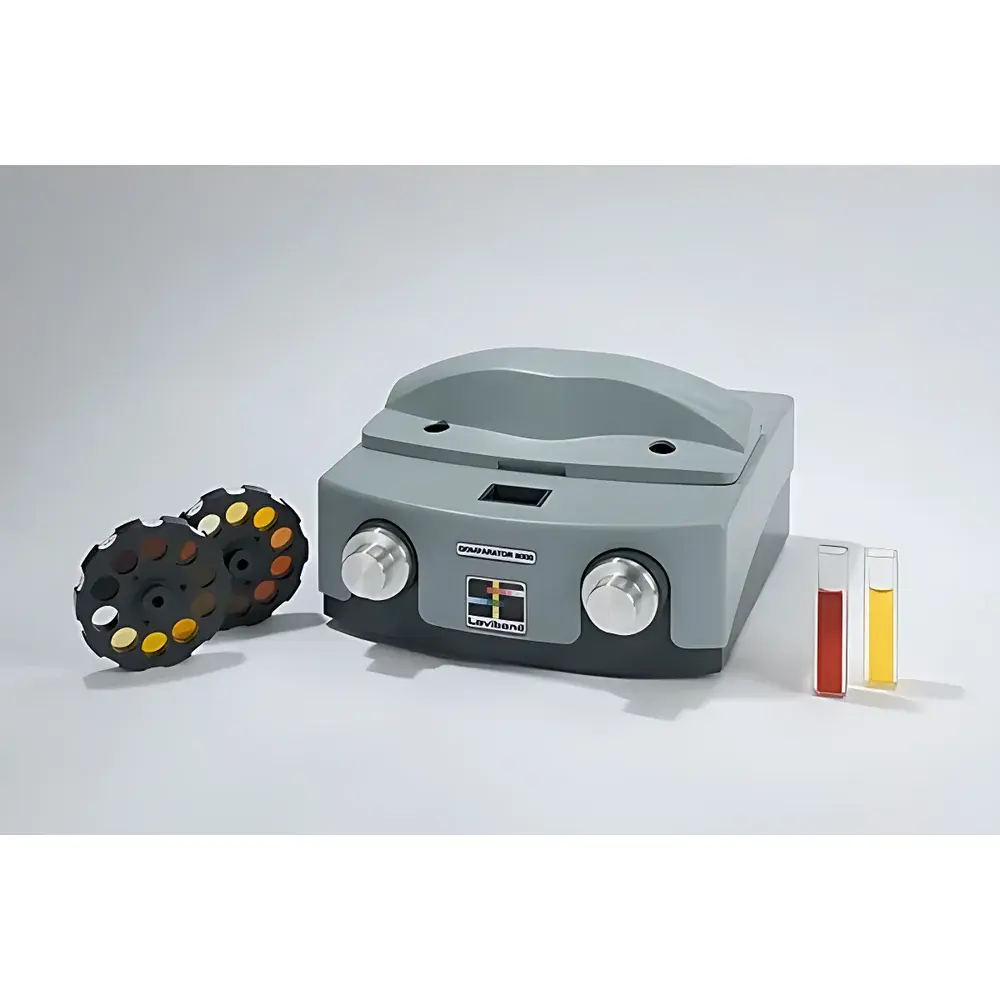
Lovibond AF228 Gardner Colorimeter
| Brand | Lovibond (Tintometer) |
|---|---|
| Origin | United Kingdom |
| Model | AF228 |
| Light Source | CIE Illuminant C (Tungsten-Halogen) |
| Gardner Scale Range | 1–18 |
| Compliance | ASTM D1544, ISO 4630, AOCS Cd 13a-97 |
| Viewing Method | Triple-Field Visual Comparison |
| Optical Path | Fixed 10.0 mm cell path |
| Standard Filters | Certified Gardner glass filters (NIST-traceable) |
| Power Supply | AC 100–240 V, 50/60 Hz |
Overview
The Lovibond AF228 Gardner Colorimeter is a precision-engineered, triple-field visual color comparator designed for the accurate and repeatable determination of Gardner color scale values in transparent to semi-transparent liquid samples. It operates on the principle of tristimulus color matching under standardized CIE Illuminant C lighting—achieved via a stabilized tungsten-halogen lamp with spectral output closely aligned to the CIE standard illuminant C (6774 K correlated color temperature). This ensures consistent photometric conditions independent of ambient daylight or laboratory lighting variations. Unlike instrumental spectrophotometers, the AF228 relies on human observer-based visual comparison between the sample and two adjacent certified Gardner glass reference standards within a single optical field. This method directly implements the fundamental protocol defined in ASTM D1544 (“Standard Test Method for Color of Transparent Liquids (Gardner Color Scale)”), making it suitable for routine QC labs requiring regulatory-compliant, operator-independent pass/fail assessments or precise grade assignment across the full Gardner scale (1 = pale straw, 18 = deep reddish-brown).
Key Features
- Triple-field viewing system enabling simultaneous side-by-side comparison of sample and two adjacent Gardner reference standards—minimizing observer bias and improving grading accuracy.
- CIE Illuminant C-compliant tungsten-halogen light source with stable intensity and spectral profile, maintained via integrated voltage regulation and thermal management.
- Pre-calibrated, NIST-traceable Gardner glass filters housed in precision-machined filter wheels; each filter corresponds to a defined Gardner unit (1–18) per ASTM D1544 Annex A1.
- Rigid aluminum alloy housing with anti-glare black interior finish to eliminate stray light interference and enhance contrast perception.
- Fixed 10.0 mm optical pathlength cuvette holder compatible with standard 12.5 mm square glass cells (e.g., Lovibond Type B), ensuring reproducible sample presentation.
- No software dependency or calibration drift—performance remains stable over time with periodic verification using certified reference filters.
Sample Compatibility & Compliance
The AF228 is validated for use with low-turbidity, optically clear liquids including refined vegetable oils (e.g., sunflower, linseed, soybean), drying oils, fatty acids, phospholipids (e.g., lecithin), alkyd resins, varnishes, lacquers, and petrochemical distillates. Samples must be free of suspended particles and bubbles; filtration through 0.45 µm membrane filters and degassing are recommended prior to measurement. The instrument meets the physical design and operational requirements of ASTM D1544, ISO 4630 (“Petroleum products — Determination of colour — Gardner colour scale”), and AOCS Cd 13a-97. Its methodology supports GLP-compliant documentation when paired with controlled observation protocols and logbook-based result recording.
Software & Data Management
The AF228 is a purely optical, non-digital instrument and does not incorporate embedded software, data logging, or connectivity features. Results are recorded manually as integer Gardner units (e.g., “Gardner 6”) along with date, operator ID, sample ID, and filter verification status. For laboratories operating under FDA 21 CFR Part 11 or ISO/IEC 17025 requirements, traceability is maintained through documented observer training records, periodic verification using certified reference filters (provided with certificate of calibration), and standardized SOPs governing sample preparation, viewing environment (e.g., controlled ambient illumination < 20 lux), and observer qualification (e.g., Ishihara test for color vision acuity).
Applications
- Quality control of edible oil refining processes—monitoring color shift during bleaching and deodorization stages.
- Batch release testing of industrial resins and coatings where Gardner color correlates with oxidation state and thermal history.
- Raw material acceptance testing for fatty acid feedstocks used in surfactant and biodiesel synthesis.
- Stability studies tracking color development in heat-aged lubricants and transformer oils per ASTM D1500 (where Gardner correlation is established).
- Regulatory submission support for pharmaceutical excipients (e.g., purified oils) requiring Gardner-compliant appearance specifications per USP & Ph. Eur. monographs.
FAQ
Is the AF228 compliant with ASTM D1544?
Yes—the AF228’s optical geometry, illuminant specification, and reference filter set fully satisfy the apparatus requirements outlined in ASTM D1544 Section 6.
Can it measure non-Gardner color scales (e.g., APHA, Saybolt)?
No—it is dedicated exclusively to Gardner scale assessment; separate comparators are required for APHA (ASTM D1209) or Saybolt (ASTM D156) measurements.
What is the recommended frequency for filter verification?
Annual verification against a NIST-traceable reference set is recommended; more frequent checks (e.g., quarterly) are advised in high-throughput QC environments.
Does the instrument require operator color vision certification?
Per ASTM D1544 Section 7.2, observers must demonstrate normal color discrimination—typically verified via Ishihara plates or Farnsworth-Munsell 100 Hue Test prior to qualification.
Is cell cleaning and handling specified in the operating procedure?
Yes—ASTM D1544 mandates solvent-rinsed, lint-free wiping of cells before each use; scratches or residue on cell walls directly impact perceived color match fidelity.





