
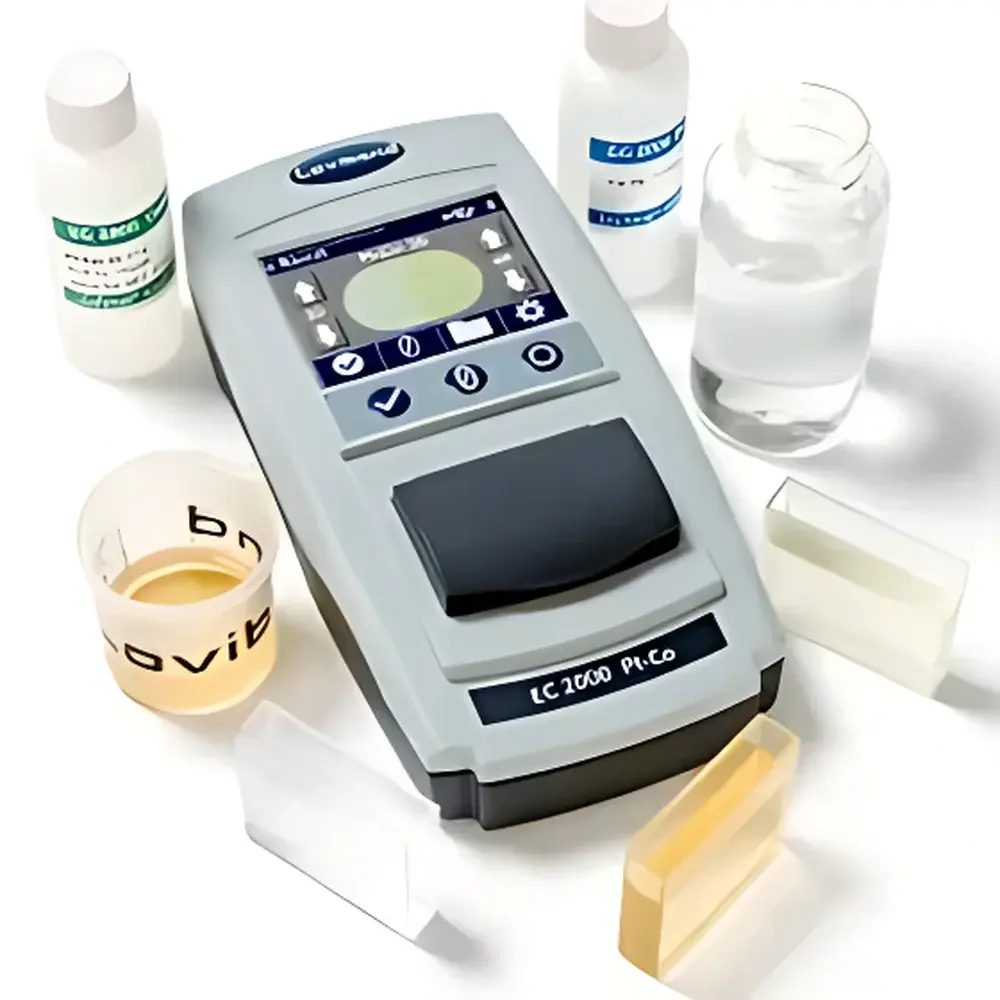
Lovibond EC2000 Pt-Co Platinum-Cobalt Colorimeter
| Brand | Lovibond (Tintometer) |
|---|---|
| Origin | United Kingdom |
| Model | EC2000 Pt-Co |
| Measurement Range | 0–500 Pt-Co |
| Resolution | 1 Pt-Co |
| Repeatability | ±3% or ±1 Pt-Co (whichever is greater) |
| Path Length | 50 mm |
| Standard Compliance | ASTM D1209, ISO 6271, APHA Method 2120 B, USP <631> |
| Viewing Field | Dual-field (2-field) comparator display |
| Cuvettes | 3 × plastic 50 mm cuvettes (W100), 1 × glass 50 mm cuvette (W100) |
| Calibration Standards | 60 mL certified Pt-Co reference solution |
| Filter Set | Integrated certified interference filters (traceable to NPL/UKAS) |
Overview
The Lovibond EC2000 Pt-Co Platinum-Cobalt Colorimeter is a precision optical instrument engineered for objective, repeatable quantification of yellow hue intensity in transparent to pale-yellow liquids. It operates on the principle of dual-field visual comparison augmented by digital photometric measurement—retaining the intuitive familiarity of traditional comparator-based color assessment while eliminating subjective interpretation bias. Unlike fully automated spectrophotometric systems, the EC2000 maintains a human-in-the-loop verification workflow: the operator views both the sample and a digitally generated reference match side-by-side on a high-contrast LCD screen, enabling immediate visual confirmation of equivalence. Its optical architecture is calibrated against primary Pt-Co reference solutions traceable to the UK’s National Physical Laboratory (NPL), ensuring metrological integrity across global laboratories. Designed specifically for compliance with ASTM D1209 (Standard Test Method for Color of Clear Liquids), this instrument delivers results directly in the Pt-Co (also known as Hazen or APHA) scale—a dimensionless unit defined by the absorbance of a solution containing 1 mg platinum per liter as chloroplatinic acid and 2 mg cobalt per liter as cobaltous chloride hexahydrate.
Key Features
- Dual-field visual comparator display with simultaneous side-by-side presentation of sample and digitally synthesized Pt-Co reference
- Integrated photometric sensor system with temperature-stabilized LED light source and narrow-band interference filters aligned to the CIE 1931 2° standard observer function
- Pre-programmed Pt-Co scale (0–500 units) with automatic unit conversion to Hazen and APHA equivalents
- Repeatability of ±3% or ±1 Pt-Co unit (whichever is greater), validated per ISO/IEC 17025-accredited procedures
- 50 mm fixed-path-length optical cell holder compatible with standardized W100 cuvettes (plastic and borosilicate glass)
- Onboard calibration routine using supplied 60 mL certified Pt-Co reference standard (certified traceable to UKAS)
- No external PC required—fully self-contained operation with non-volatile memory for up to 200 test records
Sample Compatibility & Compliance
The EC2000 is validated for use with low-turbidity, non-fluorescent, aqueous and organic liquid samples including potable water, wastewater effluents, glycerin, plasticizers, halogenated solvents (e.g., carbon tetrachloride), petroleum distillates, and pharmaceutical excipients. It excludes samples exhibiting significant scattering (turbidity > 1 NTU), fluorescence under 455 nm illumination, or strong absorption outside the 400–480 nm spectral band relevant to Pt-Co evaluation. Regulatory alignment includes full support for ASTM D1209, ISO 6271 (Water quality — Determination of colour), APHA Standard Methods 2120 B, and USP (Color). The instrument’s calibration traceability, documented audit trail, and manual verification capability satisfy GLP and GMP requirements for color testing in regulated environments—including FDA 21 CFR Part 11-compliant workflows when paired with optional data export software.
Software & Data Management
While the EC2000 operates autonomously, optional Lovibond DataLink software enables USB-based transfer of measurement logs (date/time stamp, Pt-Co value, operator ID, cuvette ID) to Windows-based laboratory information management systems (LIMS). Exported files conform to CSV and XML formats compliant with ASTM E1382 and ISO/IEC 17025 data integrity guidelines. All internal measurements are timestamped and stored with immutable metadata; no values can be edited post-acquisition. The device supports user-defined pass/fail limits and generates printable reports with embedded calibration certificate references and instrument serial number—essential for internal QA audits and third-party inspections.
Applications
- Drinking water treatment: monitoring chlorine-induced yellowing and activated carbon breakthrough
- Pharmaceutical manufacturing: raw material qualification of glycerol, propylene glycol, and PEG-based excipients per USP
- Chemical production: batch release testing of solvents (e.g., acetone, MEK, chlorinated hydrocarbons) and intermediates
- Petrochemical QA: color grading of white oils, naphthas, and refined base stocks against ASTM D1500 (though EC2000 targets Pt-Co-specific applications)
- Food & beverage R&D: stability assessment of clarified fruit juices and plant-based emulsions during shelf-life studies
- Academic research: teaching quantitative colorimetry principles in analytical chemistry curricula
FAQ
What is the difference between Pt-Co, Hazen, and APHA color scales?
All three terms refer to identical methodology and scale (0–500 units); “Pt-Co” emphasizes the reference standard composition, “Hazen” honors the developer, and “APHA” reflects adoption by the American Public Health Association. The EC2000 reports all three designations interchangeably.
Can the EC2000 measure samples with turbidity?
No. Turbidity exceeding 1 NTU interferes with absorbance measurement in the visible blue region; pre-filtration through a 0.45 µm membrane filter is required prior to analysis.
Is NIST traceability available for the calibration standard?
The included 60 mL reference solution is certified by Tintometer Ltd. against UKAS-accredited reference materials; NIST-traceable equivalents are available upon request with additional certification documentation.
How often must the instrument be recalibrated?
Annual recalibration is recommended; however, daily verification using the supplied standard is mandatory before sample analysis in GLP/GMP settings.
Does the EC2000 comply with FDA 21 CFR Part 11?
The standalone unit does not include electronic signature or audit trail functionality; full Part 11 compliance requires integration with validated LIMS software and procedural controls per organizational SOPs.




