
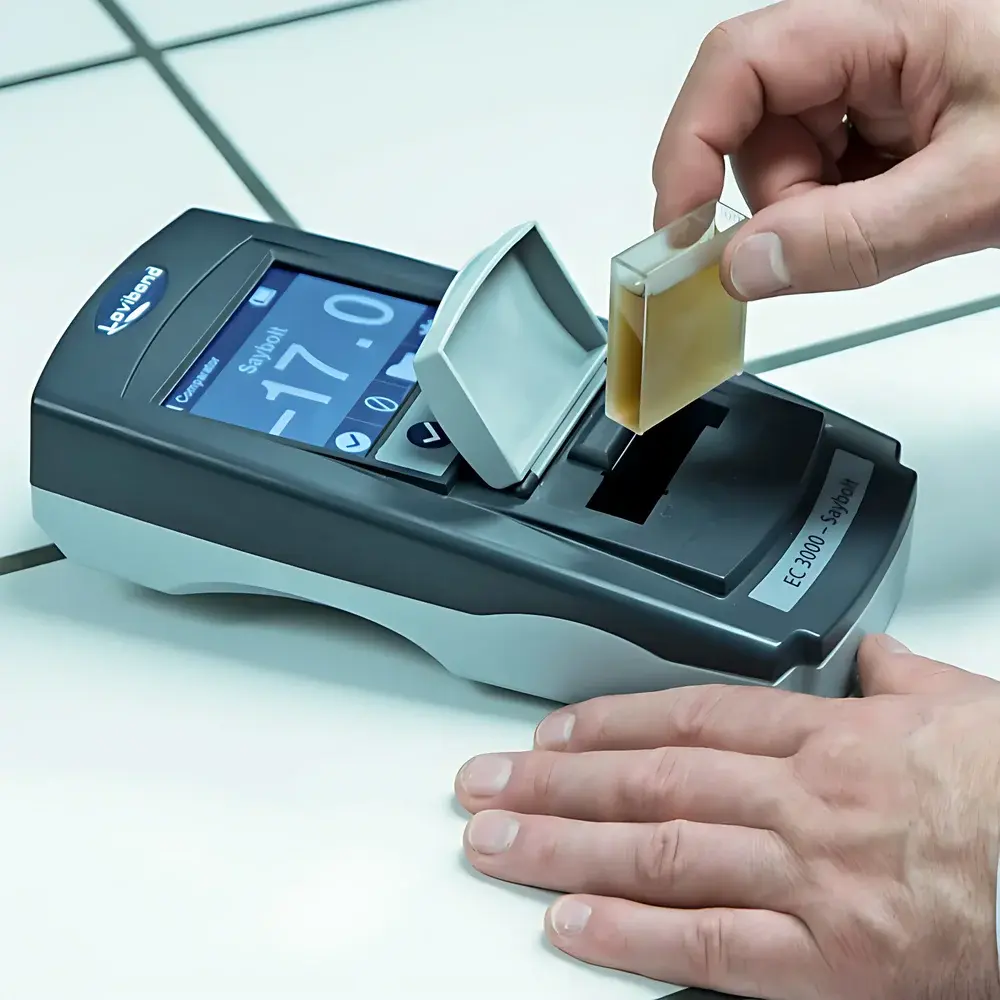
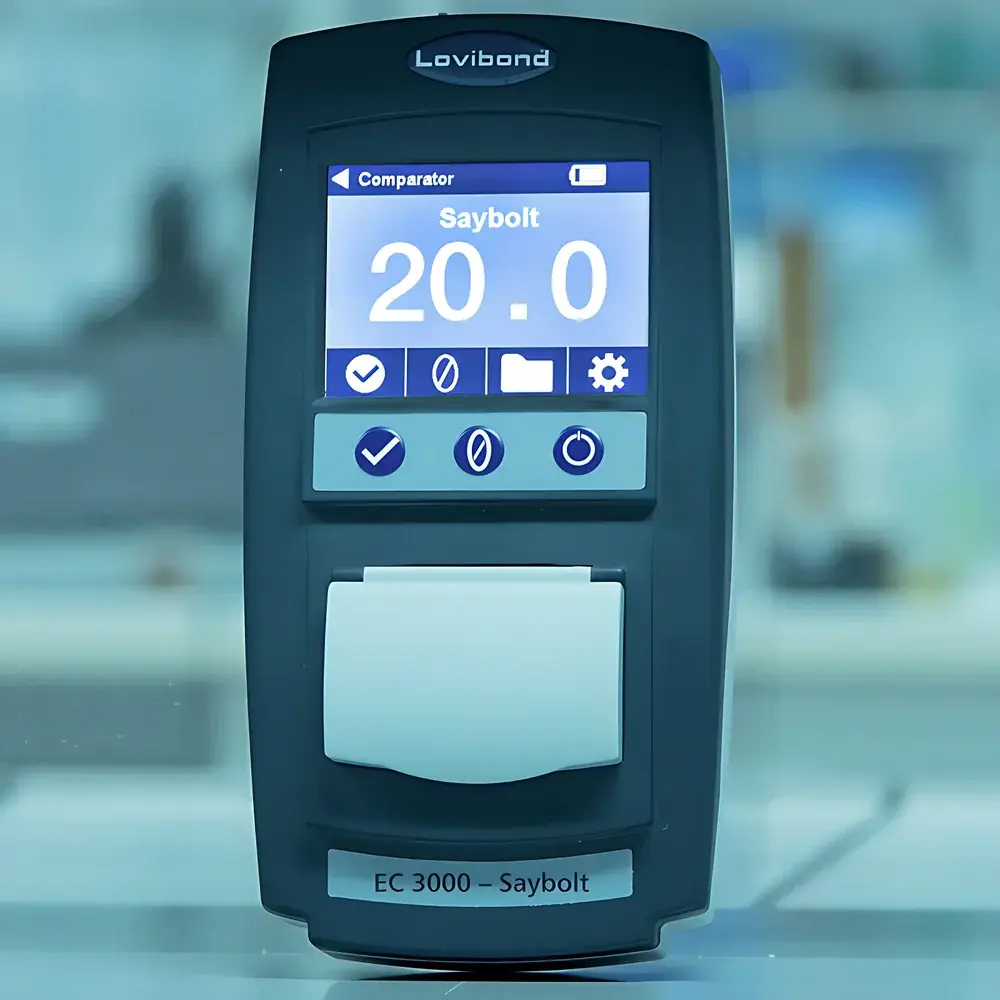
Lovibond EC3000 Saybolt Electronic Colorimeter
| Brand | Lovibond (Tintometer) |
|---|---|
| Origin | United Kingdom |
| Model | EC3000 Saybolt |
| Measurement Range | –16 to +30 Saybolt |
| Resolution | 1 Saybolt Unit |
| Repeatability | ±1 Saybolt Unit |
| Path Length | 50 mm |
| Standard Compliance | ASTM D156, ASTM D6045 |
| Field of View | Triple-field viewing system |
| Cuvettes | Two 50 mm plastic cuvettes (W100), two 50 mm glass cuvettes (W100) |
| Calibration Standards | Two 60 mL certified reference liquids |
| Filter Set | Two calibrated interference filters |
Overview
The Lovibond EC3000 Saybolt Electronic Colorimeter is a precision optical instrument engineered for the quantitative assessment of color in light-colored petroleum products according to the Saybolt color scale. Unlike subjective visual comparison methods, this instrument employs a stabilized tungsten-halogen light source and a silicon photodiode detector array to deliver objective, operator-independent measurements grounded in photometric principles. The EC3000 implements a triple-field viewing geometry—two sample positions flanking a central reference field—to replicate the perceptual contrast mechanism of human vision while eliminating observer fatigue and inter-operator variability. Its measurement principle conforms to the fundamental photometric definition of Saybolt color: the depth of yellow tint observed when light passes through a defined path length (50 mm) of a transparent liquid sample under standardized illumination and viewing conditions. Designed specifically for routine QC/QA laboratories in refineries, lubricant manufacturers, and solvent producers, the EC3000 bridges the methodological gap between legacy visual Saybolt comparators and fully automated spectrophotometric systems—offering regulatory traceability without requiring revalidation of existing ASTM D156–based workflows.
Key Features
- Triple-field optical design enables direct side-by-side comparison of sample vs. reference or two samples, preserving the visual judgment paradigm while introducing instrumental reproducibility.
- Dedicated Saybolt scale firmware with pre-programmed calibration algorithms compliant with ASTM D156 and D6045, ensuring method equivalence across laboratories.
- Integrated 50 mm path-length cuvette holders optimized for both W100 plastic and W100 borosilicate glass cells—minimizing thermal drift and refractive index artifacts common in hydrocarbon analysis.
- Factory-calibrated using NIST-traceable liquid standards and interference filter sets, each assigned unique serial-numbered certification documentation for audit readiness.
- Robust industrial housing rated IP54, suitable for deployment in refinery control rooms, blending facilities, and on-site testing vans where ambient temperature fluctuation and vibration are present.
- No spectral scanning or software installation required—operation is fully self-contained via front-panel interface with alphanumeric LCD display and tactile keypad.
Sample Compatibility & Compliance
The EC3000 is validated for use with transparent, low-absorbance hydrocarbon liquids including aviation turbine fuel (Jet A/A-1), kerosene, naphtha, white mineral oil, aliphatic and aromatic hydrocarbon solvents, and refined paraffin wax melts. It excludes opaque, turbid, or highly fluorescent samples—consistent with the scope limitations defined in ASTM D156. All measurement protocols align with Good Laboratory Practice (GLP) requirements: instrument identification, operator ID, date/time stamp, and raw reading (Saybolt unit) are retained in non-volatile memory. Optional printed reports (via RS232 interface) include full metadata required for internal quality audits and third-party regulatory reviews—including those conducted under ISO/IEC 17025-accredited testing laboratories.
Software & Data Management
While the EC3000 operates as a standalone instrument, its RS232 serial port supports bidirectional communication with external LIMS or Excel-based data logging platforms. Raw readings (–16 to +30 Saybolt, integer resolution) are transmitted in ASCII format with configurable delimiters and carriage-return line feeds. No proprietary drivers or cloud connectivity are implemented—ensuring compatibility with air-gapped networks common in process-critical infrastructure. Audit trail functionality is maintained at the instrument level: each power-on cycle resets no internal logs, but all measurements are time-stamped and stored in a circular buffer (capacity: 256 entries), accessible via query command. For FDA-regulated environments, the device may be operated within a documented validation framework supporting 21 CFR Part 11 compliance when paired with appropriate electronic signature controls at the host system level.
Applications
- Final product release testing of jet fuel per ASTM D156 specification limits (e.g., Jet A: max –16 Saybolt; Jet A-1: max –16 Saybolt).
- In-process monitoring during solvent refining to verify decolorization efficacy prior to distillation.
- Batch-to-batch consistency verification for white mineral oils used in pharmaceutical excipient manufacturing (USP referenced).
- Supplier qualification testing of naphtha feedstocks entering catalytic reforming units.
- Technical service support for lubricant blenders assessing base oil color stability after antioxidant addition.
FAQ
What is the difference between Saybolt color and Platinum-Cobalt (APHA) color?
Saybolt color is empirically defined for petroleum distillates using a specific light source, path length, and visual comparator geometry; APHA is designed for aqueous solutions and uses a different reference scale and illuminant. Although numerical ranges overlap, the scales are not interchangeable—ASTM explicitly prohibits cross-correlation without empirical correlation studies.
Can the EC3000 measure samples colder than 25°C?
Yes, provided the sample remains fully liquid and free of haze or crystallization; however, ASTM D156 mandates temperature control at 15.6°C ± 0.5°C for official reporting—users must employ an external thermostatic bath to meet this requirement.
Is periodic recalibration required?
Per ASTM D6045, verification with certified reference liquids is recommended before each analytical session; full recalibration by an authorized Lovibond service center is advised annually or after mechanical shock or lamp replacement.
Does the EC3000 comply with ISO 8217 marine fuel specifications?
No—ISO 8217 specifies R&L (Ring and Ball) or ASTM D1500 (ASTM color) for residual fuels; Saybolt applies only to distillate fuels covered under ISO 8570 or ASTM D975.




