
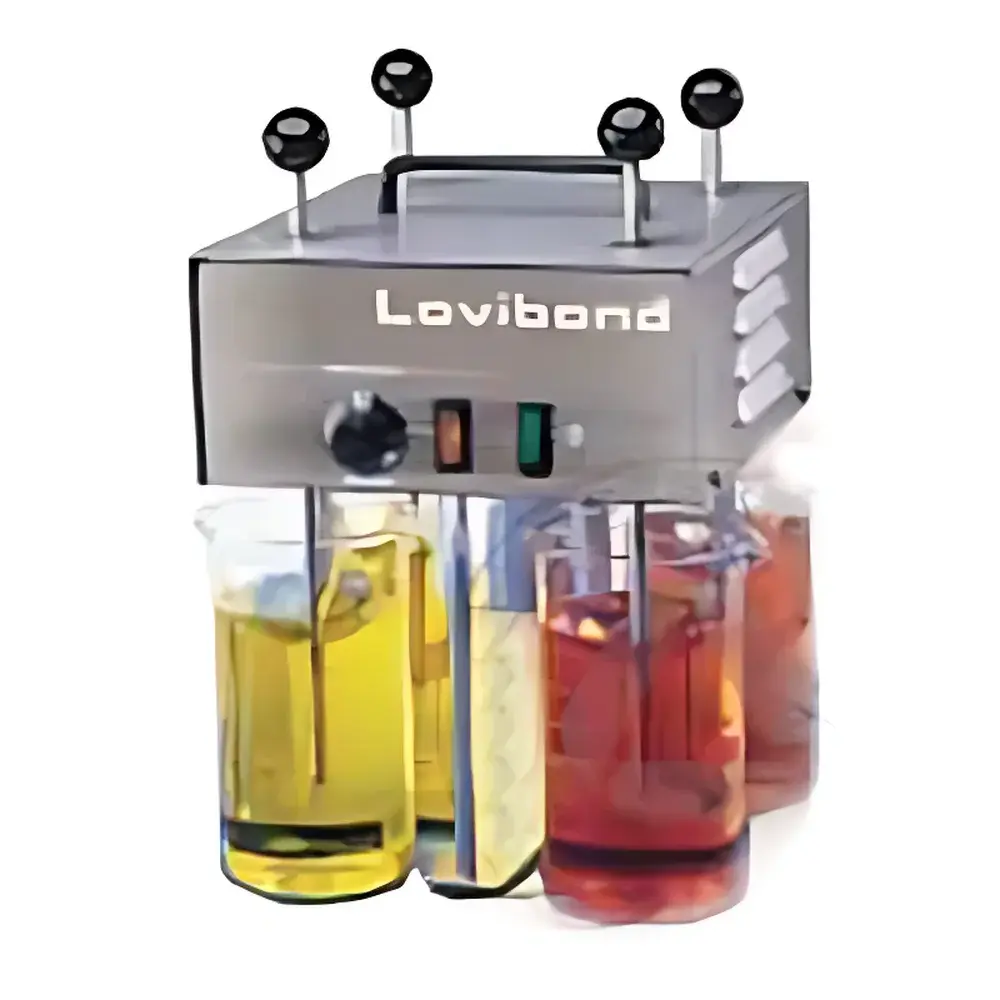
Lovibond ET99700 Portable Jar Test Apparatus for Flocculation and Settling Performance Assessment
| Brand | Lovibond (Tintometer) |
|---|---|
| Origin | United Kingdom |
| Model | ET99700 |
| Stirring Positions | 4 |
| Speed Range | 10–150 rpm, continuously variable |
| Speed Accuracy | ±10 rpm |
| Operating Temperature | 10–45 °C |
| Power Supply | 220 V / 60 Hz |
| Dimensions | 230 × 245 × 325 mm |
| Weight | ~6.9 kg |
| Compliance | CE Marked |
| Standard Configuration | ET99700 unit, carrying case, user manual, warranty card (Chinese) |
| Note | 1500 mL low-temperature and high-temperature beakers (for ET99710) sold separately |
Overview
The Lovibond ET99700 Portable Jar Test Apparatus is an engineered solution for quantitative evaluation of coagulation-flocculation efficiency and subsequent sedimentation behavior in aqueous suspensions. Designed around the standardized jar test methodology—widely adopted in water and wastewater treatment process optimization—the instrument enables controlled, parallel assessment of multiple sample conditions under reproducible hydrodynamic shear profiles. Its operational principle relies on precise rotational agitation via four independently driven stirrers, each generating defined velocity gradients (G-values) within standardized cylindrical vessels. This facilitates empirical determination of optimal coagulant dosage, flocculant type selection, mixing intensity (rapid mix vs. slow mix), and settling kinetics—critical parameters for full-scale clarifier design, chemical dosing calibration, and regulatory compliance reporting.
Key Features
- Four independent stirring stations with continuous speed control from 10 to 150 rpm, enabling simultaneous comparison of up to four treatment conditions.
- Digital LED display providing real-time monitoring of current rotational speed for each station, ensuring traceable operational parameters during method execution.
- Adjustable impeller height and geometry to accommodate varying vessel diameters and liquid depths—supporting consistent shear distribution across 1000–1500 mL sample volumes.
- Integrated light-source alignment system: a fixed vertical lamp positioned centrally beneath the stirring axis allows unobstructed visual observation of floc formation, growth, and settling dynamics without parallax error or external lighting dependency.
- Robust benchtop architecture constructed from corrosion-resistant polymer housing and stainless-steel drive shafts; designed for long-term stability in laboratory and field-deployed environments.
- CE-marked electrical safety compliance and thermal management suitable for continuous operation within ambient temperatures of 10–45 °C.
Sample Compatibility & Compliance
The ET99700 is compatible with standard ASTM D2035-22 (Standard Practice for Coagulation-Flocculation Jar Tests) and ISO 5667-3:2018 (Water quality — Sampling — Part 3: Guidance on preservation and handling of water samples). It supports use with glass or borosilicate beakers (e.g., 1500 mL tall-form cylinders), though high- and low-temperature variants (ET99710 accessories) are not included in base configuration. The apparatus meets GLP-aligned documentation requirements when paired with laboratory notebooks or electronic lab notebooks (ELNs); its digital speed readout provides auditable evidence of test condition adherence. While not intrinsically 21 CFR Part 11 compliant, it integrates seamlessly into validated workflows where operator-entered parameters and observed endpoints are recorded in compliant data systems.
Software & Data Management
The ET99700 operates as a standalone hardware platform without embedded firmware or proprietary software. All operational parameters—including set speed, duration, and visual observations—are manually documented by the user. This design prioritizes method transparency, eliminates software validation overhead, and ensures compatibility with any institutional LIMS or ELN platform. For laboratories requiring automated data capture, optional third-party USB-connected timers or RPM loggers may be interfaced externally. Calibration verification is performed using certified tachometers traceable to national standards; routine checks are recommended before each analytical batch per ISO/IEC 17025:2017 clause 7.7.
Applications
- Optimization of coagulant (e.g., Al₂(SO₄)₃, FeCl₃) and flocculant (e.g., polyacrylamide) dosing in municipal and industrial water treatment plants.
- Evaluation of turbidity removal efficiency and supernatant clarity following sedimentation—correlating with final effluent quality targets under EPA Method 180.1 or ISO 7027.
- Research and development of novel coagulants, including bio-based or hybrid formulations, where comparative settling velocity and floc size distribution are critical metrics.
- Training and education in environmental engineering curricula, supporting hands-on instruction in physical-chemical treatment principles.
- Field-based preliminary screening of raw water sources prior to pilot-scale testing or full-scale facility commissioning.
FAQ
What beaker sizes are supported by the ET99700?
The apparatus is configured for standard 1500 mL tall-form cylindrical beakers; custom-height vessels may be accommodated via mechanical adjustment of impeller position.
Is the unit suitable for elevated temperature testing?
The base ET99700 model is rated for ambient operation only (10–45 °C). High-temperature beakers (ET99710 accessory) must be used with external heating mantles and are not thermally integrated with the stirrer assembly.
Does the device support automated data export?
No. The ET99700 provides local digital speed readouts only; all data recording and analysis must be performed manually or via external logging tools.
Can the stirring speed be programmed with time-dependent ramp profiles?
No. Speed is manually adjusted and held constant per test phase; multi-stage protocols (e.g., rapid mix → slow mix) require operator intervention between steps.
What maintenance is required?
Routine cleaning of stirrer shafts and beaker contact surfaces is recommended after each use; no scheduled lubrication or internal servicing is specified by the manufacturer under normal operating conditions.







