
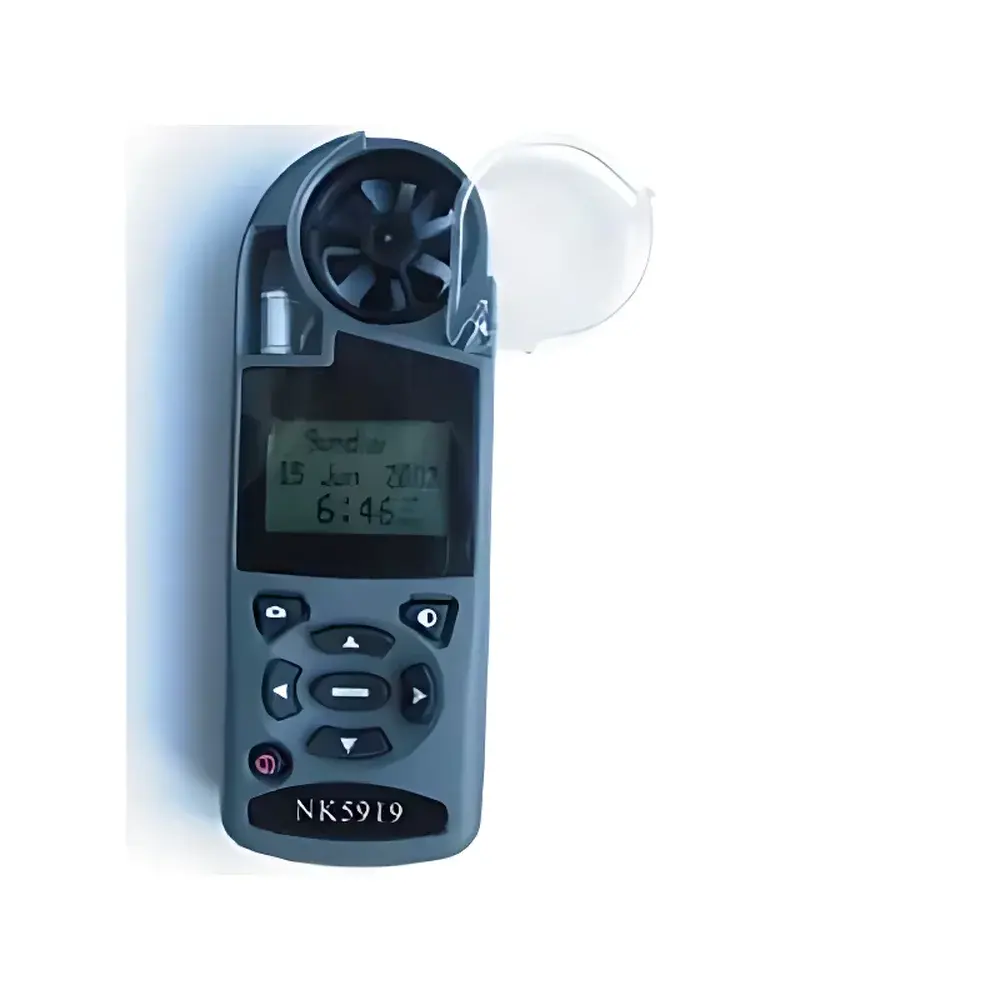
Lovibond NK5919 Waterproof Portable Anemometer & Weather Meter
| Brand | Lovibond (Tintometer) |
|---|---|
| Origin | United Kingdom |
| Model | NK5919 |
| IP Rating | IP67 |
| Display | Backlit Graphical LCD (User-Selectable Green/Red) |
| Power | 2×AAA Alkaline Batteries (Typical Life: 400 h) |
| Operating Temperature | –10 °C to +55 °C |
| Storage Temperature | –30 °C to +60 °C |
| Dimensions | 127 × 45 × 28 mm |
| Weight | 102 g |
| Compliance | CE Marked, NIST-Traceable Calibration Available |
| Data Logging | Internal Memory (480 Points), Adjustable Interval (2 s – 12 h), Manual or Auto-Triggered |
| Interface | RS-232 (via NK PN-0830 PC Interface Kit, USB Adapter Optional) |
| Languages | English, French, German, Italian, Spanish |
| Auto Power-Off | Configurable (15–60 min Inactivity) |
Overview
The Lovibond NK5919 Waterproof Portable Anemometer & Weather Meter is a field-deployable, multi-parameter environmental measurement instrument engineered for high-reliability operation in demanding outdoor, emergency response, and industrial hygiene applications. It employs a precision-calibrated 1-inch diameter impeller anemometer with sapphire jewel bearings and hardened stainless-steel shafting—designed per ISO 7726 and ASTM D5485 standards for air velocity measurement in turbulent and transitional flow regimes. The device integrates real-time sensing of wind speed (in seven selectable units), ambient temperature (air, water, snow), relative humidity, wind chill index (WCI), heat stress index (HSI), and dew point temperature—all derived from primary sensor outputs using algorithms aligned with NOAA/NWS 2001 WCI revision and NWS Heat Index tables. Its single-chip microprocessor architecture ensures deterministic measurement timing (1-second response across all parameters), minimal thermal drift, and robust signal conditioning—critical for GLP-compliant field data acquisition where traceability and repeatability are mandated.
Key Features
- IP67-rated enclosure providing full dust ingress protection and submersion resistance up to 1 m for 30 minutes—validated per IEC 60529.
- High-stability impeller assembly with sapphire bearing system; calibration drift <1% after 100 hours at 7 m/s (16 mph); angular error ≤ ±3% at 15° yaw under ISO 7726-defined test conditions.
- Multi-unit wind speed output: m/s, ft/min, km/h, mph, knots, Beaufort scale (0–12B), with auto-ranging and unit-specific accuracy specifications.
- Dual-sensor thermal system: RTD-based air/water/snow temperature probe (US Patent 5,939,645) and polymer capacitive RH sensor (US Patent 6,257,074), both thermally isolated to minimize conduction errors.
- Onboard calculation engines for wind chill (NOAA/NWS 2001), heat stress (NWS HI), and dew point—using fundamental psychrometric equations per ASHRAE Fundamentals Chapter 1.
- Graphical LCD with user-selectable backlight (aviation green or high-visibility red), programmable contrast, and real-time trend visualization of min/max/avg values.
- Configurable data logging: 480-point internal memory, sampling intervals from 2 seconds to 12 hours, manual or time-triggered storage, and timestamped records including date/time via integrated RTC with leap-year compensation.
Sample Compatibility & Compliance
The NK5919 is validated for use in ambient air, freshwater, and snowpack environments—its sealed thermal sensor housing prevents condensation-induced drift during rapid thermal transients. Relative humidity measurements adhere to ISO 16000-22 for indoor air quality monitoring and meet the ±3.0% RH tolerance (5–95% RH, non-condensing) required by OSHA Technical Manual Section III: Chapter 2 for occupational heat stress assessment. All factory calibrations are NIST-traceable per ANSI/NCSL Z540-1, with optional on-site recalibration kits (e.g., NI30824 humidity standard) supporting ISO/IEC 17025-compliant laboratory maintenance programs. CE marking confirms conformity with EU EMC Directive 2014/30/EU and RoHS 2011/65/EU. The instrument satisfies field-use requirements under EPA Method TO-15 (ambient air sampling support), NFPA 1620 (emergency response meteorological assessment), and EN 13274-2 for personal exposure monitoring equipment.
Software & Data Management
Data export is facilitated via RS-232 serial interface using the dedicated NK PN-0830 PC Interface Kit, which includes Windows-compatible software for raw data download, graphical time-series plotting, statistical summary (mean, SD, min/max), and CSV export compatible with LIMS and ELN platforms. The software supports audit trail generation per FDA 21 CFR Part 11 requirements—including user authentication, electronic signatures, and immutable record timestamps—when deployed in regulated QA/QC environments. Firmware updates are delivered via secure authenticated channels, preserving configuration integrity and calibration constants. No cloud dependency: all processing occurs locally on-device, ensuring data sovereignty and operational continuity in low-connectivity field deployments.
Applications
- Industrial Hygiene: Real-time assessment of ventilation efficacy, HVAC commissioning, and OSHA-mandated heat stress monitoring in foundries, power plants, and agricultural facilities.
- Emergency Response: Rapid deployment during wildfire suppression, HAZMAT incidents, and disaster recovery operations requiring immediate microclimate characterization.
- Environmental Research: Boundary-layer meteorology studies, urban canopy effect analysis, and ecological site assessments requiring portable, multi-parameter weather profiling.
- Building Science: Commissioning of natural ventilation systems, infiltration rate estimation, and envelope performance validation per ASHRAE Standard 119.
- Educational Fieldwork: Undergraduate atmospheric science labs and vocational training in occupational safety, where ruggedized instrumentation with pedagogical UI enhances experiential learning.
FAQ
What is the maximum recommended continuous wind speed for reliable impeller operation?
Continuous exposure above 27 m/s (60 mph) accelerates mechanical wear and may cause irreversible bearing degradation. For sustained measurements, operation within 0.4–40.0 m/s is advised per ISO 7726 Class B accuracy specification.
Does the NK5919 support regulatory compliance for GMP/GLP documentation?
Yes—the device supports 21 CFR Part 11–compliant data export when used with NK PN-0830 software, including electronic signatures, audit trails, and calibration history retention.
How often does the unit require recalibration?
Factory calibration is valid for 24 months under normal use. Humidity sensor drift remains within ±2% RH over this period; however, field recalibration using NI30824 is recommended before critical deployments or after exposure to condensing environments.
Can the NK5919 measure wind speed inside ducts or confined spaces?
Yes—it accepts user-defined duct geometry (circular or rectangular) and dimensions (in, ft, cm, m) up to 6.55 m max equivalent diameter, enabling volumetric flow rate calculation (CFM, m³/h) directly from velocity profiles.
Is the temperature sensor suitable for immersion in water or snow?
Yes—the thermally isolated probe design (US Patent 5,939,645) allows direct contact with liquid water and snowpack without thermal lag or seal failure, maintaining ±1.0 °C accuracy between –29.0 and +70.0 °C.
Related Products







