
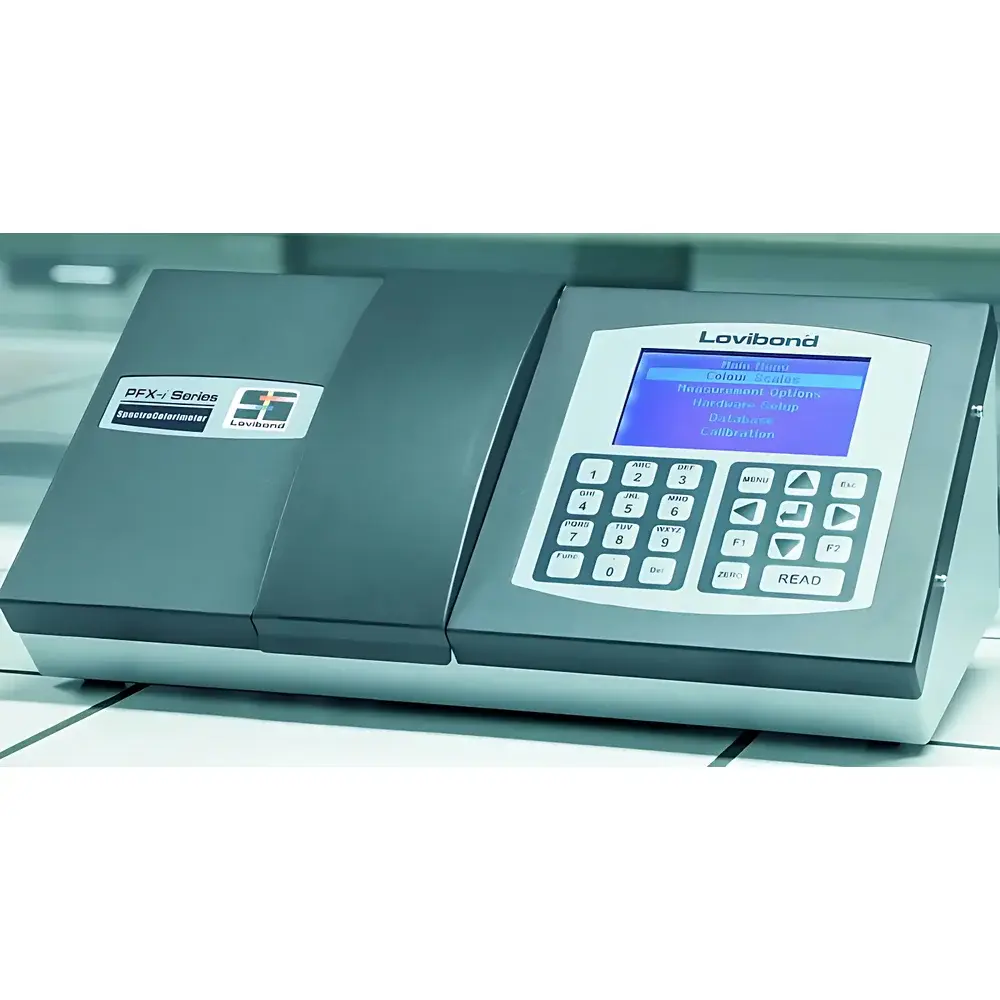
Lovibond PFXi195/1 Automated Colorimeter
| Brand | Lovibond (Tintometer) |
|---|---|
| Origin | United Kingdom |
| Model | PFXi195/1 |
| Spectral Range | 420–710 nm |
| Spectral Bandwidth | 10 nm |
| Repeatability | ±0.0004 in CIE x,y coordinates |
| Measurement Time | <30 s |
| Light Source | 5 V, 10 W Tungsten-Halogen Lamp |
| CIE Illuminants | A, B, C, D65 |
| Standard Observer Angles | 2°, 10° |
| Path Length Range | 0.1–50 mm |
| Data Interfaces | USB, LAN, RS232 |
| Data Storage Capacity | 100,000 measurements |
| Display | 240 × 128 backlit LCD |
| Keypad | 23 tactile polyester membrane keys with audible feedback |
| Operating Languages | English, Chinese, French, German, Italian, Portuguese |
| Housing Material | Steel with textured epoxy coating |
| Dimensions & Weight | 435 × 195 × 170 mm / 6.8 kg |
| Compliance | CE, RoHS, WEEE |
| Built-in Color Scales | Pt-Co/Hazen/APHA (ASTM D1209), Gardner (ASTM D1544/D6166), Iodine (DIN 6162), CIE XYZ/Lab, Spectral Reflectance Data |
Overview
The Lovibond PFXi195/1 Automated Colorimeter is a precision optical measurement instrument engineered for high-reproducibility color quantification in liquid samples across chemical, petrochemical, pharmaceutical, food, and industrial lubricant applications. Based on fixed-wavelength photometric analysis using nine precision interference filters, the PFXi195/1 delivers traceable, standardized color assessment without reliance on full-spectrum scanning. Its optical architecture conforms to CIE 1931 standard observer functions and supports dual viewing angles (2° and 10°), enabling alignment with both legacy and modern color specification protocols. The instrument operates under multiple CIE illuminants—including A, B, C, and D65—to ensure metrological consistency across diverse lighting conditions referenced in international test methods. Designed for laboratory and production QC environments, it provides rapid (<30 s), operator-independent measurements with automated baseline calibration and robust thermal stability—critical for long-term repeatability in regulated settings.
Key Features
- Nine fixed interference filters covering 420–710 nm with 10 nm bandwidth, optimized for ASTM- and DIN-compliant color scale fidelity
- Integrated dual-angle (2°/10°) photometric detection system aligned with CIE 1931 and CIE 1964 standard observers
- Automated one-touch baseline calibration with real-time drift compensation
- Steel housing with textured epoxy coating ensures resistance to chemical splashes, solvents, and mechanical abrasion in industrial labs
- Modular cuvette chamber design enables rapid cleaning, optical path verification, and maintenance without tools or disassembly
- Simultaneous support for six interface languages—including English, Chinese, French, German, Italian, and Portuguese—facilitating multinational deployment
- Comprehensive internal memory storing up to 100,000 timestamped measurements with sample ID, operator tag, and calibration log metadata
Sample Compatibility & Compliance
The PFXi195/1 accepts standard glass or quartz cuvettes with path lengths from 0.1 mm to 50 mm, accommodating highly concentrated dyes, viscous oils, and low-absorbance aqueous solutions. It is validated for use with transparent to semi-transparent liquids meeting ISO 4630 (Gardner), ASTM D1209 (Pt-Co), ASTM D1544 (Gardner), ASTM D6166 (Gardner for dark oils), and DIN 6162 (Iodine Number color correlation). The device complies with CE marking requirements for electromagnetic compatibility (EN 61326-1) and safety (EN 61010-1), as well as RoHS Directive 2011/65/EU and WEEE Directive 2012/19/EU. Its optical calibration traceability aligns with NIST-traceable reference standards, supporting GLP and GMP documentation workflows where audit-ready calibration records and measurement history are mandatory.
Software & Data Management
Data export and remote configuration are supported via USB mass storage mode, Ethernet (TCP/IP), and RS232 serial communication. The instrument natively generates CSV-formatted reports compatible with LIMS integration and statistical process control (SPC) platforms. Firmware and color scale updates—including new ASTM or ISO-defined scales—are deployable over LAN without physical access, ensuring ongoing method compliance. Audit trail functionality logs all critical events—including calibration actions, user logins, parameter changes, and measurement deletions—with timestamps and operator IDs. While not FDA 21 CFR Part 11–certified out-of-the-box, the PFXi195/1’s immutable data logging, electronic signature readiness, and role-based access control (via optional software modules) provide a foundation for validation in regulated pharmaceutical and cosmetic manufacturing environments.
Applications
- Quantitative assessment of Pt-Co/Hazen/APHA color in purified water, solvents, and pharmaceutical excipients (ASTM D1209)
- Gardner color grading of resins, drying oils, varnishes, and biodiesel feedstocks (ASTM D1544/D6166)
- Iodine color evaluation in fatty acids and halogenated hydrocarbons per DIN 6162
- Batch-to-batch color consistency monitoring in surfactant, dye, and pigment synthesis
- Stability testing of light-sensitive formulations via CIE Lab ΔE tracking over time
- Raw material release testing in contract manufacturing organizations (CMOs) requiring documented color conformance
FAQ
Does the PFXi195/1 require annual recalibration by an external service provider?
No—routine user-performed baseline calibration suffices for daily operation. However, annual verification against NIST-traceable liquid or solid color standards is recommended for ISO/IEC 17025-accredited laboratories.
Can spectral reflectance data be exported for third-party analysis?
Yes—the instrument stores full 9-channel photometric output per measurement, which can be exported as raw intensity values alongside CIE XYZ and Lab coordinates.
Is the cuvette chamber compatible with non-standard path lengths or custom cell geometries?
The optical path is defined by inserted cuvettes; any ISO-standard rectangular or round cell with nominal path length between 0.1 mm and 50 mm may be used, provided it fits the mechanical guide and maintains optical alignment.
How does the PFXi195/1 handle turbid or particulate-containing samples?
It is designed exclusively for clear, homogeneous liquids. Turbidity introduces scattering artifacts that invalidate photometric color assessment; filtration or centrifugation prior to measurement is required.
What cybersecurity protocols apply to LAN-connected units?
The embedded TCP/IP stack supports static IP assignment, subnet masking, and basic firewall filtering at the network layer. No TLS or authentication is implemented in firmware; deployment behind enterprise-grade firewalls is advised.




