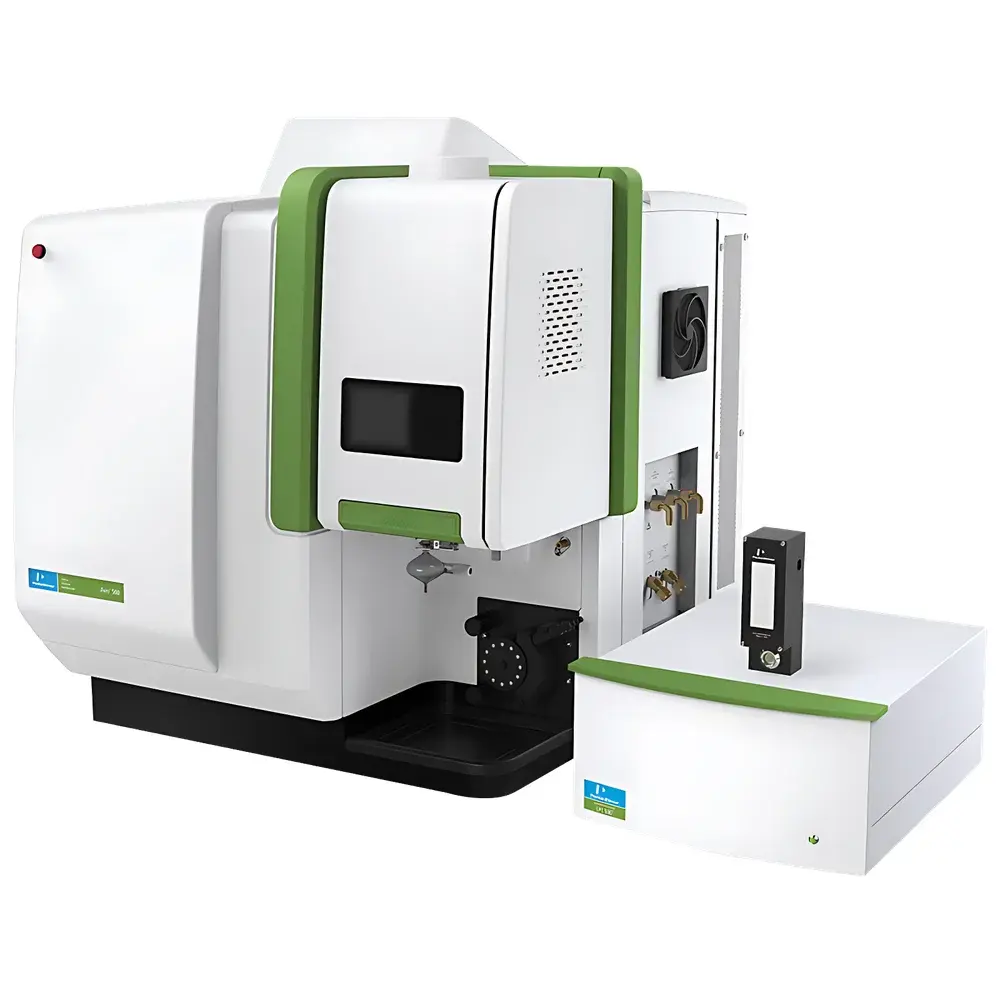
LPC500 + Avio500 Integrated Lubricant Analysis System
| Brand | PerkinElmer |
|---|---|
| Origin | USA |
| Manufacturer Type | Original Equipment Manufacturer (OEM) |
| Product Category | Imported Laboratory Instrument |
| Model | LPC500 + Avio500 |
| Application | Elemental Analysis & Particle Counting in Lubricants |
| Sample Volume | <1 mL per dual analysis |
| Cycle Time | ≤45 seconds per sample |
Overview
The LPC500 + Avio500 Integrated Lubricant Analysis System is an engineered solution for concurrent elemental quantification and particulate contamination assessment in lubricating oils, hydraulic fluids, and turbine oils. This system couples a laser-based liquid particle counter (LPC500) with a high-resolution radial-view ICP-OES spectrometer (Avio 500), enabling synchronized analysis of the same diluted sample aliquot without re-injection or manual transfer. The integration leverages orthogonal detection principles: optical scattering for particle sizing and counting (per ISO 4406, ISO 11171, and ASTM D6786), and plasma emission spectroscopy for multi-element quantification (e.g., Fe, Cr, Al, Cu, Si, Na, Ca, Mg, Pb, Sn, Zn, P, B, Mo). Designed specifically for condition monitoring laboratories and OEM lubricant testing facilities, the system supports predictive maintenance workflows by correlating wear metal concentrations with particle morphology and abundance—critical for early-stage machinery fault detection.
Key Features
- Single-sample dual-modality analysis: Simultaneous ICP-OES elemental profiling and ISO-compliant particle counting from one <1 mL sample injection.
- Automated sample handling interface: Integrated autosampler and fluidic routing module ensures reproducible dilution, aspiration, and sequential delivery to both detectors.
- Avio 500 ICP-OES platform: Equipped with solid-state RF generator, echelle optical system, and CCD detector optimized for low-background trace metal detection in hydrocarbon matrices (detection limits typically sub-pptr for key wear metals).
- LPC500 particle counter: Utilizes calibrated laser extinction and light-scattering detection across ≥20 user-definable size channels (e.g., ≥4 µm(c), ≥6 µm(c), ≥14 µm(c), ≥21 µm(c), ≥38 µm(c), ≥70 µm(c)) with NIST-traceable calibration.
- Real-time synchronization engine: Software-controlled timing alignment between plasma ignition, integration period, and particle transit window ensures temporal coherence of elemental and particulate data.
- Ruggedized design for routine lab operation: Complies with IEC 61000-4 electromagnetic compatibility standards and features integrated argon gas management for Avio 500 and temperature-stabilized flow cell for LPC500.
Sample Compatibility & Compliance
The system accommodates mineral-, synthetic-, and bio-based lubricants—including engine oils (SAE 0W–60), gear oils, greases (after solvent extraction), hydraulic fluids (ISO L-HM, L-HV), and turbine oils (ISO L-TSA, L-TGA). Sample preparation follows ASTM D5185 (ICP-OES) and ASTM D7690 (liquid particle counting), with optional acid digestion for total element recovery. Data output complies with ISO 17025 requirements for accredited testing laboratories. Full audit trail functionality satisfies FDA 21 CFR Part 11 and EU Annex 11 expectations when deployed in regulated environments supporting aviation or power generation asset integrity programs.
Software & Data Management
Syngistix™ for ICP-OES and WinLPC™ software are unified via a common database schema and shared method editor. Users define joint analysis templates specifying dilution factors, plasma parameters, particle threshold settings, and reporting thresholds (e.g., ISO cleanliness codes, elemental alarm levels per OEM specifications such as SAE AS4059 or ISO 4406:2017). All raw spectral intensities, particle histograms, and metadata (operator ID, timestamp, instrument status logs) are stored in encrypted SQLite format. Export options include CSV, PDF analytical reports, and LIMS-compatible XML (ASTM E1384). Version-controlled method libraries support GLP/GMP change control procedures.
Applications
- Rotating equipment health monitoring: Correlating elevated Fe/Cr ratios with >10 µm ferrous particle counts to differentiate abrasive wear from fatigue spalling.
- Filter efficiency validation: Quantifying upstream/downstream particle distributions alongside Al, Si, and Ca concentrations to assess filter media performance and contaminant source identification.
- New oil qualification: Screening base stock purity and additive package consistency via simultaneous measurement of intentional elements (Zn, P, Ca, Mg) and extrinsic contaminants (Na, K, Cl).
- Fleet oil trending: Longitudinal analysis of particle count trends (e.g., ISO 4406 code shifts) paired with cumulative wear metal accumulation rates for remaining useful life estimation.
- Root cause failure analysis: Cross-referencing elemental fingerprints (e.g., high Cu + low Al) with particle morphology (via optional LPC500 image capture add-on) to identify bearing cage vs. bushing degradation modes.
FAQ
Does the system require separate sample preparations for particle counting and ICP-OES?
No. The integrated fluidic architecture delivers a single diluted sample to both instruments sequentially within one automated run.
Can the LPC500 detect non-metallic particles such as silica or carbon soot?
Yes. The laser extinction principle detects all suspended particulates regardless of composition, provided they exceed the system’s lower size detection limit (typically 4 µm(c) for oils).
Is method validation support available for ISO/IEC 17025 accreditation?
PerkinElmer provides documented IQ/OQ protocols, reference material recommendations (e.g., NIST SRM 2781, ISO Medium Test Dust), and uncertainty budget templates aligned with EURACHEM guidelines.
What argon purity is required for Avio 500 operation in oil matrix analysis?
Grade 5.0 (99.999% pure) argon with dew point ≤ –70 °C is recommended to minimize background carbon and oxide interferences in low-viscosity oil digests.
How is carryover managed between high-contamination and clean samples?
The system employs programmable high-pressure solvent flush cycles (xylene or heptane) with real-time blank monitoring; residual signal thresholds trigger additional cleaning before next sample injection.