
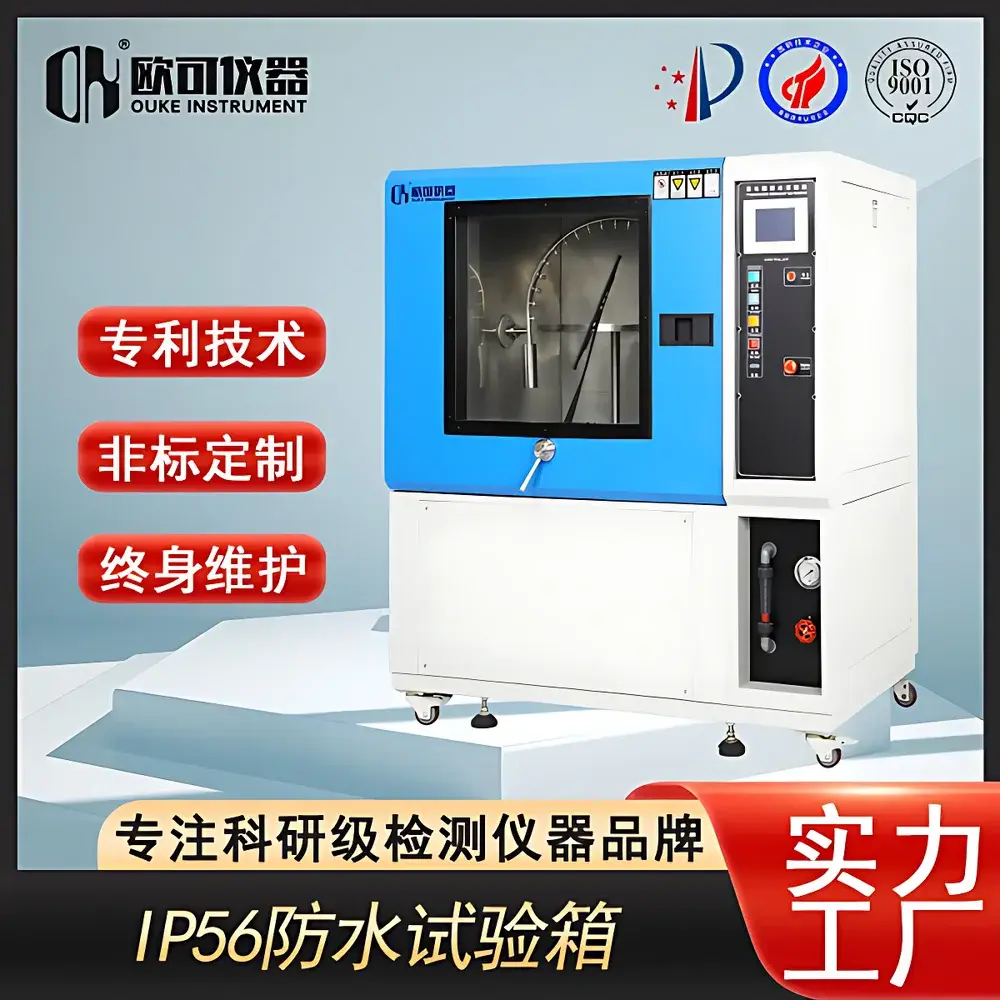
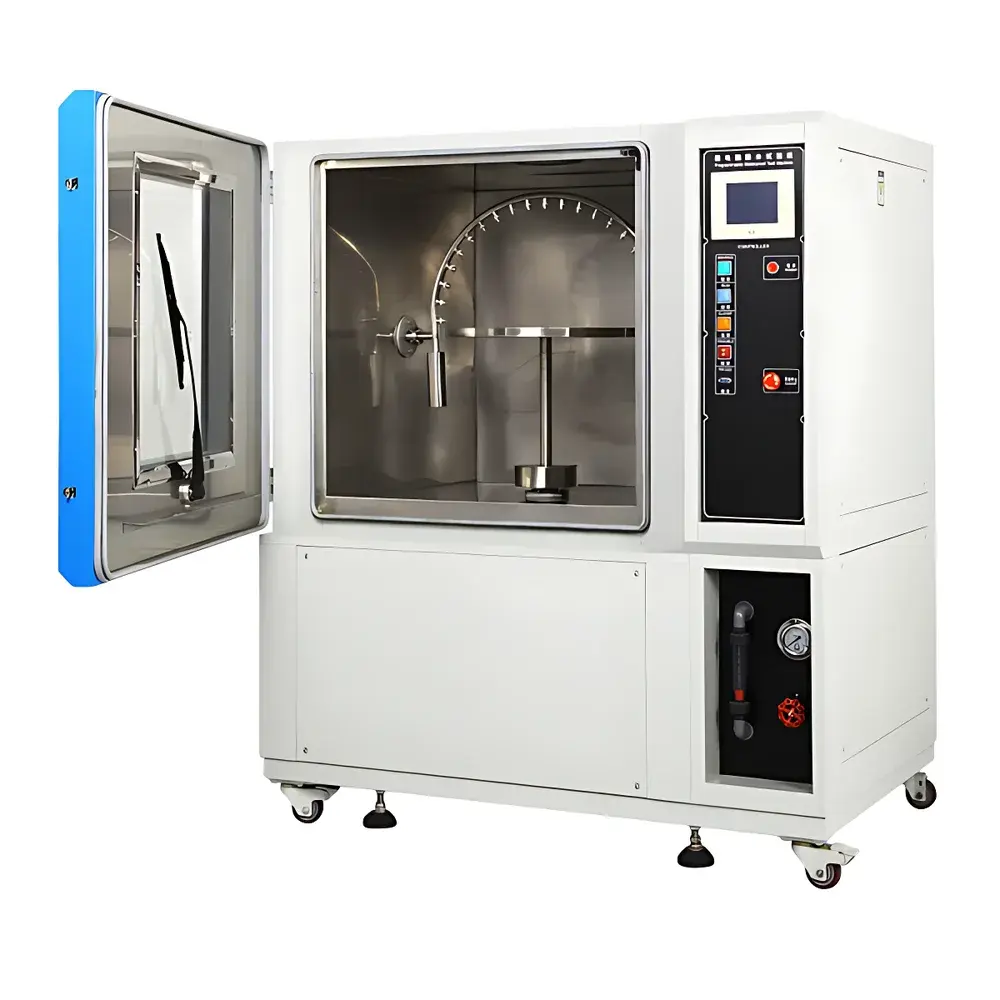
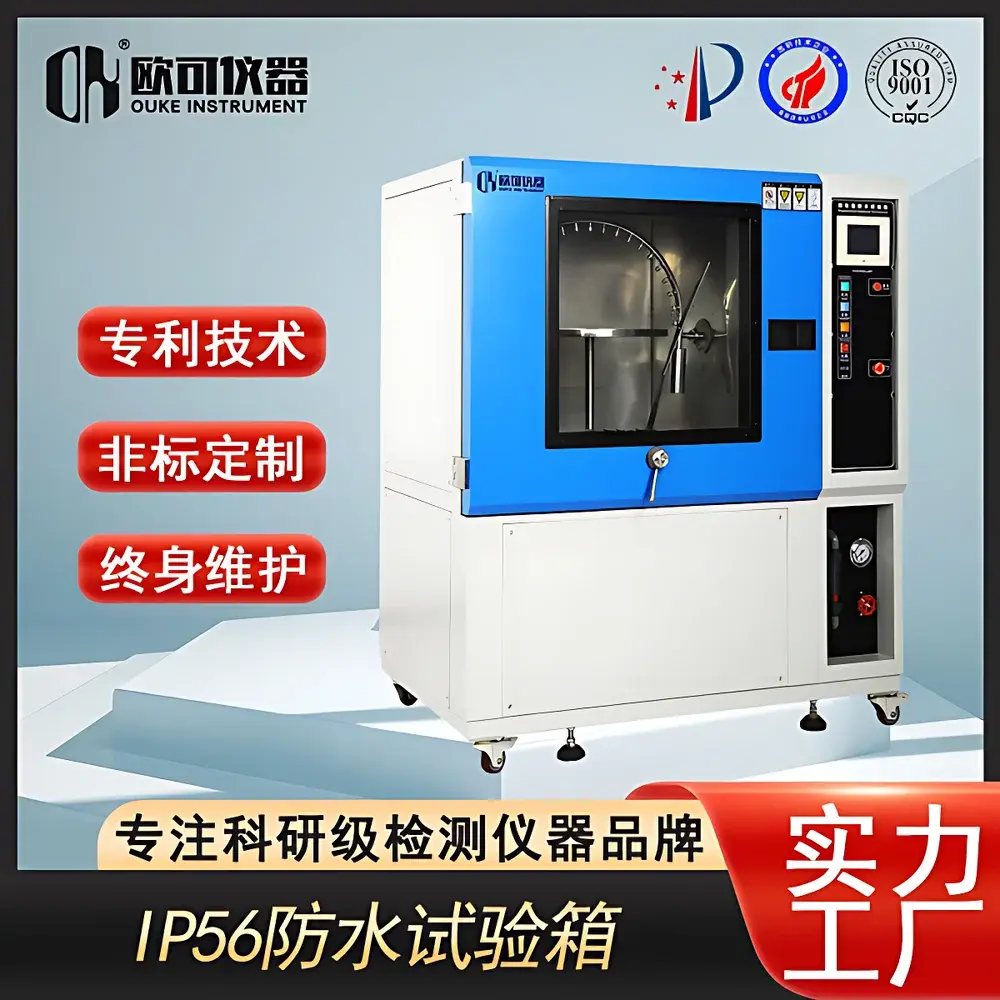
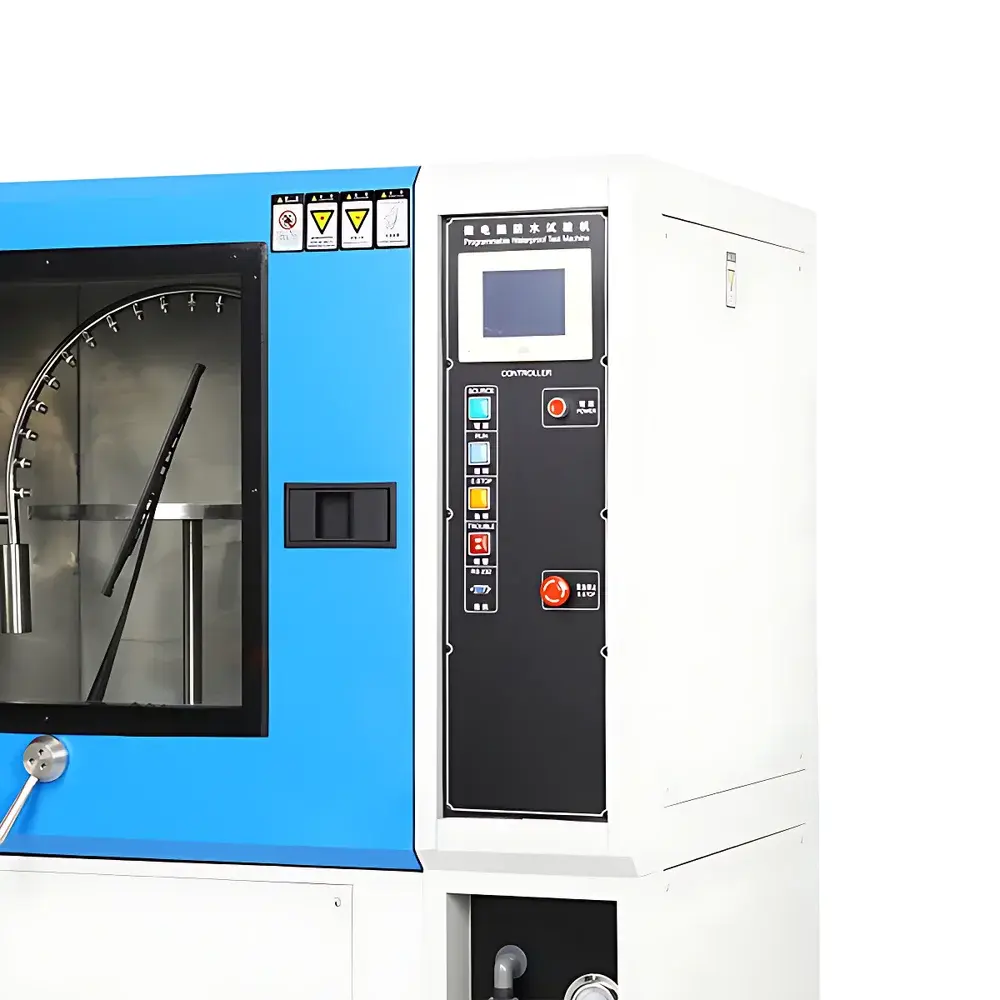
OK LS-803 Oscillating Spray Arm Rain Test Chamber
| Brand | OK Instruments |
|---|---|
| Origin | Guangdong, China |
| Manufacturer Type | Direct Manufacturer |
| Country of Origin | China |
| Model | LS-803 |
| Price | USD 3,500 (FOB Guangdong) |
| Temperature Range | (RT + 10°C) to 55°C |
| Rainfall Intensity | 10–20 cm/h |
| Droplet Diameter | 0.5–4.5 mm |
| Wind Speed Range | 5–18 m/s |
| Test Duration | 0–999 min |
Overview
The OK LS-803 Oscillating Spray Arm Rain Test Chamber is an engineered environmental simulation system designed specifically for dynamic, localized water ingress validation in automotive and heavy-duty mobile equipment applications. Unlike standardized IPX3/IPX4 drip or oscillating pipe testers governed by IEC 60529, the LS-803 implements a precisely controllable linear spray arm architecture—based on Couette-type oscillatory fluid dynamics—to replicate real-world hydrodynamic exposure conditions such as wheel-splash, wiper sweep zones, and asymmetric side-body impingement. Its core operational principle relies on synchronized angular oscillation of a multi-nozzle stainless-steel spray bar, coupled with regulated hydraulic pressure, calibrated droplet sizing, and programmable spatial positioning relative to the test specimen. This enables deterministic reproduction of OEM-defined test profiles—including those specified in VW PVW 1410, GMW 3172 Section 5.3.2 (Spray Test), and Ford FLTM BO 162-05—where sealing integrity at critical junctions (e.g., door sills, sunroof drains, A-pillar seals) must be validated under motion-synchronized wetting.
Key Features
- Modular oscillating spray arm assembly: 1.0–3.0 m customizable length, constructed from ASTM A276 316 stainless steel with precision-machined mounting flanges and IP65-rated actuation housing.
- Interchangeable nozzle manifold: Supports standardized fan-pattern nozzles (e.g., Spraying Systems Co. VN series) with adjustable spacing (50–100 mm center-to-center) and orientation angles (±15° to ±90° relative to vertical axis).
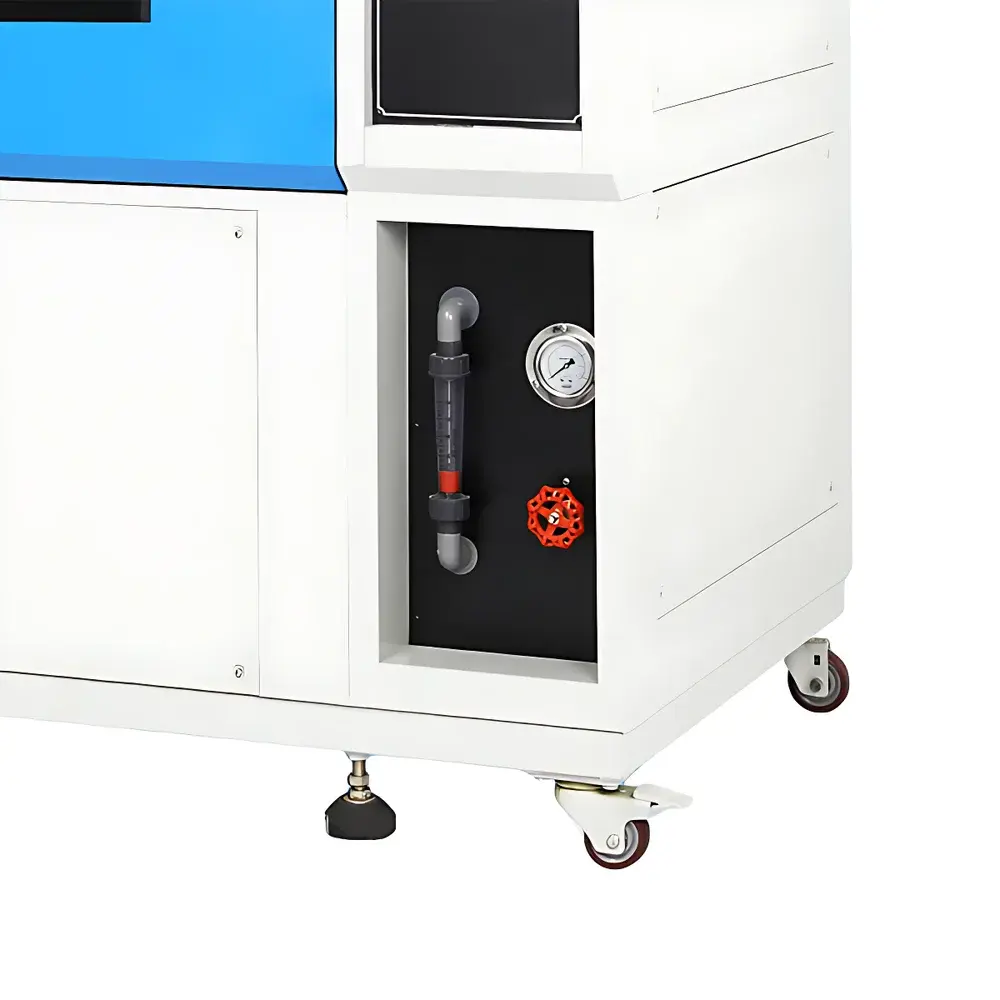
- High-fidelity hydraulic control: Dual-stage pressure regulation (0.1–0.8 MPa, ±0.02 MPa repeatability) with inline Coriolis mass flow metering (±0.5% FS accuracy) and particulate filtration (5 µm absolute rating).
- Programmable motion control: Servo-driven oscillation mechanism offering continuous angular range from ±0° to ±180°, speed adjustment from 1°/s to 90°/s, and cycle timing resolution of 0.1 s.
- Integrated environmental conditioning: Built-in heating module maintains chamber ambient temperature between RT+10°C and 55°C during prolonged tests; optional humidity monitoring available.
- PLC-based HMI interface: 7-inch TFT touchscreen with password-protected parameter locking, audit trail logging (ISO 13485-compliant event timestamps), and USB export of test execution records.
Sample Compatibility & Compliance
The LS-803 accommodates specimens ranging from individual components (e.g., HVAC housings, lamp assemblies) to full vehicle cabs and agricultural machinery cabins. Optional motorized turntables (max. load: 5,000 kg, 0.1–3 rpm continuous rotation) enable azimuthal exposure variation. The system is configured to meet functional requirements of major OEM specifications—notably VW PVW 1410 Clause 4.2.3 (spray arm geometry and dwell time), GMW 3172 Table 7 (water pressure and impact angle tolerances), and Ford FLTM BO 162-05 Annex A (nozzle distribution density). While not certified to IEC 60529 for IP classification, its test methodology aligns with ISO 16750-4 (Road vehicles — Environmental conditions and testing for electrical and electronic equipment — Part 4: Climatic loads) Annex C for rain exposure simulation. All firmware and calibration records support GLP/GMP traceability per FDA 21 CFR Part 11 when paired with optional electronic signature modules.
Software & Data Management
Control logic resides in a CE-certified industrial PLC (Siemens S7-1200 series) with deterministic scan cycle <10 ms. The embedded HMI firmware supports up to 99 user-defined test programs, each storing complete parameter sets: oscillation profile (start/end angle, dwell time, acceleration ramp), hydraulic setpoints (target pressure, flow rate, temperature), and sequence logic (pre-wet, main spray, post-drain phases). Real-time graphs display pressure, flow, and angular position synchronously. Data export conforms to CSV and XML formats compatible with LIMS integration. Audit logs capture operator ID, timestamp, parameter changes, and fault events—with write-protection enabled during active test cycles to prevent mid-execution modification.
Applications
- Automotive: Validation of door weatherstrip compression force retention after cyclic spray exposure; evaluation of drain channel efficacy in panoramic roof systems; verification of sensor housing ingress protection under crosswind-augmented rainfall.
- Commercial Vehicles: Testing cab seal integrity for off-highway construction equipment subjected to mud-saturated spray environments.
- Agricultural Machinery: Assessing hydraulic valve block enclosure resistance to high-angle, low-velocity irrigation-style wetting.
- Rail Transport: Simulating track-side water ejection during high-speed transit for undercarriage electronics enclosures.
- Defense & Aerospace: Functional testing of avionics bay access panels against tropical monsoon rainfall profiles per MIL-STD-810H Method 506.6.
FAQ
Does the LS-803 comply with IEC 60529 IPX3 or IPX4?
No. It is purpose-built for OEM-specific spray protocols—not generic enclosure rating standards. Its design prioritizes geometric and kinematic fidelity over standardized arc coverage.
Can the spray arm be repositioned vertically and laterally during a test?
Yes. Motorized Z-axis lift (±300 mm travel) and X-axis translation (±500 mm) are available as factory options, enabling dynamic distance modulation per test phase.
Is calibration certification included with delivery?
A NIST-traceable calibration report for pressure transducer, flow meter, and angular encoder is provided. Annual recalibration services are supported via OK’s ISO/IEC 17025-accredited service lab.
What water quality is required to prevent nozzle clogging?
Deionized water with ≤1 ppm total dissolved solids (TDS) and particle count 5 µm) is recommended. Integrated dual-stage filtration (10 µm + 5 µm) is standard.
Can test sequences be exported for third-party analysis?
Yes. Full parameter logs—including real-time sensor traces—export in timestamped CSV format with column headers compliant with ASTM E2500-13 data interchange conventions.
Related Products



