
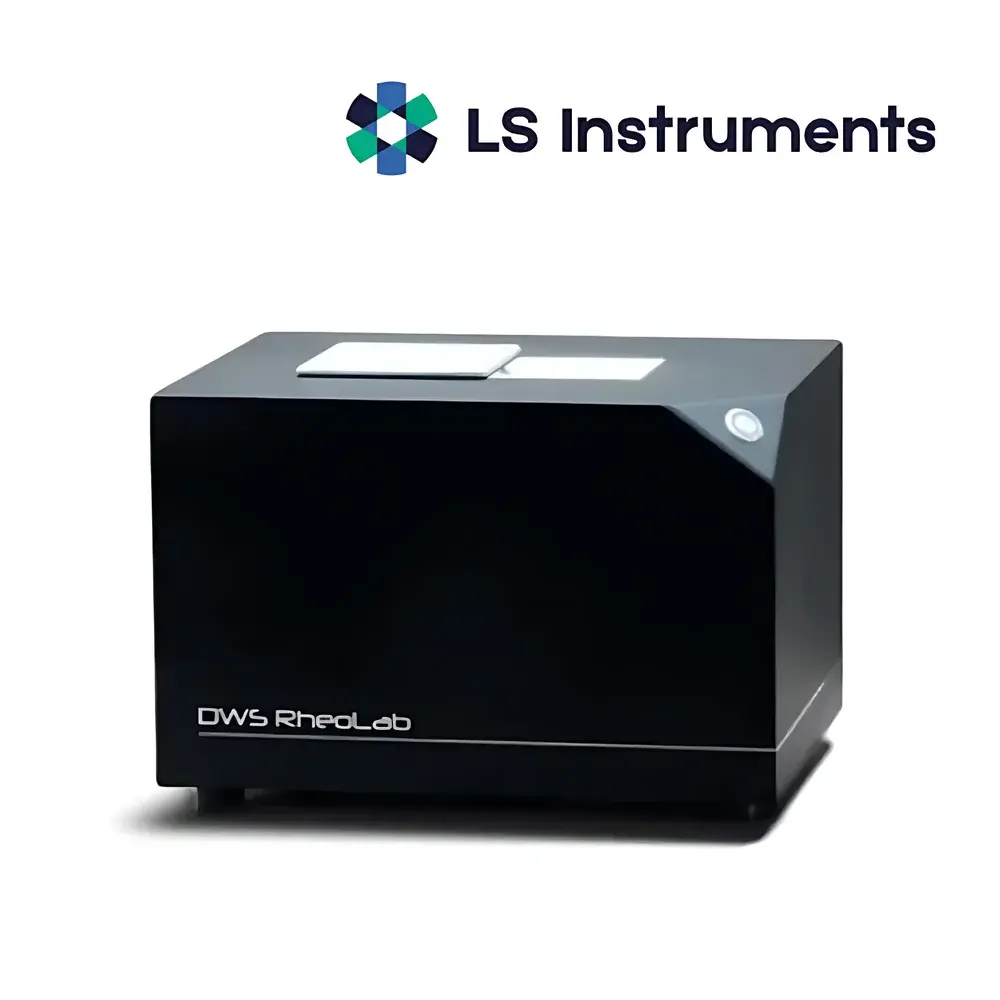
LS Instruments DWS RheoLab Diffusing Wave Spectroscopy (DWS) Microrheometer
| Brand | LS Instruments |
|---|---|
| Origin | Switzerland |
| Model | DWS RheoLab |
| Temperature Range | 5°C–100°C |
| Frequency Range | 0.1 Hz–10 MHz |
| Minimum Measurable Frequency | 0.1 Hz |
| Maximum Measurable Frequency | 10⁷ Hz |
| Sample Volume Requirement | ≥150 µL |
| Sample State | Liquid |
| Measurement Principle | Diffusing Wave Spectroscopy (DWS) |
| Compliance | Designed for GLP/GMP-aligned workflows |
| Software Platform | LS Instruments RheoSoft v5.x |
Overview
The LS Instruments DWS RheoLab is a high-precision, non-invasive microrheometer engineered for the optical characterization of soft matter viscoelasticity at microscopic length and macroscopic time scales. Unlike conventional rotational or oscillatory rheometers that impose macroscopic shear or deformation, the RheoLab employs Diffusing Wave Spectroscopy (DWS)—a multiple-light-scattering variant of dynamic light scattering—to probe the thermal motion of embedded tracer particles (typically 100–1000 nm in diameter) within a turbid or semi-opaque sample. By quantifying the intensity autocorrelation function of multiply scattered light, the instrument reconstructs the mean-squared displacement (MSD) of particles over time, enabling direct calculation of the frequency-dependent complex shear modulus G*(ω) = G′(ω) + iG″(ω) across an exceptional dynamic range—from 0.1 Hz to 10 MHz—without mechanical contact, sample perturbation, or external forcing. This principle makes it uniquely suited for fragile, heterogeneous, or low-volume systems where traditional rheometry fails due to wall slip, sedimentation, or structural damage.
Key Features
- True non-contact operation: Samples remain fully sealed in standard quartz or glass cuvettes (150–500 µL volume); no couplings, spindles, or geometries required.
- Ultra-broad dynamic frequency coverage: Measures relaxation spectra from millisecond to kilosecond timescales (0.1 Hz to 10⁷ Hz), enabled by Echo-DWS technology (patented EP 1720000) and high-speed CMOS detection.
- Sub-microliter sensitivity: Reliable microrheological data obtainable from as little as 150 µL—critical for precious biologics, clinical isolates, or combinatorial formulation screening.
- High modulus resolution: Capable of resolving storage moduli up to 10⁵ Pa in stiff gels and concentrated polymer solutions, surpassing conventional DLS- and particle-tracking-based microrheometers.
- Temperature-controlled environment: Integrated Peltier stage with ±0.1°C stability across 5°C–100°C, supporting Arrhenius analysis and thermal transition mapping.
- Robust architecture for routine lab use: Modular optical path, vibration-damped baseplate, and automated alignment routines reduce operator dependency and ensure inter-day reproducibility.
Sample Compatibility & Compliance
The DWS RheoLab accommodates a wide spectrum of liquid-phase soft materials—including colloidal dispersions, protein solutions, hydrogels, emulsions, microstructured surfactant phases, and biopolymer melts—without requiring dilution, labeling, or rheological conditioning. Its non-destructive nature preserves sample integrity across repeated measurements, making it ideal for real-time stability studies (e.g., gelation kinetics, aggregation onset, or phase separation monitoring). The system is designed to support regulatory-compliant workflows: RheoSoft software optionally enables electronic signatures, full audit trails, user role management, and raw-data immutability—features aligned with FDA 21 CFR Part 11, ISO/IEC 17025, and ICH Q5C guidelines. Instrument qualification documentation (IQ/OQ/PQ templates) and traceable calibration protocols are available upon request.
Software & Data Management
RheoSoft v5.x provides an integrated environment for acquisition, real-time correlation analysis, MSD fitting, and linear viscoelastic model inversion (e.g., generalized Maxwell, Cole-Cole, or fractional Zener models). All raw intensity time series, intermediate correlation functions, and final G′/G″ spectra are stored in HDF5 format with embedded metadata (temperature, timestamp, sample ID, operator, instrument configuration). Batch processing, scriptable macros (Python API), and export to ASTM D445/D7483-compatible formats facilitate integration into LIMS and enterprise data systems. Optional modules include time-resolved aging analysis, multi-sample comparative reporting, and compliance mode with electronic signature capture and change control logs.
Applications
- Early-stage formulation development in pharmaceuticals (e.g., subcutaneous depot gels, mRNA-LNP stability, monoclonal antibody aggregation thresholds)
- Texture evolution in dairy, plant-based, and infant nutrition matrices under thermal or enzymatic stress
- Rheological fingerprinting of cosmetic emulsions and haircare polymers during shelf-life testing
- Yield stress estimation and network dynamics in drilling fluids and enhanced oil recovery formulations
- Microstructural response of battery slurries and solid-electrolyte interphases to cycling-relevant shear histories
- Fundamental studies of cytoskeletal mechanics, extracellular matrix remodeling, and biofilm viscoelasticity
FAQ
How does DWS differ from conventional DLS or particle-tracking microrheology?
DWS leverages multiple scattering events to amplify signal-to-noise ratio and extend the measurable MSD range by orders of magnitude—enabling robust modulus extraction in highly turbid or weakly scattering samples where single-scattering DLS fails and particle tracking suffers from limited trajectory length.
Can the RheoLab measure yield stress or nonlinear behavior?
No—DWS is inherently a linear, small-amplitude technique operating under thermal equilibrium conditions. It reports only the linear viscoelastic spectrum G*(ω); nonlinear parameters (e.g., yield strain, thixotropy index) require complementary large-deformation rheometry.
What tracer particle size and concentration are recommended?
Standard operation uses 200–500 nm polystyrene or silica tracers at 0.1–1.0 vol%; optimal concentration balances scattering intensity against interparticle interactions—RheoSoft includes a built-in scattering calculator to guide selection.
Is temperature ramping supported during measurement?
Yes—programmable temperature ramps (0.1–5°C/min) are fully synchronized with data acquisition; however, modulus spectra are reported per isothermal segment to maintain thermodynamic validity.
Does the system require regular optical recalibration?
The laser wavelength and detector quantum efficiency are factory-calibrated; annual verification using NIST-traceable neutral density filters and reference scatterers is recommended for GLP environments.



