
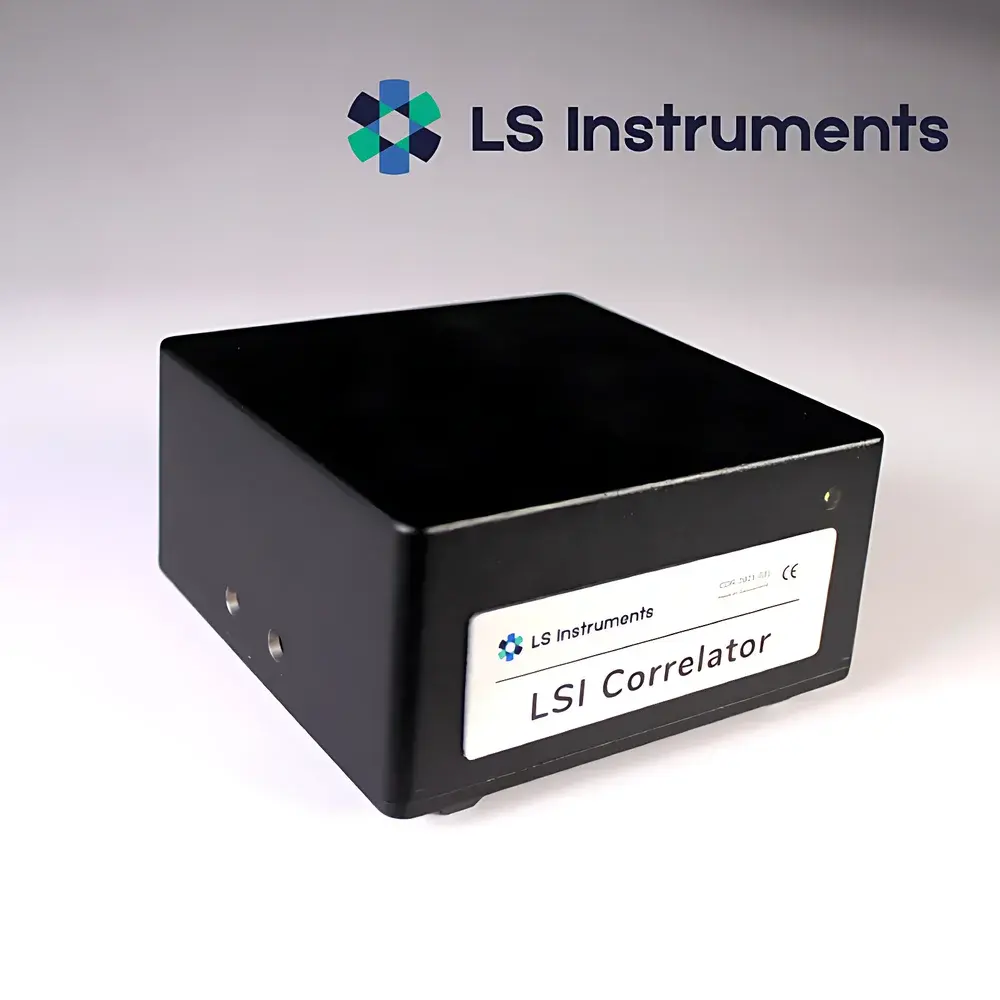
LS Instruments LSI Correlator Digital Autocorrelator
| Brand | LS Instruments |
|---|---|
| Origin | Switzerland |
| Model | LSI Correlator |
| Application Scope | Dynamic Light Scattering (DLS), Fluorescence Correlation Spectroscopy (FCS), Diffusing Wave Spectroscopy (DWS), Diffuse Correlation Spectroscopy (DCS) |
| Correlation Algorithm | Multi-tau and Linear-tau Digital Correlation |
| Time Delay Range | 12.5 ns – 3436 s (13 decades) |
| Number of Channels | 322 total (296 detection + 26 auxiliary) |
| Fastest Configurable Initial Delay | 12.5 ns, 200 ns, 400 ns, 800 ns, or 3200 ns |
| Normalization Modes | Symmetric and Compensation Normalization |
| Max. Count Rate | 20 Mcps (at 52 ms integration) |
| Interface | USB 2.0 and Gigabit Ethernet |
| OS Support | Windows & Linux |
| Firmware Upgradability | Field-upgradable via host software |
| Power Supply | External stabilized DC source |
| Dimensions | 120 × 120 × 53.6 mm (aluminum housing) |
| Detector Protection | Real-time gated output with user-defined count-rate threshold |
| Synchronization | Dedicated clock output for hardware timing alignment |
| Software Integration | Native APIs for MATLAB, LabVIEW, Python |
Overview
The LS Instruments LSI Correlator is a high-performance digital hardware correlator engineered for precision temporal correlation analysis in photon-counting-based scattering and fluorescence experiments. It implements real-time autocorrelation and cross-correlation of pulse trains generated by single-photon avalanche diodes (SPADs), photomultiplier tubes (PMTs), or other time-resolved detectors. Its core functionality supports established techniques including Dynamic Light Scattering (DLS), Fluorescence Correlation Spectroscopy (FCS), Diffusing Wave Spectroscopy (DWS), and Diffuse Correlation Spectroscopy (DCS). Unlike software-based correlation methods, the LSI Correlator performs all correlation calculations in dedicated FPGA logic—ensuring deterministic latency, minimal dead time, and immunity to host CPU load or OS scheduling artifacts. This architecture delivers reproducible, high-fidelity correlation functions essential for extracting diffusion coefficients, hydrodynamic radii, concentration fluctuations, and micro-rheological parameters from complex colloidal, biological, or soft-matter systems.
Key Features
- Multi-tau and linear-tau correlation modes with programmable configuration—enabling optimal resolution across ultrafast (nanosecond) and slow (thousands of seconds) dynamics.
- 13-decade time delay coverage (12.5 ns to 3436 s) using 322-channel architecture, with 296 dedicated detection channels and 26 auxiliary channels for synchronization or reference signals.
- User-selectable initial delay settings (12.5 ns, 200 ns, 400 ns, 800 ns, 3200 ns) to suppress statistical noise in early-time correlation data without sacrificing dynamic range.
- Dual normalization options—symmetric and compensation normalization—supporting rigorous intensity fluctuation analysis compliant with ISO 22412 (DLS) and standard FCS data reduction protocols.
- Real-time detector overload protection via fast-gated output: automatically disables signal routing when instantaneous count rate exceeds a user-defined threshold—critical for safeguarding high-cost SPAD/PMT modules during alignment or sample loading.
- Dedicated synchronization clock output enables precise temporal alignment with external hardware such as lasers, shutters, galvo scanners, or stage controllers—essential for multi-modal or pump-probe configurations.
- Firmware-upgradable design allows field deployment of algorithm enhancements, bug fixes, and new correlation schemes without hardware replacement—maintaining long-term platform relevance.
Sample Compatibility & Compliance
The LSI Correlator is compatible with aqueous and organic colloidal dispersions, protein solutions, polymer melts, cell suspensions, tissue phantoms, and turbid media where multiple scattering dominates (e.g., DWS applications). Its robust timing resolution and low-jitter input circuitry meet requirements for GLP-compliant DLS instrumentation per ISO 22412:2017 and USP . When integrated into FCS setups, it supports quantitative analysis under FDA 21 CFR Part 11–compliant workflows when paired with validated software environments. The aluminum enclosure provides EMI shielding and thermal stability, ensuring consistent performance in shared-lab environments subject to variable ambient conditions.
Software & Data Management
The correlator ships with native control and analysis software supporting CONTIN, cumulant, and exponential fitting algorithms for DLS particle size distribution derivation. Raw correlation data are exported in HDF5 and ASCII formats, enabling traceable post-processing in MATLAB, Python (NumPy/SciPy), or R. A comprehensive API suite supports bidirectional communication—allowing custom experiment orchestration, real-time feedback loops, and integration into automated QC pipelines. All API calls are timestamped and logged, supporting audit trails required under GMP/GLP frameworks. Firmware updates are delivered as signed binaries with SHA-256 checksum verification to ensure integrity and authenticity.
Applications
- Sub-micron particle sizing in pharmaceutical nanosuspensions and lipid nanoparticles (LNPs) under non-invasive, low-volume conditions.
- Protein aggregation kinetics monitoring via FCS in microfluidic chips—capturing oligomer formation with sub-millisecond resolution.
- Mechanical characterization of hydrogels and biopolymer networks using DWS-derived mean-square displacement (MSD) profiles.
- In vivo blood flow mapping in preclinical models using DCS, leveraging the correlator’s high dynamic range and low-noise correlation at physiological count rates.
- Time-resolved studies of micelle formation, vesicle fusion, and membrane phase transitions through multi-parameter correlation analysis.
FAQ
What correlation algorithms does the LSI Correlator support?
It implements both multi-tau (16/8 scheme) and linear-tau correlation algorithms, configurable via firmware settings to match experimental time-scale requirements.
Can the device operate independently of a host computer?
Yes—the correlator runs autonomously once configured; host interaction is required only for setup, data retrieval, and firmware updates.
Is the correlator compatible with third-party detectors?
It accepts TTL-compatible NIM-standard photon pulses with adjustable input thresholds and impedance matching, ensuring interoperability with most commercial SPADs, PMTs, and SiPMs.
How is data integrity ensured during network interruption?
Internal buffering and autonomous error recovery allow uninterrupted correlation operation—even during host crash or Ethernet disconnection—with no loss of accumulated correlation data.
Does the system support 21 CFR Part 11 compliance?
When deployed with validated software and procedural controls (e.g., electronic signatures, audit trail logging), the hardware meets foundational technical requirements for Part 11–aligned analytical workflows.



