
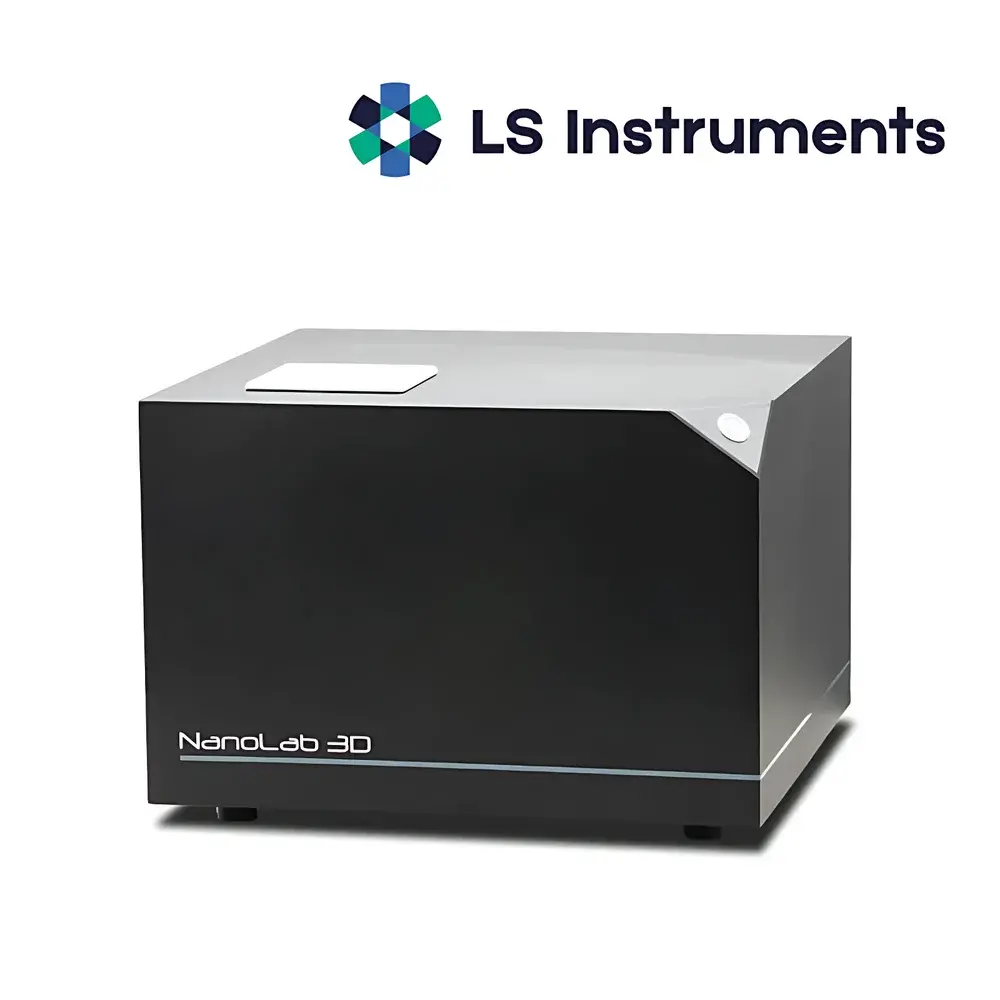
LS Instruments NanoLab 3D Modulated 3D Cross-Correlation Dynamic Light Scattering Analyzer
| Brand | LS Instruments |
|---|---|
| Origin | Switzerland |
| Model | NanoLab 3D |
| Particle Size Range | 0.3 nm – 10 µm |
| Sample Volume | as low as 4 µL (optional) |
| Temperature Control Range | 4 °C – 85 °C |
| Viscosity Measurement Range | 0.01 cP – >1000 cP |
| Compliance | ISO 22412 (at ≤23 °C ambient) |
| Technique | Modulated 3D Cross-Correlation DLS |
Overview
The LS Instruments NanoLab 3D is a high-precision, benchtop dynamic light scattering (DLS) analyzer engineered for rigorous nanoparticle characterization in both research and quality control environments. Unlike conventional single-beam DLS systems, the NanoLab 3D implements a patented modulated 3D cross-correlation optical architecture—combining two phase-modulated laser beams with spatially offset detection channels. This configuration enables true suppression of multiple scattering contributions at the signal acquisition level, eliminating the need for empirical dilution corrections or heuristic filtering. The instrument operates on the fundamental principle that Brownian motion-induced intensity fluctuations in scattered light are statistically encoded in the temporal autocorrelation function; however, in concentrated dispersions (>0.1% w/v), multiply scattered photons distort this function, leading to systematic bias in hydrodynamic diameter estimation. By performing simultaneous, phase-synchronized scattering experiments and computing their cross-correlation, the NanoLab 3D isolates the singly scattered component—thereby recovering physically meaningful correlation decay profiles even at optical densities exceeding OD = 3. This foundational capability underpins its unique suitability for undiluted protein formulations, polymer melts, colloidal suspensions, and vaccine adjuvant dispersions where sample integrity, minimal handling, and process-representative conditions are critical.
Key Features
- Modulated 3D cross-correlation DLS architecture—patented optical design enabling intrinsic multiple-scattering rejection without user intervention
- Simultaneous measurement of hydrodynamic diameter, polydispersity index (PDI), and zero-shear microviscosity via tracer-particle diffusion analysis
- Extended dynamic range: 0.3 nm to 10 µm (diameter), validated across NIST-traceable latex standards and protein monomer/dimer mixtures
- Ultra-low sample consumption: standard cuvette mode requires only 15 µL; optional 4 µL capillary cell available for precious biologics
- Programmable temperature control from 4 °C to 85 °C with ±0.1 °C stability, supporting accelerated stability studies and thermal transition profiling
- Integrated micro-rheology module enabling viscosity determination from 0.01 cP to >1000 cP without mechanical shear or wall effects
- Rugged, vibration-damped optical platform with fiber-coupled lasers and thermally stabilized detectors for long-term operational reproducibility
Sample Compatibility & Compliance
The NanoLab 3D accommodates aqueous and organic dispersions—including monoclonal antibodies, mRNA-LNPs, quantum dots, silica nanoparticles, and surfactant micelles—without mandatory dilution. Its robustness against multiple scattering ensures compliance with ISO 22412:2017 for DLS-based particle sizing, provided ambient laboratory temperature remains ≤23 °C during calibration and validation. For regulated environments, the system supports audit-trail-enabled operation when paired with LsLab software configured under 21 CFR Part 11-compliant settings (electronic signatures, user role management, immutable data logs). All raw correlation data, instrument parameters, and environmental metadata (temperature, laser power, count rate) are embedded in proprietary .lsd files—ensuring full traceability for GLP/GMP submissions. Optional Stop-Flow Cell integration enables continuous flow-through measurement in closed-loop systems, satisfying PAT (Process Analytical Technology) requirements for real-time monitoring of inline nanomanufacturing processes.
Software & Data Management
LsLab software provides a modular, workflow-driven interface designed for both novice users and expert rheologists. Measurement protocols—from single-point size analysis to time-resolved aggregation kinetics or temperature ramps—are configured via intuitive drag-and-drop sequencing. Core analysis engines include the ISO-standard cumulant method (for Z-average and PDI) and LS Instruments’ proprietary CORENN algorithm: a physics-informed machine learning inversion technique that combines non-negative least squares with adaptive noise modeling and kernel regularization. Unlike conventional CONTIN or NNLS approaches, CORENN explicitly accounts for detector dead time, afterpulsing artifacts, and baseline drift—yielding stable, unimodal or multimodal PSDs even from low-SNR datasets. All results are stored in an ACID-compliant SQLite database with hierarchical project tagging, version-controlled method templates, and batch-export functionality to CSV, Excel, or ASTM E2936-compliant XML formats.
Applications
- Biopharmaceutical development: real-time monitoring of mAb aggregation, PEGylated protein stability, and lipid nanoparticle (LNP) integrity during formulation and storage
- Materials science: sizing and dispersity assessment of metal-organic frameworks (MOFs), carbon nanotubes, and conductive polymer nanoparticles
- Quality assurance: release testing of nanomedicines per USP and Ph. Eur. 2.9.31 guidelines
- Micro-rheology of complex fluids: zero-shear viscosity mapping of hydrogels, synovial fluid analogs, and concentrated emulsions
- Reaction kinetics: in situ tracking of nanoparticle nucleation and growth during sol-gel synthesis or precipitation reactions
- PAT implementation: integration with bioreactors and continuous manufacturing lines via Ethernet/OPC UA interfaces
FAQ
How does modulated 3D cross-correlation differ from traditional DLS?
It replaces single-channel autocorrelation with dual-beam, phase-modulated cross-correlation—physically rejecting multiply scattered photons at acquisition rather than attempting post-hoc correction.
Can NanoLab 3D measure samples above 10% w/v solids?
Yes—validated up to 25% w/v for polystyrene latices and 15% w/v for IgG solutions, contingent on particle refractive index contrast and solvent viscosity.
Is CORENN algorithm compliant with regulatory submission requirements?
CORENN is fully documented in the instrument’s Design Qualification (DQ) and Validation Master Plan (VMP); raw data and algorithm parameters are exportable for independent verification.
What maintenance is required for long-term accuracy?
Annual factory recalibration is recommended; daily verification uses built-in NIST-traceable reference standards and automated alignment diagnostics.
Does the system support GMP-compliant electronic records?
Yes—when deployed with LsLab Enterprise Edition and configured with role-based access control, electronic signatures, and immutable audit trails per 21 CFR Part 11.



