
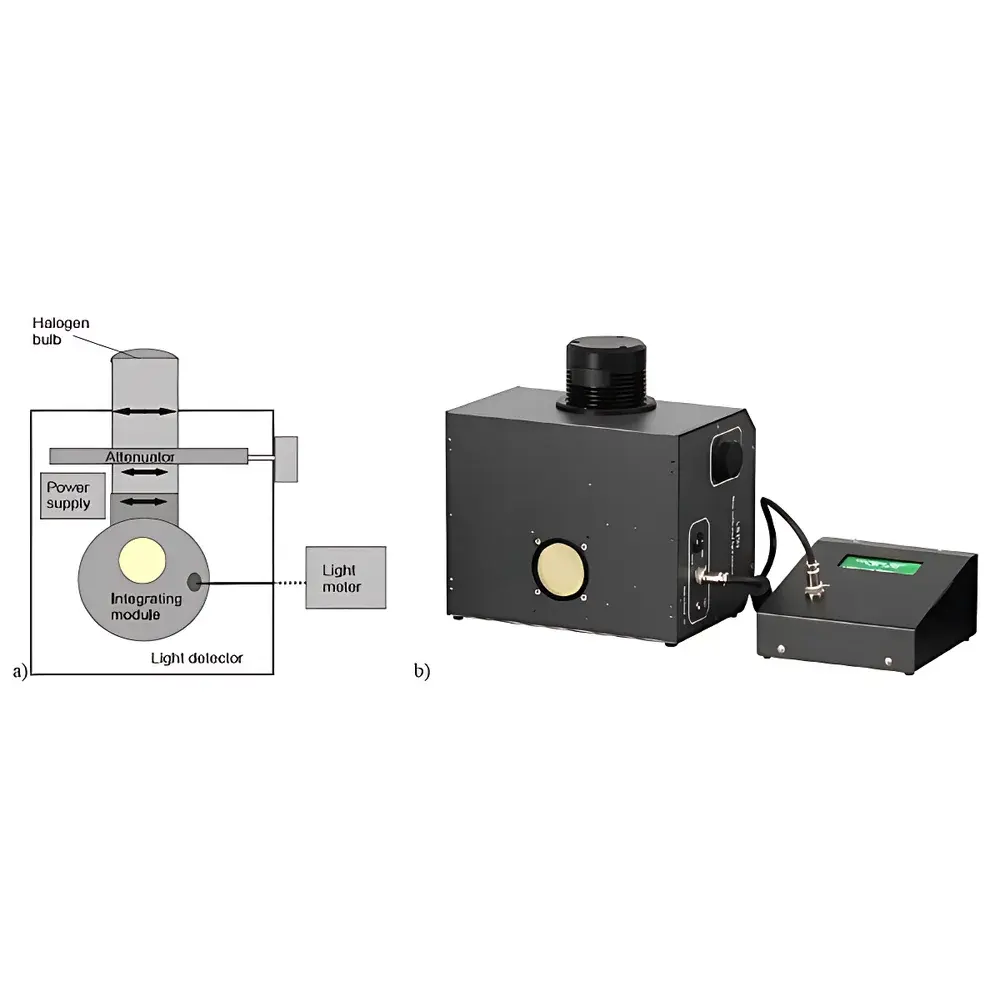
LS-MAH Manual Halogen Light Source by Inframet
| Brand | Inframet |
|---|---|
| Origin | Poland |
| Model | LS-MAH |
| Light Source Type | Tungsten-Halogen |
| Spectral Range | 400–2000 nm |
| Color Temperature | 2856 K (400–1100 nm) |
| Source Diameter | 40 mm |
| Luminance Adjustment Range | 60 mcd/m² to 6 kcd/m² (base version) |
| Luminance Dynamic Range | ≥10⁵ (base), ≥10⁸ (advanced, optional) |
| Intensity Control | Manual mechanical attenuator via rotary knob |
| Spectral Filtering | Manual insertion of bandpass or narrowband filters (advanced version only) |
| Emission Profile | Lambertian, ±15° half-angle |
| Operating Temperature | +5 °C to +35 °C |
| Storage Temperature | −5 °C to +55 °C |
| Relative Humidity | <90% RH (non-condensing) |
| Dimensions | 280 × 260 × 230 mm |
| Weight | 8 kg |
Overview
The LS-MAH Manual Halogen Light Source is a precision-engineered optical calibration tool developed by Inframet (Poland) for laboratory and metrology applications requiring stable, spectrally broad, and manually controllable illumination. Based on a high-stability tungsten-halogen filament, the LS-MAH emits continuous radiation across the visible (400 nm), near-infrared (NIR, up to ~1100 nm), and short-wave infrared (SWIR, up to 2000 nm) spectral bands. Its calibrated color temperature of 2856 K—matching the CIE Standard Illuminant A—ensures photometric and radiometric consistency with natural daylight under incandescent conditions. Designed as a primary source in optical test benches, the LS-MAH delivers a Lambertian emission profile with ≤±15° angular uniformity, enabling repeatable irradiance distribution essential for objective imaging performance evaluation. Unlike automated or programmable sources, its manual architecture prioritizes mechanical robustness, long-term stability, and operator-controlled granularity—making it especially suitable for environments where deterministic repeatability, minimal electronic interference, and traceable setup procedures are critical.
Key Features
- Stable tungsten-halogen emitter with 40 mm effective source diameter and low spatial non-uniformity
- Continuous spectral output from 400 nm to 2000 nm; color temperature of 2856 K certified over 400–1100 nm
- Manual luminance adjustment via precision mechanical attenuator—rotary knob enables smooth, backlash-free control across ≥10⁵ dynamic range (base version) or ≥10⁸ (advanced version with optional calibration)
- Lambertian angular distribution (±15° half-angle) ensures predictable collimation behavior when coupled with parallel beam tubes
- Modular filter interface supports manual insertion of user-supplied bandpass or narrowband interference filters (advanced version only)
- Thermally stabilized housing maintains operational integrity between +5 °C and +35 °C ambient; conforms to IEC 60068-2 environmental stress testing guidelines
- Compact footprint (280 × 260 × 230 mm) and rigid aluminum chassis facilitate integration into optical tables, ISO-class cleanrooms, and vibration-isolated metrology stations
Sample Compatibility & Compliance
The LS-MAH is routinely deployed in conjunction with collimating optics (e.g., parallel beam tubes) and standardized target arrays—including USAF 1951, Siemens star, and ISO 12233 slanted-edge patterns—to quantify imaging system parameters such as modulation transfer function (MTF), spatial resolution, geometric distortion, and relative illumination uniformity. It is compatible with monochrome and multispectral cameras operating in VIS-NIR (e.g., silicon-based sensors) and SWIR (e.g., InGaAs detectors). The source meets foundational requirements for ISO 15739 (electronic still-picture imaging — noise measurements), ISO 12233 (acutance and resolution), and ASTM E308 (computing CIE colors from spectrophotometry data). While not supplied with NIST-traceable calibration certificates in base configuration, advanced versions support optional factory calibration per ISO/IEC 17025-accredited procedures—including luminance and spectral radiance validation at discrete wavelengths (450, 550, 750, 950, 1550 nm).
Software & Data Management
The LS-MAH operates independently of software control, aligning with GLP-compliant test workflows that emphasize auditability and procedural transparency. All adjustments—luminance level, filter selection, and positioning—are fully manual and mechanically recorded in lab notebooks or digital logbooks. For laboratories implementing FDA 21 CFR Part 11–compliant documentation systems, the absence of embedded firmware or network interfaces eliminates cybersecurity validation overhead and simplifies IQ/OQ/PQ protocol development. Users may integrate the LS-MAH into broader test automation frameworks via external photometer feedback loops (e.g., using calibrated silicon or thermopile sensors), though such configurations require third-party instrumentation and are outside the scope of Inframet’s standard support.
Applications
- MTF and resolution verification of VIS-NIR and SWIR imaging systems (e.g., surveillance cameras, industrial inspection sensors, aerospace EO/IR payloads)
- Distortion mapping of lens assemblies using grid or dot-target projection under controlled spectral conditions
- Relative illumination and vignetting analysis across field-of-view in multi-spectral camera modules
- Calibration reference source for radiometric intercomparison between imaging radiometers and integrating sphere systems
- Functional testing of night-vision devices (Gen II+/III) under standardized A-illuminant conditions
- Education and research labs requiring hands-on understanding of spectral radiance, luminance scaling, and optical throughput modeling
FAQ
Is the LS-MAH compatible with automated test systems?
Yes—when paired with external photometric sensors and programmable motion stages, the LS-MAH can serve as a stable illumination node within semi-automated optical test sequences. However, it does not feature digital interfaces (e.g., USB, RS-232, or Ethernet) or internal microcontrollers.
Does the base version include spectral calibration data?
No—the base LS-MAH ships without spectral radiance or luminance calibration reports. Optional factory calibration packages (traceable to PTB or NPL standards) are available upon request and include spectral power distribution (SPD) curves and luminance uncertainty budgets.
Can the LS-MAH be used for UV or mid-wave IR applications?
No—it is optimized for 400–2000 nm. Below 400 nm, quartz envelope transmission drops significantly; above 2000 nm, halogen filament emissivity declines and thermal noise dominates. For MWIR (3–5 µm) or LWIR (8–14 µm), blackbody sources are recommended.
What maintenance is required?
Annual filament inspection and cleaning of optical windows with spectroscopic-grade solvents are advised. Avoid touching the quartz envelope with bare hands; use lint-free gloves during handling or replacement.
Is the LS-MAH compliant with CE or UKCA marking requirements?
Yes—the device complies with EU Directive 2014/30/EU (EMC) and 2014/35/EU (LVD), and carries CE marking. UKCA marking is available upon request for shipments to Great Britain.






