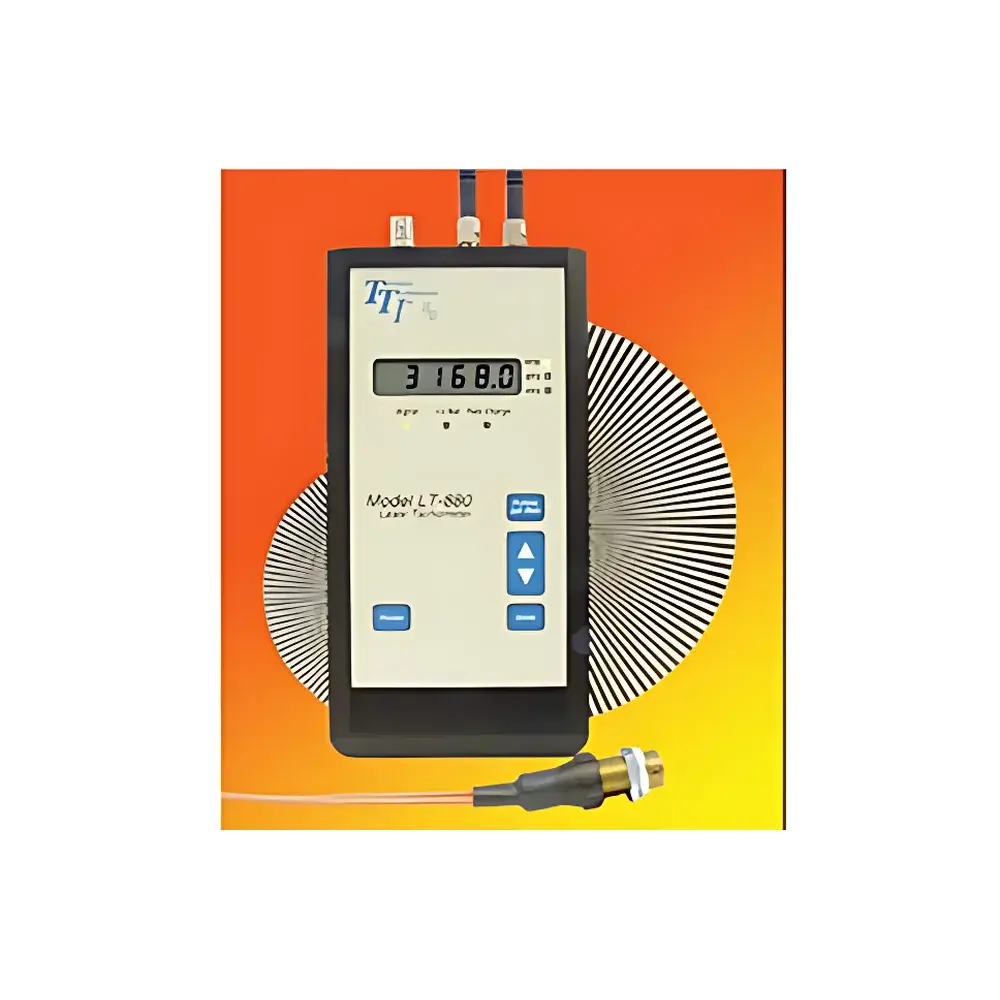
LT-880 Fiber-Optic Laser Tachometer
| Origin | Imported |
|---|---|
| Manufacturer Type | Authorized Distributor |
| Model | LT-880 |
| Pricing | Available Upon Request |
Overview
The LT-880 Fiber-Optic Laser Tachometer is a precision non-contact rotational and linear speed measurement instrument engineered for high-reliability field and laboratory applications. It operates on the principle of optical pulse detection—capturing reflective or non-reflective transitions (e.g., edges, color changes, or surface discontinuities) on rotating or translating targets without requiring retroreflective tape or dedicated encoder marks. A fiber-coupled probe delivers laser illumination and collects backscattered light through a flexible, extended-length optical cable (standard length ≥3 m), enabling safe, remote operation in hazardous, confined, or thermally sensitive environments—including inside enclosures, near high-voltage equipment, or within rotating machinery housings. The system generates TTL/CMOS-compatible digital output pulses synchronized to each detected transition, making it fully compatible with oscilloscopes, frequency analyzers, data acquisition systems, and programmable logic controllers for downstream spectral analysis, vibration diagnostics, or real-time velocity control.
Key Features
- Fiber-optic probe architecture with integrated Class 2 laser diode (650 nm, <1 mW output) for stable, low-drift signal acquisition
- Maximum sampling rate of 40,000 pulses per second (PPS), supporting resolution down to 0.025 ms inter-pulse interval
- Triple-mode display: RPM (revolutions per minute), RPS (revolutions per second), and raw PPS—switchable via front-panel controls
- High-contrast 6-digit LCD with automatic range scaling and polarity indication for bidirectional motion detection
- Rechargeable Ni-MH battery pack (3.6 V, 1200 mAh) providing ≥8 hours of continuous operation; full charge in <2.5 hours
- Robust aluminum alloy housing (IP54-rated) with ergonomic handheld form factor (172 × 78 × 36 mm, 320 g)
- No external power supply required—fully portable and intrinsically safe for use in Class I Division 2 zones
Sample Compatibility & Compliance
The LT-880 is compatible with a broad spectrum of industrial targets—including metallic shafts, plastic gears, printed encoder disks, conveyor belts with contrasting markings, and turbine blades with natural surface variations. It does not require calibration against known-speed references for routine use, though NIST-traceable verification is supported using certified rotary calibrators (e.g., Fluke 720A Speed Calibrator). The device complies with IEC 61326-1:2013 (EMC requirements for electrical equipment used in measurement, control, and laboratory applications) and meets EN 60825-1:2014 safety standards for laser products. While not certified for pharmaceutical GMP or aerospace DO-160 environments, its output signal integrity supports integration into FDA 21 CFR Part 11–compliant data logging workflows when paired with validated acquisition software.
Software & Data Management
The LT-880 operates as a standalone sensor with no embedded firmware or onboard storage. Its TTL/CMOS output (0–5 V logic, 50 Ω impedance, rise/fall time <10 ns) is designed for direct connection to third-party instrumentation—including National Instruments DAQ modules, Keysight oscilloscopes, and LabVIEW-based monitoring platforms. Users may configure external counters or custom Python/Matlab scripts to compute angular acceleration, harmonic content (via FFT), or dwell-time statistics from pulse train data. Optional USB-to-TTL adapters enable real-time streaming to PC-based applications, with timestamped CSV export suitable for audit trails under GLP-compliant quality systems.
Applications
- Rotational speed validation of motors, pumps, compressors, and gearboxes during commissioning and preventive maintenance
- Vibration analysis support via time-domain pulse spacing measurement for torsional oscillation detection
- Linear velocity assessment of web handling systems (paper, film, foil) using edge-triggered tracking on moving substrates
- Encoder disk characterization—measuring actual vs. nominal PPR (pulses per revolution) and detecting missing or duplicated pulses
- Calibration cross-check of contact tachometers and proximity sensors in ISO/IEC 17025-accredited metrology labs
- Academic research in mechanical dynamics, where non-intrusive, high-temporal-resolution speed data is required for model validation
FAQ
Does the LT-880 require reflective tape or special target preparation?
No. It detects natural reflectivity differences—such as black/white transitions on encoder wheels, machined surface steps, or paint boundaries—without adhesive markers.
Can it measure bidirectional rotation?
Yes. Pulse polarity and sequence timing allow direction discrimination when used with quadrature-capable external analyzers.
What is the maximum measurable distance between probe and target?
Up to 1.2 m for high-contrast targets (e.g., matte black on polished steel); optimal performance achieved at 0.1–0.5 m working distance.
Is the output signal isolated or grounded?
The TTL/CMOS output shares common ground with the instrument’s internal circuitry; galvanic isolation requires an external optocoupler module.
How is accuracy affected by ambient lighting?
Built-in optical bandpass filtering (centered at 650 nm ±10 nm) and synchronous detection minimize interference from fluorescent, LED, and daylight sources.