
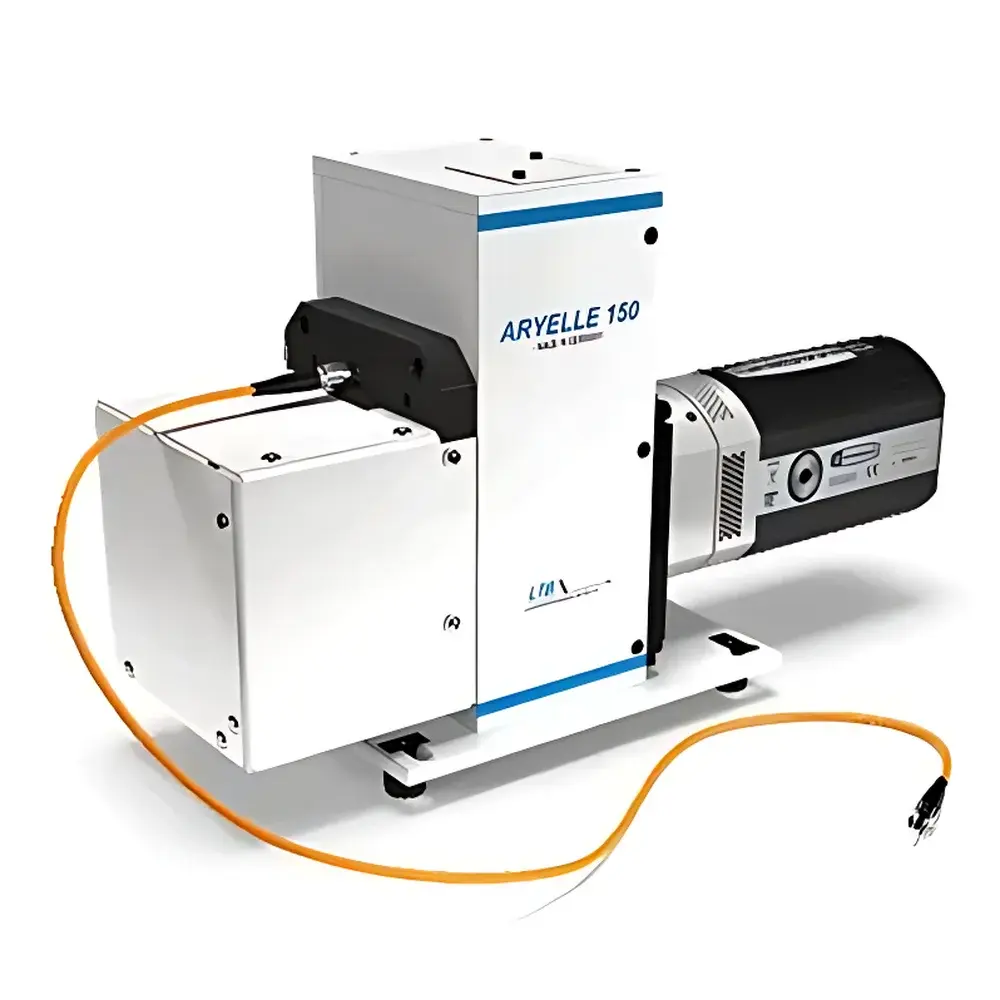
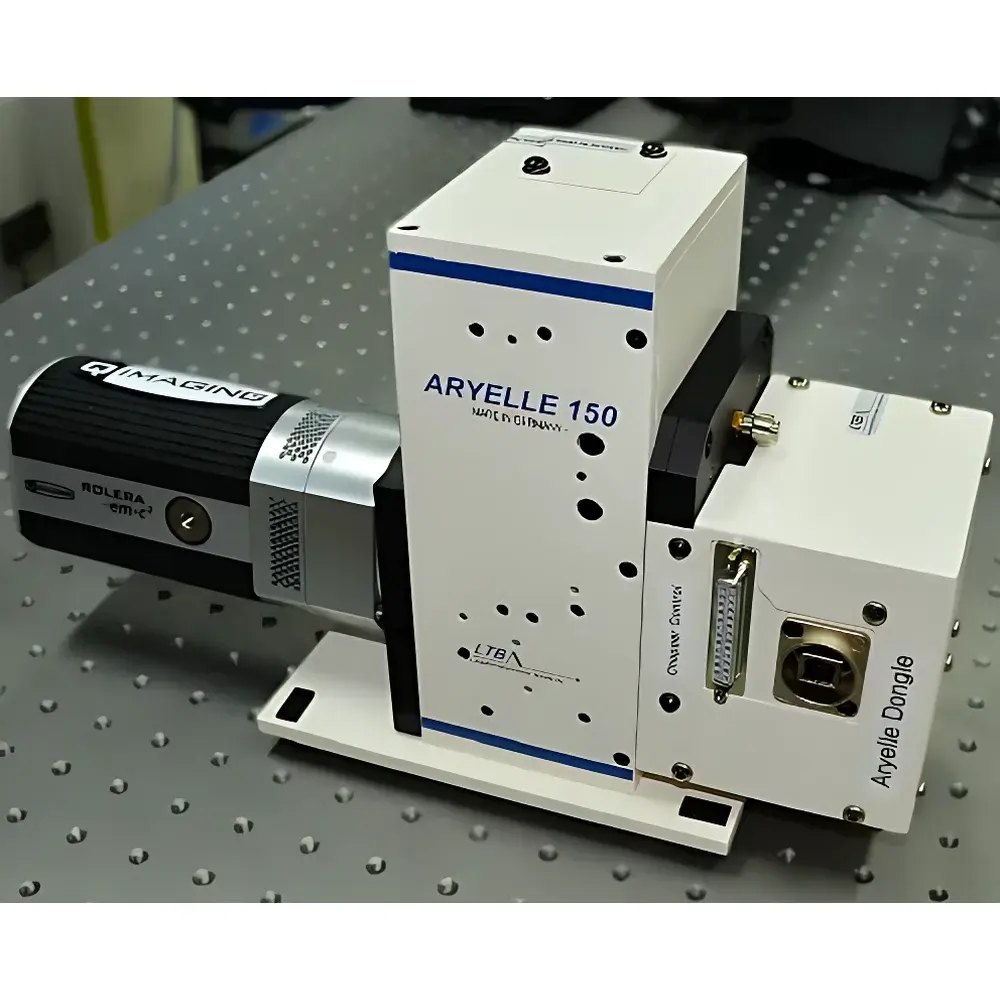
LTB ARYELLE150 Laser-Induced Breakdown Spectroscopy (LIBS) Spectrometer
| Brand | LTB |
|---|---|
| Origin | Germany |
| Model | ARYELLE150 |
| Instrument Type | Benchtop |
| Integration | Integrated |
| Laser Energy Range | 5 mJ – 850 mJ |
| Spectral Resolution (λ/Δλ) | 6,000 – 15,000 |
| Wavelength Coverage (Single Acquisition, No Scanning) | 200–600 nm (configurable options: 220–800 nm, 200–590 nm, 230–548 nm) |
| Slit Width | 35 µm (customizable) |
| Spectral Sampling Rate | Up to 30 spectra/s |
| Detector Interface | Fiber-coupled (SMA) or free-space |
| Calibration Source | Integrated Hg lamp with automated wavelength recalibration |
| Spectral Accuracy | Better than 1/4 of spectral resolution |
| Detector Options | EMCCD (1004 × 1002, 8 × 8 µm pixels), Scientific Cooled CCD or ICCD (application-dependent) |
| Dark Current | 0.06 e⁻/pixel/sec (@ −50 °C) |
| Full Well Capacity | 32,700 e⁻ (linear) |
| Max EMCCD Gain | 4000 |
| Timing Resolution (LIBS gating) | 100 ns minimum step width |
| NIST Emission Database Integration | Yes |
| Automatic Spectral Line Identification | Yes |
Overview
The LTB ARYELLE150 is a compact, high-performance echelle spectrometer engineered specifically for time-resolved, broadband optical emission spectroscopy in laser-induced breakdown spectroscopy (LIBS) and Raman applications. Operating on the principle of crossed-beam echelle dispersion—where a coarse echelle grating provides primary dispersion and a prism enables secondary cross-dispersion—the ARYELLE150 delivers simultaneous UV-VIS-NIR spectral acquisition without mechanical scanning. Its 150 mm focal length, f/7 aperture, and optimized optical train yield exceptional imaging quality and photon throughput across a single-shot spectral range of 200–600 nm (with optional configurations extending to 220–800 nm). Designed for industrial and laboratory environments requiring robustness, portability (<2 kg, 210 × 120 × 85 mm³), and rapid spectral turnaround, the ARYELLE150 supports real-time elemental analysis via plasma emission detection following nanosecond-laser ablation. Its modular architecture allows seamless integration with external Nd:YAG or excimer lasers (5–850 mJ pulse energy), gated detectors, and fiber-optic delivery systems—making it suitable for in-line process monitoring, scrap sorting, alloy verification, and geological sample screening.
Key Features
- Ultra-compact echelle design: 210 × 120 × 85 mm³ footprint, <2 kg mass—ideal for mobile LIBS platforms and space-constrained setups.
- Simultaneous broadband detection: No wavelength scanning required; full spectrum captured in one exposure (e.g., 200–600 nm, gap-free).
- High practical resolving power: λ/Δλ = 6,000–15,000 (at 35 µm slit width); peak resolution down to 16 pm @ 230 nm.
- Flexible detector compatibility: Optimized for 8 × 8 mm² active area sensors—including scientific-grade cooled CCDs, ICCDs, and low-noise EMCCDs (1004 × 1002 pixels, 8 × 8 µm).
- Sub-microsecond temporal gating: Synchronized LIBS timing control with 100 ns minimum gate width for plasma evolution studies.
- Onboard calibration infrastructure: Integrated mercury vapor lamp and software-controlled shutter enable automated wavelength recalibration prior to each measurement sequence.
- Fiber-optic or free-space input: SMA-905 interface standard; optional collimator mounts for direct beam coupling.
Sample Compatibility & Compliance
The ARYELLE150 is compatible with solid, liquid, and aerosol samples when coupled with appropriate LIBS ablation optics and sample chambers. It meets core requirements for ISO/IEC 17025-accredited laboratories performing elemental composition analysis, supporting traceable calibration via NIST-traceable emission standards. While the spectrometer itself is not an analytical instrument per se, its optical performance and stability enable compliance with ASTM E2926 (Standard Test Method for Determination of Elements in Solid Samples by LIBS) and ASTM E3125 (Standard Guide for LIBS Analysis of Metals). When integrated into GMP-regulated manufacturing lines (e.g., pharmaceutical excipient verification or battery cathode material QA), the system supports audit-ready data logging—including timestamped spectra, calibration logs, and detector gain settings—when paired with compliant third-party acquisition software adhering to FDA 21 CFR Part 11 electronic record requirements.
Software & Data Management
LTB provides native acquisition and analysis software featuring real-time spectral preview, automated background subtraction, and intensity normalization. The software embeds the NIST Atomic Spectra Database (ASD) v2023, enabling automatic identification of atomic and ionic emission lines across >70 elements. Spectral matching employs least-squares fitting with user-adjustable confidence thresholds and interference masking. Export formats include ASCII (.txt), HDF5, and industry-standard JCAMP-DX for long-term archival and cross-platform interoperability. Raw spectral data retains full metadata (wavelength calibration coefficients, slit width, integration time, detector temperature, gain setting), ensuring reproducibility and traceability. Optional API access (C/C++, Python) permits integration into custom MES or SCADA environments for closed-loop process control.
Applications
- Laser-Induced Breakdown Spectroscopy (LIBS): Quantitative and semi-quantitative elemental analysis of metals, soils, polymers, and ceramics.
- Raman spectroscopy: High-throughput fingerprinting of molecular vibrations when used with notch-filtered excitation sources.
- Plasma diagnostics: Time-resolved study of electron temperature and density via Boltzmann plot and Stark broadening analysis.
- Process analytical technology (PAT): Real-time composition monitoring in metal recycling, additive manufacturing powder bed QC, and cement raw mix control.
- Absorption and emission spectroscopy: Gas-phase species detection (e.g., NO, OH radicals) in combustion research and environmental monitoring.
FAQ
What detector types are supported by the ARYELLE150?
The spectrometer is optimized for EMCCD (1004 × 1002, 8 × 8 µm), scientific cooled CCD, and ICCD detectors with 8 × 8 mm² active area. Detector selection depends on application-specific needs for sensitivity, gating speed, and dark current tolerance.
Does the ARYELLE150 require external calibration sources?
No—it includes an integrated mercury calibration lamp and motorized shutter, enabling fully automated wavelength recalibration within the software environment.
Can the ARYELLE150 resolve adjacent emission lines from transition metals (e.g., Fe I at 238.204 nm and Cr I at 238.209 nm)?
Yes—its practical resolution of up to λ/Δλ = 15,000 (≈16 pm @ 230 nm) enables separation of these lines under optimal slit and detector conditions.
Is the system compliant with FDA 21 CFR Part 11 for regulated environments?
The hardware and firmware support audit trails and electronic signatures when deployed with validated third-party acquisition software meeting Part 11 requirements; LTB provides documentation packages for IQ/OQ validation support.
What is the maximum spectral acquisition rate in LIBS mode?
Up to 30 full-spectrum acquisitions per second, limited by detector readout speed and system cooling capacity—achievable with EMCCD readout optimization and binning.
Related Products





