
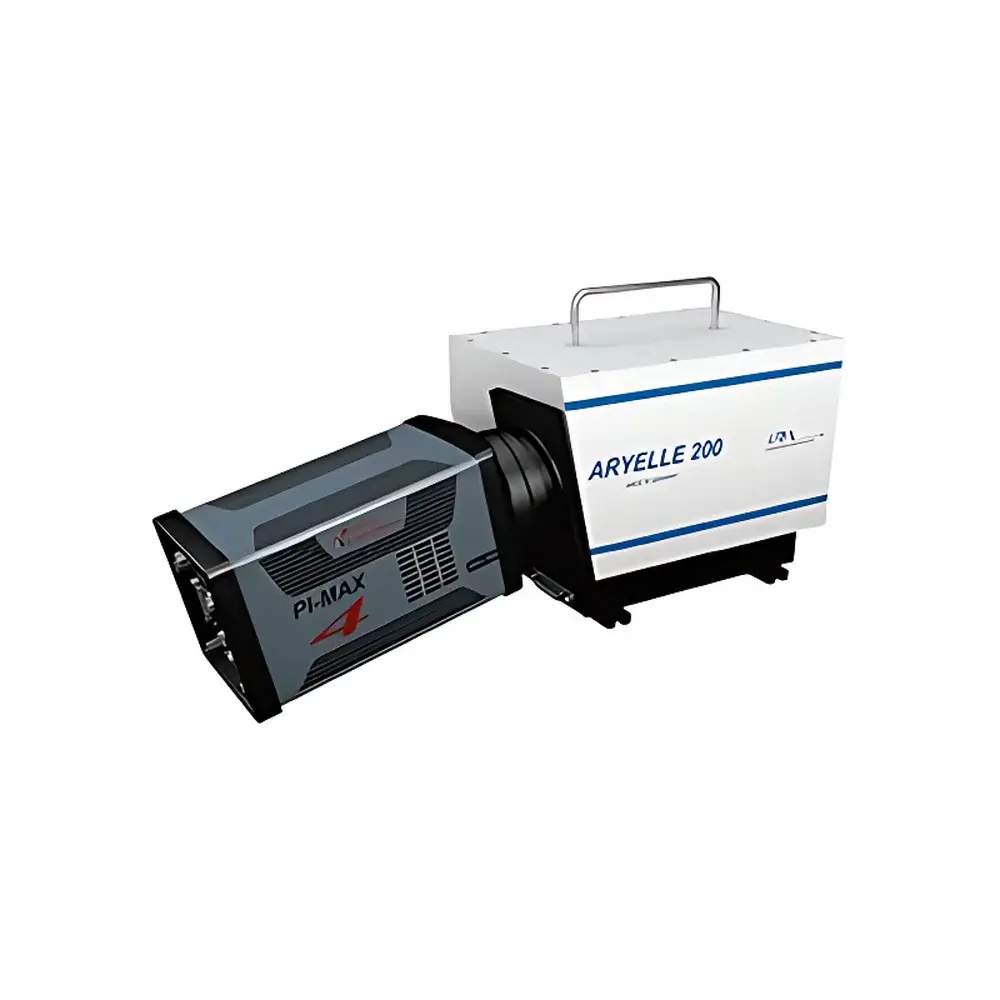
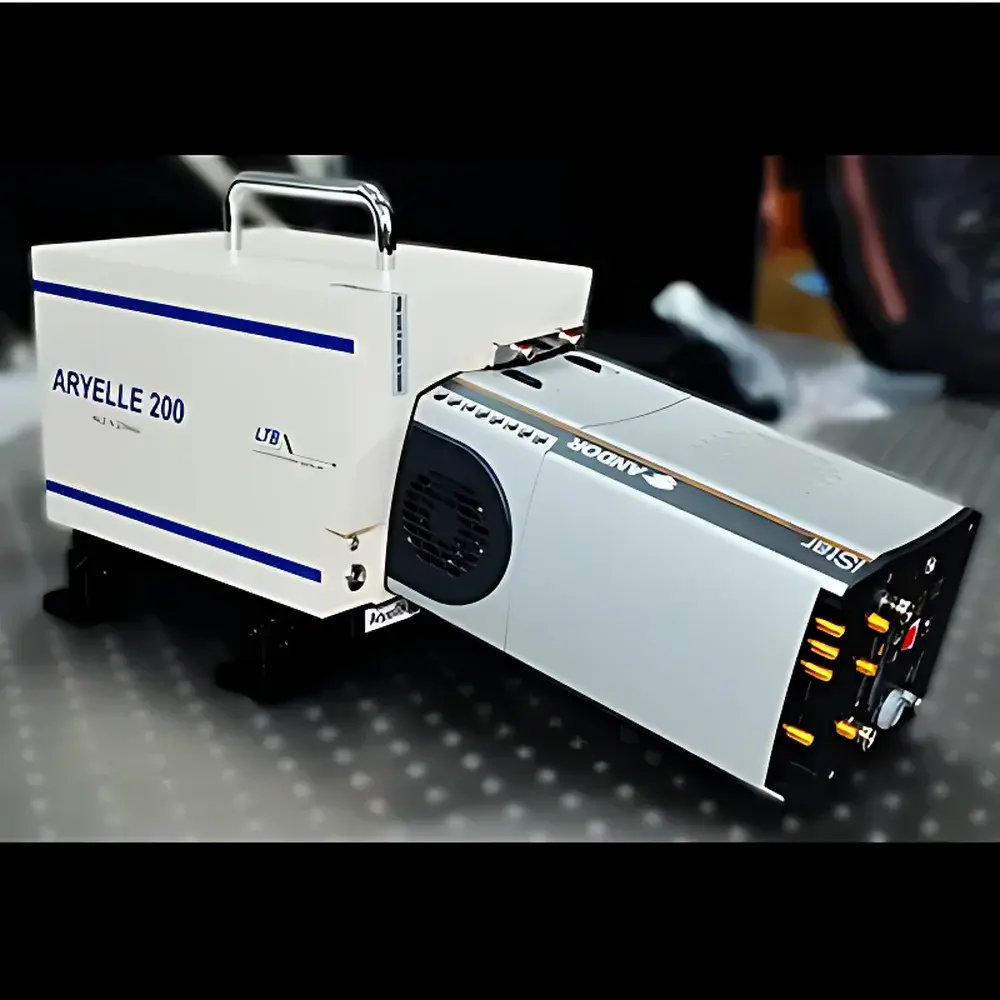
LTB ARYELLE200 Laser-Induced Breakdown Spectroscopy (LIBS) Spectrometer
| Brand | LTB |
|---|---|
| Origin | Germany |
| Model | ARYELLE200 |
| Instrument Type | Benchtop |
| Integration | Fully Integrated |
| Laser Energy Range | 5 mJ – 850 mJ |
| Spectral Resolution (λ/Δλ) | 7,000 – 20,000 (practical) |
| Wavelength Coverage (single-shot, gap-free) | 200–750 nm (configurable options: 192–594 nm, 225–574 nm, 200–900 nm, 250–950 nm) |
| Slit Width | 45 µm (optional widths available) |
| Detector Interface | SMA fiber coupling or free-space input |
| Spectral Sampling Rate | Up to 30 spectra/s |
| Detector Options | ICCD (1024 × 1024, 13 × 13 µm pixels), scientific cooled CCD/EMCCD/EMICCD |
| Minimum ICCD Gate Width | 5 ns (optional down to 0.5 ns) |
| ICCD Max Relative Gain | 1000 |
| Dark Noise | 0.2 e⁻/pixel/sec |
| Full Well Capacity | 100,000 e⁻ |
| Calibration Source | Internal Hg lamp with automated software-driven recalibration |
| NIST Emission Database Integration | Yes |
| Automatic Line Identification | Yes |
Overview
The LTB ARYELLE200 is a benchtop, fully integrated echelle spectrometer engineered for high-resolution, broadband optical emission spectroscopy in demanding analytical environments. It operates on the principle of laser-induced breakdown spectroscopy (LIBS), where a pulsed laser ablates a micro-volume of sample material, generating a transient plasma whose emitted light is dispersed and resolved by the echelle grating optics. The instrument combines a 200 mm focal length f/10 optical design with a high-dispersion echelle grating and prism cross-disperser to achieve true simultaneous spectral acquisition across ultraviolet (UV), visible (VIS), and near-infrared (NIR) regions—without mechanical scanning or wavelength gaps. Its compact, thermally stable monolithic housing minimizes drift and ensures long-term calibration integrity, making it suitable for both laboratory research and industrial process monitoring applications requiring elemental fingerprinting at ppm-level sensitivity.
Key Features
- Simultaneous, gap-free spectral coverage from 200 nm to 750 nm (extendable to 192–950 nm via optional configurations), enabling full elemental line detection in a single laser shot.
- Practical spectral resolving power of λ/Δλ = 7,000–20,000 (corresponding to 25–94 pm resolution at 8,000; highest practical resolution: 11.5 pm at 225 nm), validated against NIST-traceable emission standards.
- Modular detector compatibility: supports intensified CCD (ICCD) with sub-5 ns gate control (down to 0.5 ns optional), scientific-grade cooled CCD, EMCCD, and EMICCD sensors—all optimized for the 13 × 13 mm² active area.
- Fiber-coupled (SMA) or free-space optical input, facilitating flexible integration with LIBS, Raman, or absorption spectroscopy setups.
- Onboard mercury lamp and automated software-based wavelength recalibration ensure traceable, repeatable spectral alignment without external reference sources.
- Real-time spectral acquisition at up to 30 full-frame spectra per second, supporting dynamic process monitoring and high-throughput sample screening.
Sample Compatibility & Compliance
The ARYELLE200 accommodates solid, liquid, and powdered samples via standard LIBS ablation geometries—including open-air, controlled-atmosphere, and vacuum-compatible chambers. Its non-contact, micro-destructive analysis requires no sample preparation for conductive or insulating materials, including metals, alloys, ceramics, polymers, geological matrices, and biological tissues. The system complies with ISO/IEC 17025 requirements for analytical instrument validation and supports audit-ready documentation workflows. When deployed in regulated environments (e.g., pharmaceutical raw material verification or aerospace alloy certification), its firmware and software architecture are compatible with GLP/GMP-aligned data integrity practices, including electronic signatures, audit trails, and 21 CFR Part 11–compliant user access controls (when integrated with validated LIMS or ELN platforms).
Software & Data Management
The included spectroscopy suite provides native integration with the NIST Atomic Spectra Database (ASD), enabling automatic identification of elemental emission lines based on intensity-weighted matching against >200,000 certified transitions. Spectral preprocessing includes dark-current subtraction, flat-field correction, cosmic-ray rejection, and wavelength-pixel mapping refinement. Quantitative analysis modules support univariate and multivariate calibration (e.g., PLS, PCA), limit-of-detection estimation, and matrix-matched standardization. All raw and processed data are stored in vendor-neutral HDF5 format, ensuring interoperability with Python (SciPy, Astropy), MATLAB, and third-party chemometric tools. Software updates are delivered via secure, version-controlled repositories with full revision history and release notes compliant with IEC 62304 for medical device software lifecycle management.
Applications
- Industrial LIBS for real-time elemental composition analysis of metal alloys during scrap sorting, foundry feedstock verification, and additive manufacturing powder certification.
- In-line process monitoring of coating thickness, dopant uniformity, and contamination levels in semiconductor wafer fabrication and photovoltaic cell production.
- Forensic and archaeological material provenancing using trace-element ratio profiling (e.g., Sr/Ca, Pb isotopes via high-resolution line-shape deconvolution).
- Environmental soil and water analysis for heavy-metal speciation (e.g., Cr(VI) vs. Cr(III)) when coupled with selective laser excitation protocols.
- Research-grade Raman-LIBS hybrid measurements enabled by shared optical path and synchronized detector gating, allowing concurrent molecular vibrational and atomic emission detection.
FAQ
What is the minimum detectable concentration for common elements using ARYELLE200 in LIBS mode?
Detection limits vary by element, matrix, and laser parameters; typical values range from 1–50 ppm for metallic elements in homogeneous solids under optimized ablation conditions (e.g., 100 mJ, Q-switched Nd:YAG at 1064 nm).
Can the ARYELLE200 be used for time-resolved plasma diagnostics?
Yes—the ICCD detector supports gate widths as low as 0.5 ns, enabling temporal resolution of plasma evolution stages (breakdown, continuum decay, ionic/atomic line emergence) with sub-nanosecond precision.
Is spectral recalibration required between measurement sessions?
No—automated recalibration using the internal Hg lamp occurs before each acquisition sequence, maintaining wavelength accuracy within ±0.05 pixels (≤1/4 of the instrument’s practical resolution) over 8-hour operational periods.
Does the system support remote operation and integration into factory automation networks?
Yes—Ethernet-based TCP/IP communication protocol, SCPI command set, and OPC UA interface options enable seamless integration into Industry 4.0 architectures and centralized supervisory control systems.
Are custom spectral ranges or detector configurations available?
Yes—LTB offers application-specific configurations including UV-enhanced coatings, deep-cooled EMCCD variants, and extended-NIR modules (up to 1100 nm), all validated per ISO 14644 cleanroom assembly protocols.



