
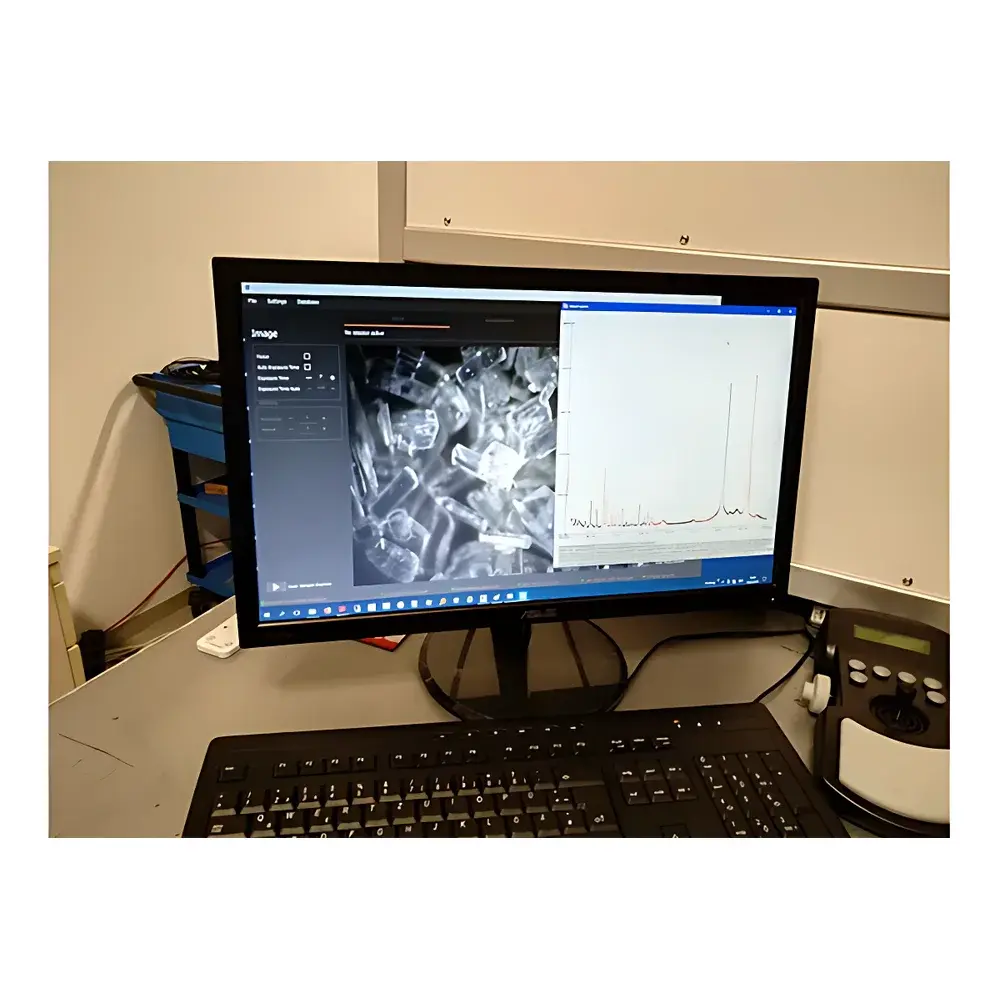
LTB CORALIS Combined Raman and LIBS Spectroscopy System
| Brand | LTB |
|---|---|
| Origin | Germany |
| Model | CORALIS |
| Instrument Type | Benchtop |
| Integration | Fully Integrated Dual-Modal Platform |
| LIBS Laser Energy | Up to 50 mJ (1064 nm, optionally 532 nm or 266 nm) |
| Raman Laser Power | Up to 50 mW (532 nm and 785 nm) |
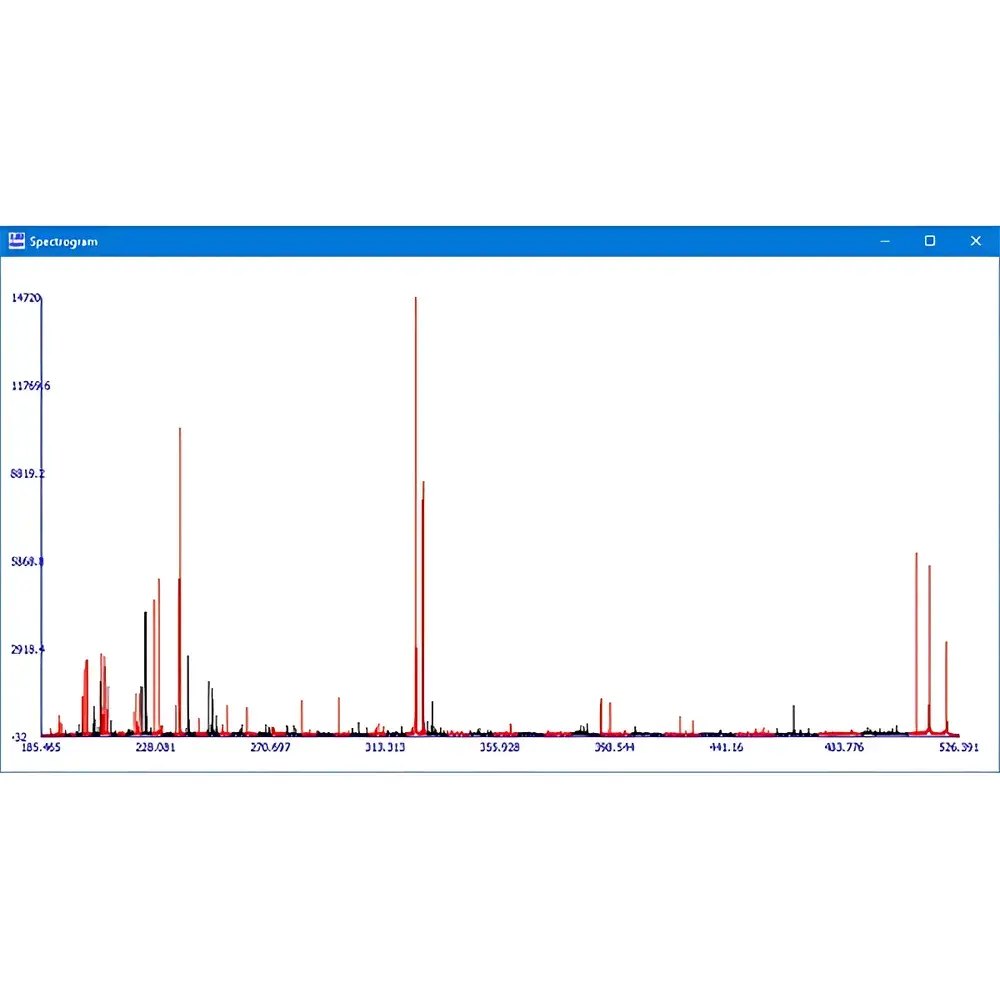
| Spectral Coverage (LIBS) | 190–520 nm (scan-free) |
| Spectral Resolution (LIBS) | 0.013–0.035 nm |
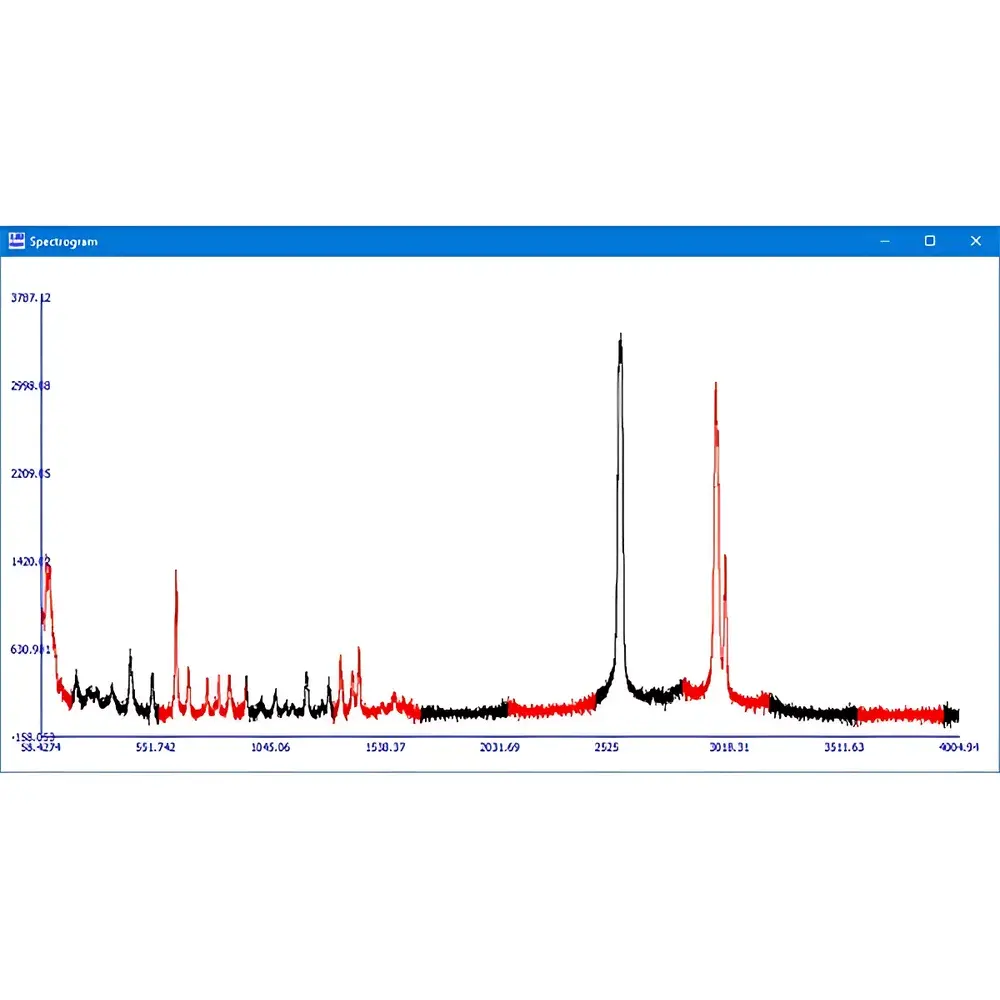
| Spectral Coverage (Raman) | 530–950 nm (up to 6000 cm⁻¹) |
| Spectral Resolution (Raman) | 2.5–2.0 cm⁻¹ (532 nm), 1.7–1.4 cm⁻¹ (785 nm) |
| XYZ Stage Travel | X=50 mm, Y=50 mm, Z=35 mm |
| Positioning Accuracy & Repeatability | 1 µm |
| Macro Imaging Field | 28 × 19 mm (10×) |
| Micro Imaging Field | 3.5 × 2.5 mm (80×) |
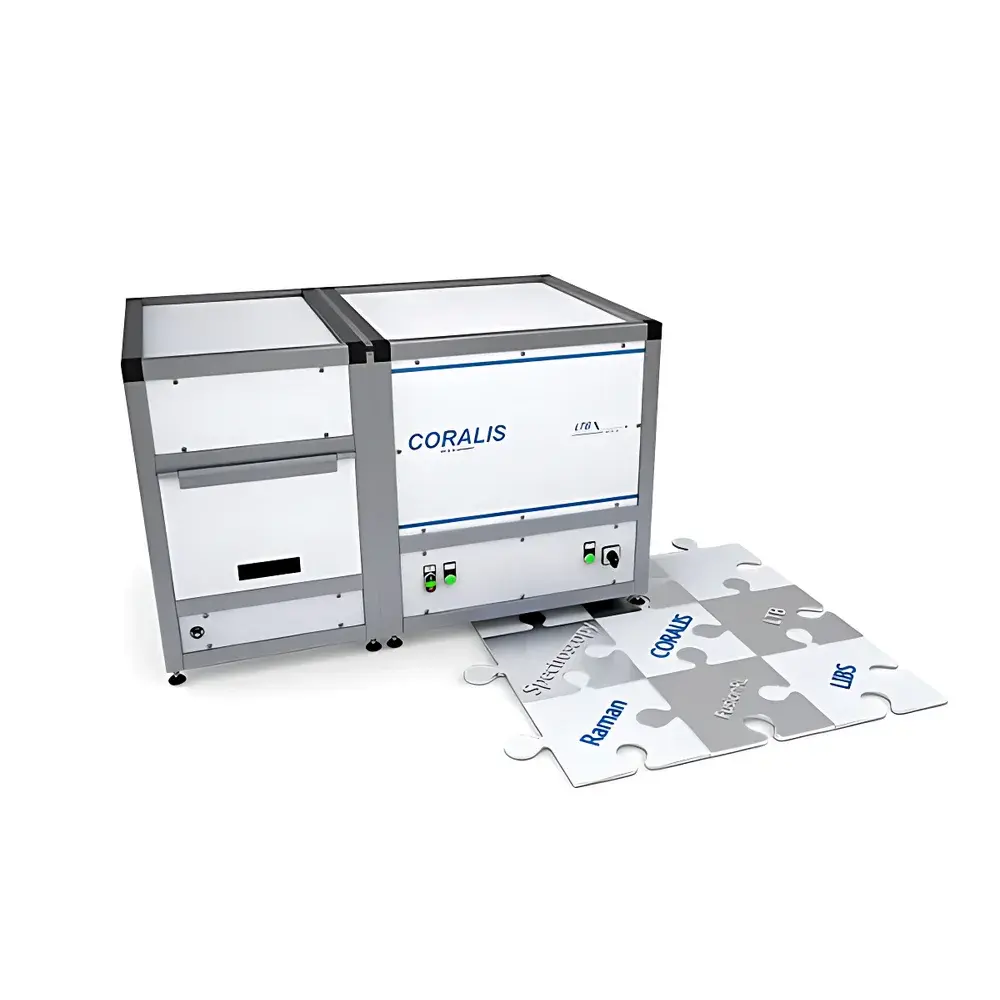
| Dimensions | 1200 × 750 × 750 mm |
| Laser Safety Class | Class 1 |
| Software | FusionRL CORALIS |
Overview
The LTB CORALIS Combined Raman and LIBS Spectroscopy System is a fully integrated benchtop platform engineered for simultaneous and sequential micro-analytical characterization of solid and liquid samples using two complementary optical spectroscopic techniques: Laser-Induced Breakdown Spectroscopy (LIBS) and Raman spectroscopy. Unlike hybrid systems relying on external coupling or manual reconfiguration, CORALIS employs a patented dual-wing optical architecture centered on two high-throughput, scan-free echelle spectrometers—each optimized for its respective modality. This design enables true single-shot, high-resolution LIBS elemental analysis with sub-10 µm spatial resolution, alongside non-destructive, high-sensitivity Raman molecular fingerprinting at the same measurement location. The system operates under Class 1 laser safety certification, incorporating interlocked enclosures and automatic beam gating to ensure operational compliance without compromising analytical flexibility.
Key Features
- Patented dual-echelle spectrometer architecture enabling concurrent spectral acquisition across 190–520 nm (LIBS) and 530–950 nm (Raman), with no moving parts or mechanical scanning.
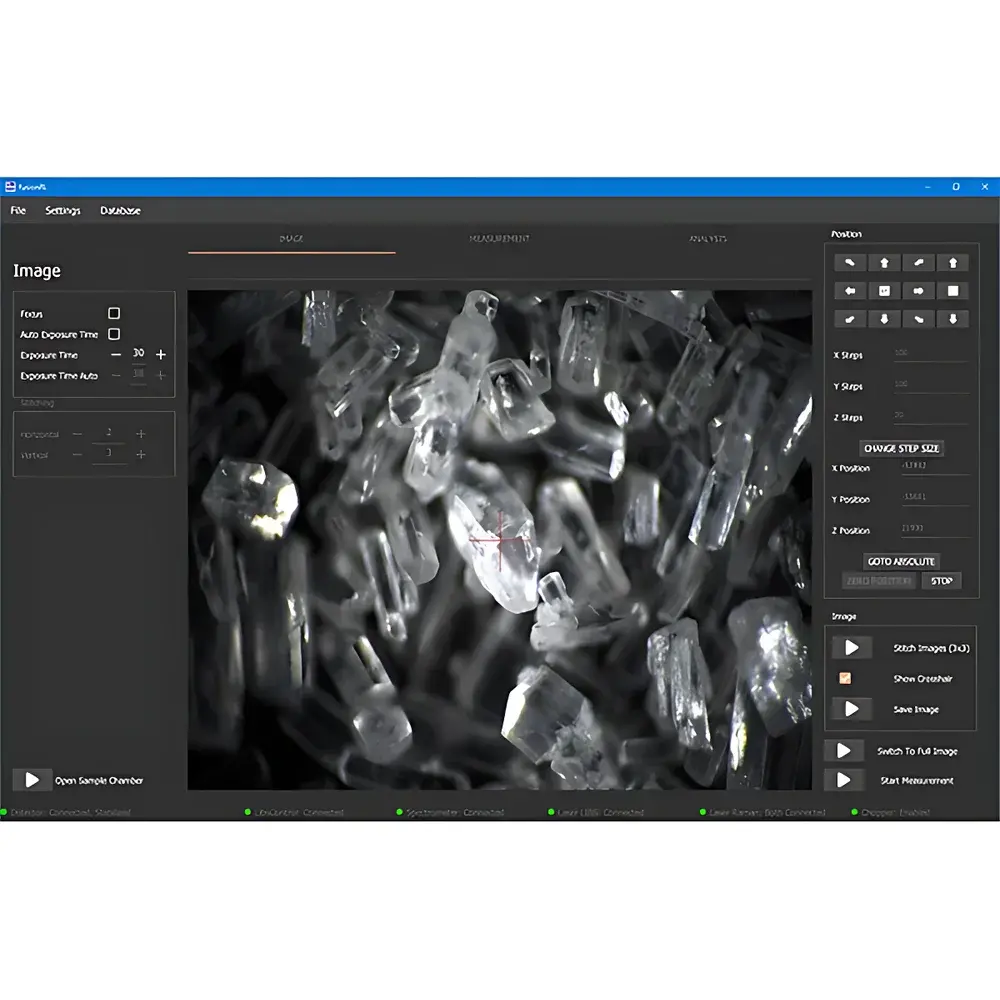
- Sub-micrometer precision XYZ motorized stage (50 × 50 × 35 mm travel; 1 µm accuracy/repeatability) coupled with dual-magnification sample imaging: macro overview (28 × 19 mm, 10×) and micro-detail (3.5 × 2.5 mm, 80×).
- Dual-wavelength Raman excitation (532 nm and 785 nm), each configurable up to 50 mW output, with optimized spectral resolution of 2.0–2.5 cm⁻¹ (532 nm) and 1.4–1.7 cm⁻¹ (785 nm) across up to 6000 cm⁻¹ shift range.
- Multi-wavelength LIBS laser source (1064 nm base, optional 532 nm/266 nm), delivering up to 50 mJ pulse energy with real-time pulse monitoring and energy stabilization.
- Automated focus optimization via integrated autofocus algorithm, enabling consistent signal acquisition across heterogeneous or topographically variable samples.
- Class 1 laser enclosure with hardware-enforced interlock circuitry, eliminating need for external laser safety infrastructure while maintaining full accessibility during alignment and calibration.
Sample Compatibility & Compliance
CORALIS supports direct analysis of conductive and non-conductive solids—including metals, ceramics, geological specimens, battery electrodes, thin films, gemstones, and archaeological artifacts—as well as liquid samples in sealed cuvettes or on dried filter substrates. No vacuum or inert gas purging is required for standard operation, though optional purge modules are available for oxygen-sensitive measurements. The system conforms to IEC 60825-1:2014 (laser safety), ISO/IEC 17025:2017 (testing laboratory competence), and supports audit-ready data integrity workflows aligned with FDA 21 CFR Part 11 requirements when used with validated FusionRL software configurations. All calibration standards—including NIST-traceable LIBS and Raman reference materials—are supplied with certified uncertainty statements and metrological traceability documentation.
Software & Data Management
FusionRL CORALIS is a modular, scriptable software suite designed for both routine operation and advanced research workflows. It provides native support for single-point acquisition, multi-ROI mapping, depth profiling, particle-by-particle analysis, and layer-resolved spectral reconstruction. Preprocessing tools include adaptive baseline correction (Asymmetric Least Squares), intensity normalization (internal standard or total area), cosmic ray removal, and spectral deconvolution. Quantitative analysis leverages univariate calibration (e.g., internal standardization for LIBS), multivariate regression (PLS, PCA-MLR), and supervised classification (SVM, Random Forest) trained on user-defined or vendor-provided spectral libraries. All raw and processed data are stored in HDF5 format with embedded metadata (instrument parameters, stage coordinates, laser settings, environmental conditions), ensuring full FAIR (Findable, Accessible, Interoperable, Reusable) compliance. Audit trails, electronic signatures, and role-based access control are available under GxP-compliant deployment modes.
Applications
- Environmental monitoring: elemental and molecular speciation of atmospheric particulates collected on filters, including heavy metal quantification and organic functional group identification.
- Energy materials research: depth-resolved compositional mapping of Li-ion battery cathodes/anodes, detection of SEI layer chemistry, and degradation product identification.
- Geoscience and mineralogy: rapid phase identification in heterogeneous rock sections, trace element distribution in zoned crystals, and fluid inclusion characterization.
- Cultural heritage and archaeology: micro-destructive pigment analysis, corrosion layer stratigraphy, and provenance determination of ceramics and glass without sampling.
- Industrial quality control: coating thickness verification, contaminant identification on semiconductor wafers, and polymer additive distribution analysis.
- Jewelry and gemology: non-invasive identification of natural vs. synthetic stones, treatment detection (e.g., beryllium diffusion), and inclusion mapping at micron-scale resolution.
FAQ
Can CORALIS perform truly simultaneous LIBS and Raman acquisition?
Yes—its dual-echelle optical path and synchronized timing electronics allow concurrent spectral capture from both modalities within a single laser pulse sequence, preserving spatial registration at the sub-10 µm level.
Is vacuum or inert gas required for LIBS analysis?
No. Standard operation is performed in ambient air. Optional nitrogen or argon purge modules are available to enhance signal-to-noise ratio for specific elements (e.g., C, N, O) or suppress oxide formation in metallic samples.
How does FusionRL handle spectral library matching for unknown samples?
It employs hierarchical search protocols combining correlation-based pattern matching (for Raman) and peak-intensity-ratio fitting (for LIBS), followed by statistical confidence scoring and false-discovery rate estimation based on spectral residual analysis.
What level of spectral calibration stability is maintained over time?
Echelle grating alignment is thermally stabilized and mechanically decoupled from stage motion; wavelength calibration drift is less than ±0.002 nm over 8 hours under controlled lab conditions, verified daily via onboard Hg/Ne lamp reference.
Can CORALIS be integrated into automated production line environments?
Yes—the system supports Ethernet/IP and OPC UA communication protocols, offers programmable API access (Python/C++ SDK), and complies with SEMI E10/E127 standards for semiconductor equipment integration.




