
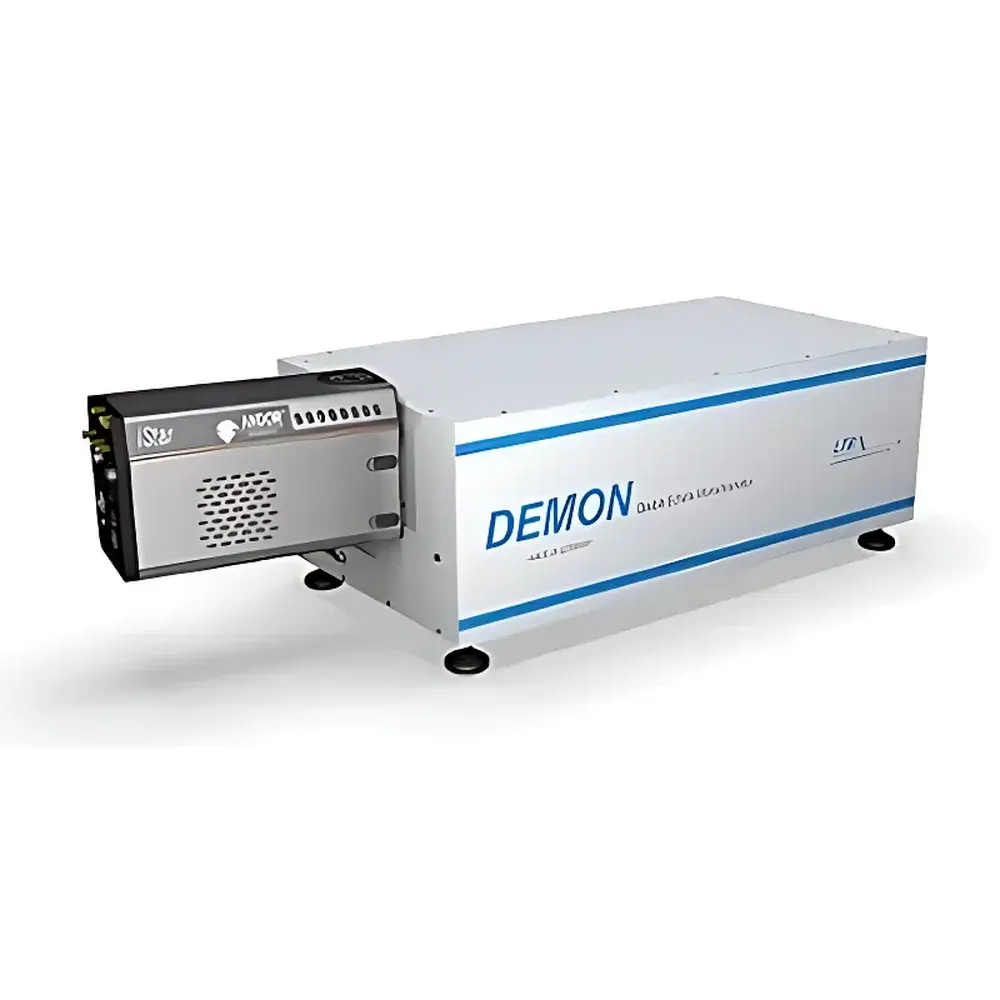
LTB DEMON Series Laser-Induced Breakdown Spectroscopy (LIBS) Echelle Spectrometer
| Brand | LTB |
|---|---|
| Origin | Germany |
| Model | DEMON Series |
| Instrument Type | Benchtop |
| Integration | Integrated |
| Laser Energy Range | 5 mJ – 850 mJ |
| Wavelength Range | 175–1100 nm (configurable) |
| Spectral Resolution | down to 1.34 pm @ 200 nm |
| Spectral Resolving Power | 75,000–200,000 |
| Linear Dispersion | λ/225,000 |
| Absolute Wavelength Accuracy | ±0.25 pm (after auto-calibration) |
| Stray Light Level | <10⁻⁶ |
| Detector Compatibility | Scientific CCD, ICCD, EMCCD, EMICCD |
| Slit Control | Motorized |
| Shutter | Integrated Mechanical |
| Exposure Time | 1 ms (CCD), 5 ns / 2 ns (ICCD) |
| Interface | Full PC-based motorized control |
| Dimensions (L×W×H) | 750 × 310 × 230 mm |
| Weight | 25 kg |
| Software | Sophi (with embedded NIST spectral database), LabVIEW driver optional |
Overview
The LTB DEMON Series is a high-throughput, ultra-high-resolution echelle spectrometer engineered specifically for laser-induced breakdown spectroscopy (LIBS) and other time-resolved plasma emission applications. Based on a patented Littrow-mounted dual-grating optical architecture—combining a pre-monochromator prism stage with an echelle grating dispersion path—the DEMON achieves exceptional spectral fidelity across the deep-ultraviolet to near-infrared range (175–1100 nm). Its optical design integrates high-reflectivity, imaging-optimized off-axis parabolic mirrors and UV-enhanced coatings, enabling sub-picometer spectral resolution (down to 1.34 pm at 200 nm) and ultra-low stray light (<10⁻⁶), critical for detecting weak atomic/ionic lines in complex multi-element plasmas. An integrated mercury calibration lamp and fully automated wavelength stabilization routine ensure long-term absolute wavelength accuracy better than ±0.25 pm—essential for isotopic shift analysis, trace element quantification, and inter-laboratory reproducibility under GLP or ISO/IEC 17025 frameworks.
Key Features
- Ultra-high resolving power of 75,000–200,000 (λ/Δλ), validated by physical line separation—not pixel interpolation
- Littrow-configured echelle monochromator with active wavelength stabilization via internal Hg reference source
- Optimized optical throughput: f/10 relative aperture with minimal vignetting across full spectral range
- Motorized slit adjustment and integrated mechanical shutter for precise temporal gating in LIBS decay studies
- Native compatibility with time-gated ICCDs (2 ns gate width), EMCCDs, and scientific-grade CCDs
- UV-optimized coupling options: solar-blind DUV mirror optics (down to 175 nm) or quartz-core UV-grade fiber
- Fully automated PC-controlled operation—including grating positioning, focus calibration, and spectral stitching
Sample Compatibility & Compliance
The DEMON spectrometer supports direct coupling to commercial and custom LIBS ablation chambers, ICP sources, laser-produced plasma (LPP) targets, and hollow-cathode lamps. Its wide dynamic range (16-bit digitization), low-noise detection architecture, and calibrated spectral response facilitate quantitative elemental analysis per ASTM E2926 (Standard Test Method for Analysis of Metals by Spark-OES) and ISO 11577 (Laser-induced breakdown spectroscopy for solid materials). The system’s passive thermal stability and rigid aluminum alloy chassis meet vibration and thermal drift requirements for ISO 17025-accredited laboratories. Optional 21 CFR Part 11-compliant audit trail logging is available through Sophi software configuration for regulated QC environments.
Software & Data Management
Sophi software provides turnkey acquisition, real-time spectral visualization, and advanced post-processing—including peak deconvolution, background subtraction, and multivariate curve resolution (MCR). The built-in NIST Atomic Spectra Database enables automatic line identification for >80 elements across ionization states (I–IV). Batch processing supports time-resolved LIBS decay fitting (e.g., plasma electron temperature and density extraction via Boltzmann plot or Stark broadening analysis). Export formats include ASCII, HDF5, and mzML-compatible metadata tagging. LabVIEW drivers and Python API (via PyVISA) enable integration into custom automation sequences for high-throughput screening or inline process monitoring.
Applications
- Quantitative and semi-quantitative elemental analysis of conductive/non-conductive solids (metals, ceramics, polymers, geological samples)
- Isotopic ratio determination in nuclear safeguards and geochemical tracing (e.g., ²³⁵U/²³⁸U, ¹⁰B/¹¹B)
- Time-resolved plasma diagnostics: electron temperature (Te), electron number density (ne), and excitation kinetics
- High-resolution absorption spectroscopy of transient molecular species in combustion or catalytic reaction zones
- Spectral characterization of narrow-linewidth semiconductor lasers, DPSS lasers, and frequency-doubled sources
- Standoff LIBS for hazardous environment monitoring (e.g., nuclear decommissioning, space exploration simulators)
FAQ
What spectral calibration standards are supported?
The DEMON includes an integrated Hg lamp for daily auto-calibration; external Ne, Ar, or Kr lamps can be coupled via fiber for extended-range validation per ISO 17025 calibration protocols.
Can the DEMON operate in vacuum or purged environments?
Yes—optional UV-transmissive purge ports and vacuum-compatible flange adapters (CF-35 or KF-40) are available for operation below 10⁻² mbar, enabling oxygen-sensitive DUV measurements down to 175 nm.
Is spectral stitching across orders fully automated?
Yes—Sophi performs real-time order alignment using overlapping reference lines and applies pixel-wise intensity correction based on grating efficiency maps.
How is detector synchronization handled for time-gated LIBS?
The spectrometer’s TTL-trigger interface synchronizes with ICCD gate delay generators (e.g., Stanford DG535) with jitter <100 ps; gate width and delay are programmable within Sophi.
Does the system support GMP/GLP audit trails?
When configured with Sophi Enterprise Edition, all acquisition parameters, calibration events, user actions, and raw data checksums are logged with timestamped, immutable records compliant with FDA 21 CFR Part 11 requirements.



