
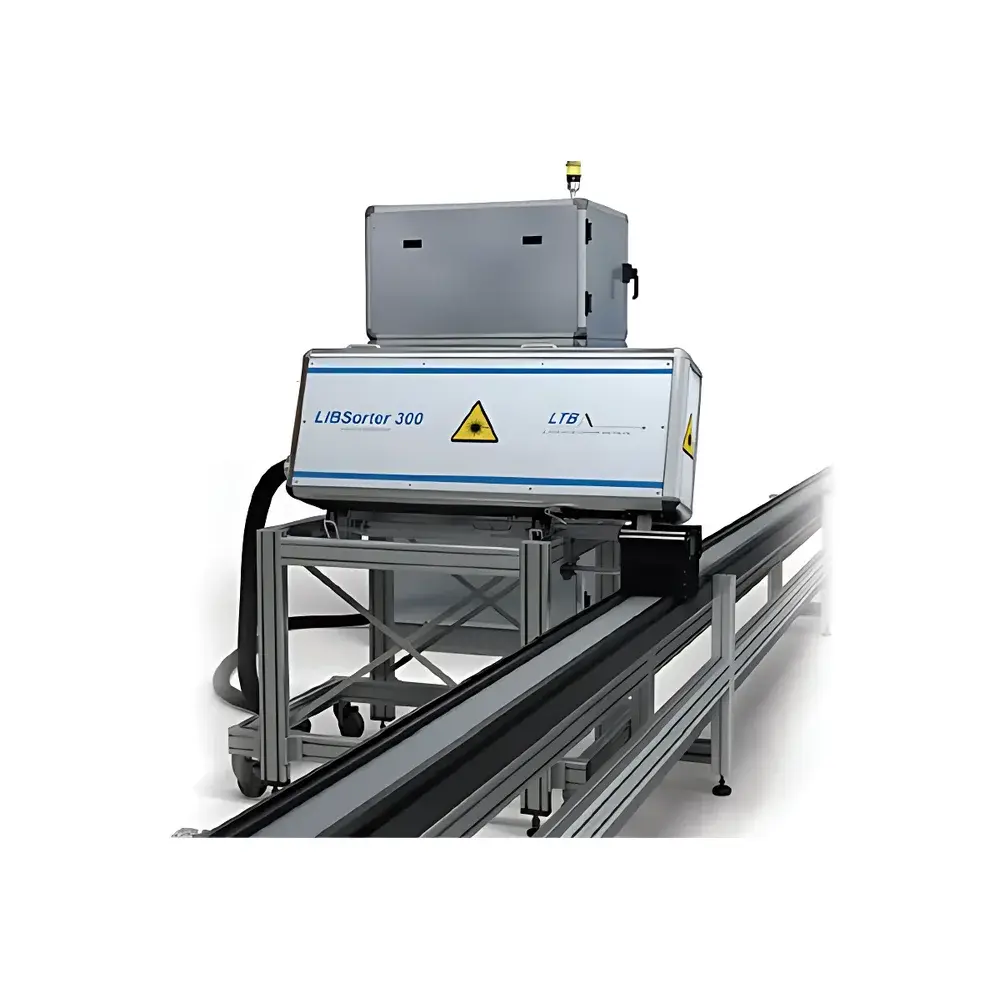
LTB LIBSorter Laser-Induced Breakdown Spectroscopy (LIBS) Metal and Ore Sorting System
| Brand | LTB |
|---|---|
| Origin | Germany |
| Manufacturer Status | Authorized Distributor |
| Origin Category | Imported |
| Model | LTB LIBSorter |
| Instrument Type | Benchtop |
| Integration | Integrated System |
| Laser Energy | 5 mJ – 850 mJ |
Overview
The LTB LIBSorter is a high-performance, industrial-grade Laser-Induced Breakdown Spectroscopy (LIBS) sorting system engineered for real-time, non-contact elemental analysis and automated classification of bulk metallic scrap—particularly unsorted aluminum alloys—in recycling and primary metal processing facilities. Operating on the fundamental principle of LIBS, the system delivers pulsed Nd:YAG laser radiation (1064 nm standard; optional harmonics at 532 nm and 266 nm, including dual-pulse configurations) onto moving material surfaces conveyed via industrial belt systems. This generates transient micro-plasmas (>10,000 K), whose emitted atomic and ionic line spectra are collected and resolved by a high-resolution ARYELLE-series echelle spectrometer. Each element exhibits characteristic spectral “fingerprints” across UV–VIS–NIR ranges (typically 190–900 nm, configurable per application), enabling simultaneous qualitative and semi-quantitative multi-element detection—including Al, Cu, Mg, Si, Fe, Mn, Zn, Sn, Pb, Cr, Ni, and Ag—without sample preparation or physical contact. Designed for integration into continuous 24/7 production lines, the LIBSorter bridges analytical chemistry and industrial automation, delivering actionable compositional data at throughput rates up to 40 samples per second.
Key Features
- Real-time, in-line elemental sorting of mixed metallic scrap streams—optimized for aluminum alloy differentiation (e.g., 1xxx, 3xxx, 5xxx, 6xxx, 7xxx series) and identification of brass, bronze, stainless steel, and cast iron
- Robust optical architecture with ±15 mm depth-of-field tolerance, accommodating variable part geometry and surface topography without mechanical focusing adjustment
- Industrial-grade enclosure rated IP53, featuring sealed housing with active thermal management for stable operation in ambient temperatures from +5 °C to +45 °C and ≤70% non-condensing relative humidity
- Integrated industrial PC running Windows-based control software with script-driven remote access (SSH/Telnet), enabling diagnostics, firmware updates, and parameter reconfiguration without on-site intervention
- Native support for industrial communication protocols: PROFINET, EtherNet/IP, and PLC-compatible digital I/O interfaces for seamless integration with existing conveyor control systems and air-jet sorting stations
- Low-maintenance design with no consumables, minimal calibration drift, and long-lifetime solid-state laser sources—engineered for >10,000 hours of continuous operational duty
Sample Compatibility & Compliance
The LIBSorter accommodates heterogeneous metallic feedstock ranging from shredded fragments (<5 mm) to large castings (up to 300 mm), provided they pass under the optical head within the defined working distance. Surface oxidation, paint, oil films, and light contamination do not preclude reliable classification due to LIBS’ inherent ablation capability. The system complies with CE marking requirements and meets electromagnetic compatibility (EMC) standards per EN 61326-1. While not certified as medical or pharmaceutical equipment, its analytical methodology aligns with ISO 11885 (water analysis), ASTM E2926 (standard guide for LIBS), and supports GLP/GMP-aligned data integrity practices through audit-trail-enabled software logging. Full traceability of spectral acquisitions, classification decisions, and system events is maintained for regulatory review.
Software & Data Management
Control and analysis are executed via LTB’s proprietary SortMaster software suite, which includes a spectral library manager, adaptive classification engine, and real-time decision dashboard. Users define custom alloy classes using reference spectra or certified standards; machine-learning-assisted algorithms continuously refine discrimination boundaries based on accumulated field data. All raw spectra, processed results, timestamps, conveyor position metadata, and sorting actuation signals are stored in structured SQLite or OPC UA-compliant formats. Export options include CSV, XML, and direct database push to MES/SCADA platforms. Software architecture supports 21 CFR Part 11-compliant user authentication, electronic signatures, and immutable audit trails—facilitating validation in regulated environments.
Applications
- Automated separation of post-consumer and post-industrial aluminum scrap for high-purity remelting feedstock preparation
- In-line grade verification of incoming ferrous and non-ferrous scrap at smelters and foundries
- Sorting of copper-bearing alloys (brass, bronze) from zinc- or lead-dominated fractions
- Identification of hazardous elements (e.g., Pb, Cd, Hg) in WEEE and automotive shredder residue (ASR)
- Pre-concentration of critical raw materials (e.g., Co, Ni, rare earths) from complex metallurgical slags and mine tailings
- Quality assurance during secondary metal casting—detecting mischarged alloys prior to melt processing
FAQ
What is the minimum detectable concentration for key alloying elements?
Detection limits vary by element, matrix, and laser parameters; typical values range from 10 ppm to 0.1 wt% for Al, Mg, Si, and Cu in aluminum matrices under optimized conditions.
Can the system be recalibrated for new alloy families after installation?
Yes—users can build, validate, and deploy custom spectral libraries using certified reference materials or representative production samples via the library manager interface.
Is vacuum or inert gas purging required for optimal spectral resolution?
No—operation is performed in ambient air; argon purge is optional for enhanced signal-to-noise ratio in specific high-precision applications.
How is system performance validated over time?
Built-in daily self-check routines monitor laser energy stability, spectrometer wavelength calibration, and detector dark current; NIST-traceable reference samples are recommended for periodic verification.
Does the LIBSorter support integration with robotic pick-and-place units?
Yes—digital I/O and Ethernet-based command protocols enable synchronization with robotic arms, servo-controlled diverters, and multi-stage sorting cascades.





