
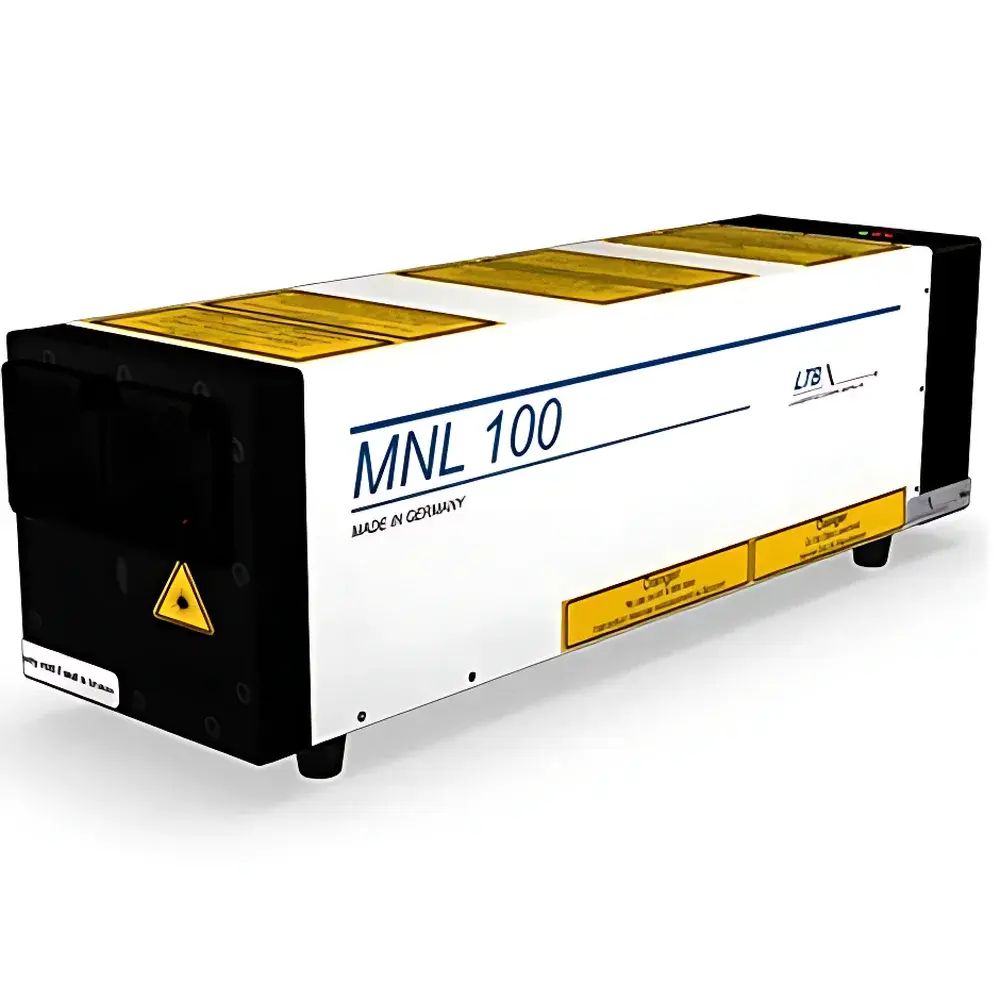
LTB MNL103HP High-Power Sealed Nitrogen Laser
| Brand | LTB |
|---|---|
| Origin | Germany |
| Model | MNL103HP |
| Output Wavelength | 337.1 nm |
| Pulse Energy (typ., after 100M shots) | 225 µJ |
| Pulse Width | 3 ns |
| Max. Repetition Rate | 30 Hz |
| Beam Divergence | 3.5 × 3 mrad (Pulse) / 0.5 × 0.3 mrad (LD-Version) |
| Energy Stability (SD/E) | ≤ 2% |
| Timing Jitter (ext. trigger to optical pulse) | ±2.5 ns |
| Beam Size | 3 × 4 mm² (Pulse) / 4 × 2.5 mm² (LD-Version) |
| Operating Voltage | 220 V AC, no external gas or water cooling required |
| Lifetime Rating | 60M / 120M shots |
Overview
The LTB MNL103HP is a high-reliability, sealed-transverse-flow nitrogen laser engineered for continuous-duty OEM integration in demanding UV photonics applications. Operating at the fundamental molecular transition of nitrogen gas (337.1 nm), it delivers nanosecond-duration pulses via superradiant amplification—eliminating the need for optical resonators and enabling exceptional temporal stability and shot-to-shot reproducibility. Unlike conventional flowing-gas or flashlamp-pumped nitrogen lasers, the MNL103HP employs a hermetically sealed, self-contained gas discharge chamber with integrated solid-state excitation circuitry. This architecture ensures zero consumables, no external N₂ supply, and no active cooling—making it uniquely suited for embedded instrumentation where footprint, power autonomy, and long-term maintenance-free operation are critical design constraints.
Key Features
- UV output at 337.1 nm with 225 µJ typical pulse energy (guaranteed ≥200 µJ after 60 million shots)
- Ultra-compact, fully sealed monoblock design: dimensions of 240 × 120 × 100 mm (L × W × H), compatible with space-constrained instrument chassis
- No external gas bottles, no water chiller, no high-voltage external PSU—operates directly from standard 220 V AC mains
- Two beam variants: standard (MNL103HP-PD) with 3.5 × 3 mrad divergence and low-divergence LD-version (MNL103HP-LD) with 0.5 × 0.3 mrad for extended working distances and reduced spatial filtering requirements
- Proven lifetime rating of up to 120 million shots, validated under continuous 30 Hz operation with ≤2% pulse energy standard deviation (SD/E)
- Sub-nanosecond timing fidelity: ±2.5 ns jitter between external TTL trigger input and optical pulse output—enabling precise synchronization with time-of-flight detectors and gated acquisition systems
- OEM-ready interface suite including TTL sync output, interlock loop, and analog energy monitor signal
Sample Compatibility & Compliance
The MNL103HP is designed for direct integration into analytical platforms requiring stable, pulsed UV excitation—including MALDI-TOF mass spectrometers, laser-induced fluorescence (LIF) microscopes, ion trap MS systems, and UV micro-spectroscopy stations. Its 337 nm output is optimized for desorption/ionization of organic matrices (e.g., α-cyano-4-hydroxycinnamic acid), excitation of common fluorophores (e.g., tryptophan, NADH), and pumping of dye lasers (e.g., Coumarin 480, Rhodamine 6G). The laser complies with IEC 60825-1:2014 Class 4 laser safety requirements and meets CE marking directives for electromagnetic compatibility (2014/30/EU) and low-voltage equipment (2014/35/EU). All units undergo factory calibration traceable to PTB (Physikalisch-Technische Bundesanstalt) standards; full test reports—including pulse energy mapping, beam profile, and lifetime validation data—are provided with each shipment.
Software & Data Management
While the MNL103HP operates as a hardware-triggered standalone source, LTB provides comprehensive OEM integration support through its LaserLink SDK—a cross-platform C/C++ and Python API enabling remote control of repetition rate, energy monitoring, and diagnostic status polling via RS-232 or USB-CDC virtual COM port. The SDK supports audit-trail logging compliant with FDA 21 CFR Part 11 requirements when deployed in regulated environments (e.g., clinical MALDI-TOF workflows). Optional firmware upgrades allow configurable pulse skipping, burst-mode operation, and real-time energy feedback loops—facilitating closed-loop intensity stabilization in GLP/GMP-compliant instrumentation. No proprietary drivers or runtime dependencies are required; all communication protocols are openly documented and interoperable with LabVIEW, MATLAB, and custom DAQ frameworks.
Applications
- MALDI-TOF Mass Spectrometry: Primary UV excitation source for matrix-assisted laser desorption/ionization, supporting high-throughput proteomics and microbial identification platforms
- Laser-Induced Fluorescence (LIF): Excitation of endogenous and exogenous fluorophores in capillary electrophoresis, microfluidic cytometry, and single-cell analysis systems
- Ion Trap Mass Spectrometry: Pulsed UV photodissociation (UVPD) and resonance-enhanced multiphoton ionization (REMPI) experiments
- UV Microscopy & Microspectroscopy: Confocal and widefield fluorescence imaging of biological tissues and semiconductor defects
- Micro-LIBS (Laser-Induced Breakdown Spectroscopy): Standoff elemental analysis in industrial process control and environmental monitoring
- Dye Laser Pumping: Efficient, narrow-linewidth pumping of tunable visible and near-IR sources for spectroscopic and metrology applications
FAQ
Is the MNL103HP compatible with existing MALDI-TOF spectrometer platforms originally designed for 337-Si or VSL-337-ND lasers?
Yes—the MNL103HP maintains identical mechanical mounting interfaces, electrical pinout, optical axis height, and pulse timing specifications as legacy 337-nm OEM lasers, enabling drop-in replacement without hardware modification.
Does the laser require periodic gas refills or maintenance during its rated lifetime?
No—the sealed discharge tube contains pre-optimized nitrogen gas mixture and is rated for 60–120 million shots without degradation or servicing.
Can pulse energy be adjusted in real time during operation?
Pulse energy is fixed per model variant; however, external attenuation (e.g., UV-grade neutral density filters or polarizers) is recommended for fine intensity control—preserving beam quality and timing integrity.
What is the maximum allowable ambient temperature for continuous 30 Hz operation?
The unit is rated for uninterrupted operation at ambient temperatures up to +40 °C with free-air convection cooling; forced airflow (>1 m/s) extends thermal headroom to +45 °C.
Are calibration certificates and lifetime validation data included with shipment?
Yes—each unit ships with a factory-issued calibration report, beam profile measurement, and accelerated lifetime test summary, all traceable to national metrology institutes.




