
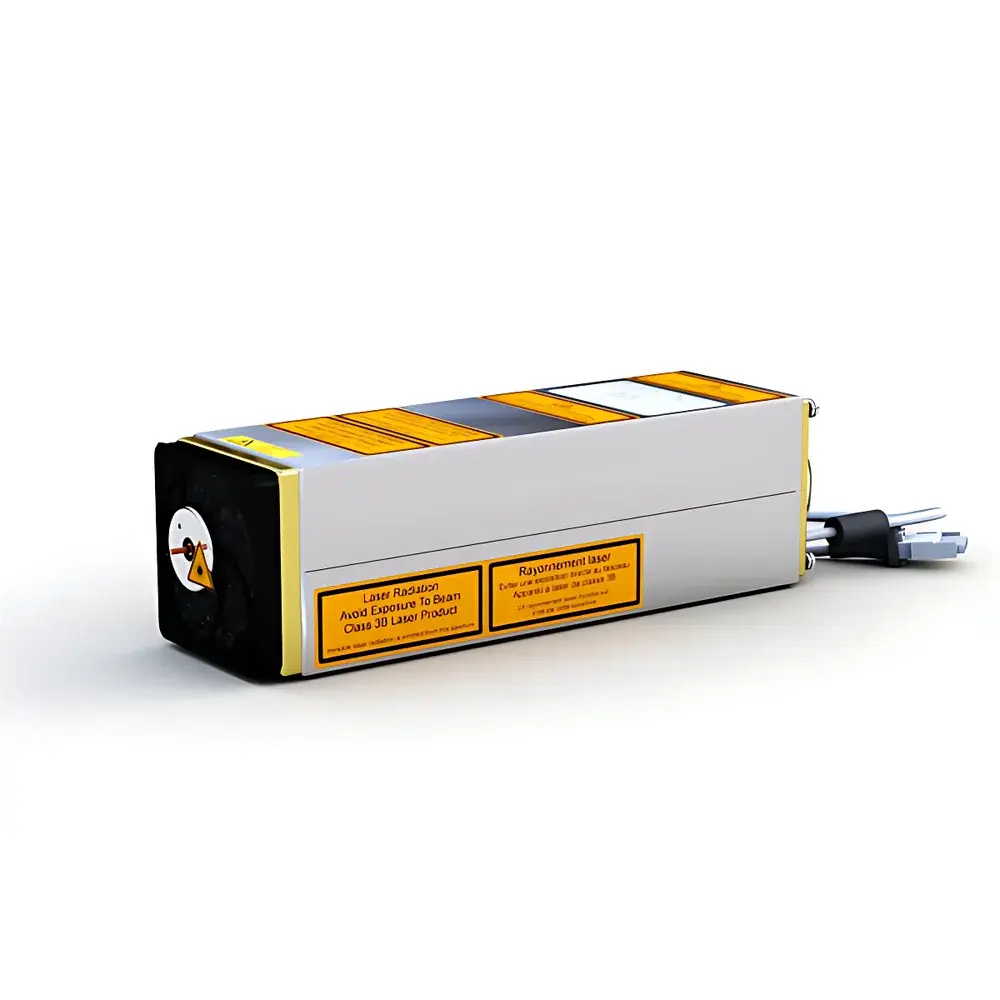
LTB MNL300 Industrial-Grade Nitrogen Molecular Laser
| Brand | LTB |
|---|---|
| Origin | Germany |
| Model | MNL300 |
| Laser Type | Pulsed Gas Laser (Nitrogen) |
| Wavelength | 337.1 nm |
| Pulse Energy | up to 85 µJ @ 20 Hz |
| Max. Repetition Rate | 80 Hz |
| Pulse Width | 3 ns |
| Average Power | 5 mW |
| Beam Dimensions | 3 × 4 mm |
| Beam Divergence | ≤3.5 × 3.5 mrad |
| Energy Stability | ≤2% RMS |
| Timing Jitter | ±5 ns |
| Sync Output Jitter | <0.2 ns |
| Trigger Input | Optical or TTL Electrical |
| Cooling | Air-cooled |
| Power Supply | 24 V DC, 60 W |
| Certifications | CE, ETL (ANSI/UL 61010-1, CAN/CSA C22.2#61010-1), FDA-compliant |
Overview
The LTB MNL300 is a compact, air-cooled pulsed nitrogen molecular laser engineered for precision ultraviolet light generation at 337.1 nm. Based on robust gas discharge physics within a sealed metal-ceramic cavity, it operates via electron-impact excitation of nitrogen molecules (N₂), producing short-duration (3 ns), high-peak-power UV pulses without requiring external optics or complex alignment. Its design emphasizes long-term operational stability and low maintenance—critical for integration into automated analytical platforms such as MALDI-TOF mass spectrometers, time-resolved fluorescence systems, and laser-induced breakdown spectroscopy (LIBS) setups. Unlike flashlamp-pumped dye lasers or solid-state frequency-tripled systems, the MNL300 delivers intrinsic wavelength stability and minimal spectral drift due to its fixed molecular transition, making it a preferred pump source where reproducible 337 nm excitation is required under demanding laboratory or industrial conditions.
Key Features
- Ultra-compact footprint: 300 × 87 × 87 mm (L×W×H), total volume 2.2 L, weight ~2.8 kg
- High reliability architecture: Fully sealed metal-ceramic laser cavity with integrated solid-state switching power supply
- Extended service life: Rated for 60 million pulses (standard 2-year warranty) or 120 million pulses (optional 3-year warranty)
- Flexible triggering: Supports both optical and TTL electrical external trigger inputs with sub-nanosecond sync output jitter (<0.2 ns)
- Stable energy delivery: ≤2% RMS pulse-to-pulse energy variation across full repetition range (up to 80 Hz)
- Low-voltage operation: Powered by 24 V DC, 60 W input; includes optional universal AC adapter (100–240 V, 50–60 Hz)
- Laser safety classification: Class 3B (IEC 60825-1), compliant with FDA 21 CFR Part 1040.10 and ANSI Z136.1
Sample Compatibility & Compliance
The MNL300 is designed for integration into OEM analytical instruments and research-grade measurement systems where consistent 337 nm UV excitation is essential. It meets international regulatory requirements for laboratory equipment, including CE marking per Directive 2014/30/EU (EMC) and 2014/35/EU (LVD), ETL certification to UL 61010-1 and CSA C22.2 No. 61010-1, and FDA registration as a laser product under 21 CFR 1040.10. Its stable temporal and spatial beam profile ensures compatibility with standard UV-compatible optics, fiber couplers (e.g., quartz core), and detector systems used in LIF, phosphorescence lifetime imaging, and MALDI ionization sources. No consumables or gas refills are required—the sealed cavity eliminates degradation mechanisms associated with gas leakage or electrode erosion.
Software & Data Management
While the MNL300 operates as a standalone hardware module without embedded firmware or user interface, it supports full synchronization and remote control via TTL-level trigger signals and programmable delay generators. When integrated into larger instrumentation platforms (e.g., mass spectrometers or fluorescence lifetime analyzers), it complies with GLP/GMP data integrity requirements through hardware-level timing traceability: all pulse events can be timestamped externally using the low-jitter sync output (<0.2 ns jitter). For audit-ready environments, system integrators may log trigger commands and pulse counts alongside analytical data in accordance with FDA 21 CFR Part 11 when paired with validated acquisition software and secure electronic records infrastructure.
Applications
- Laser-Induced Fluorescence (LIF) and Time-Resolved Phosphorescence Spectroscopy
- Matrix-Assisted Laser Desorption/Ionization Time-of-Flight Mass Spectrometry (MALDI-TOF MS)
- Pumping of tunable dye lasers (e.g., replacement for VSL337i)
- Micro-scale Laser-Induced Breakdown Spectroscopy (Micro-LIBS)
- UV photolysis and photochemical reaction initiation
- Calibration of UV-sensitive detectors and radiometers
- Industrial process monitoring requiring repeatable UV pulse trains
FAQ
What is the typical lifetime specification for the MNL300?
The MNL300 is warranted for 60 million laser pulses or 2 years of operation (whichever occurs first); an extended warranty option covers 120 million pulses or 3 years.
Does the MNL300 require water cooling or external gas supply?
No—it is fully air-cooled and uses a permanently sealed nitrogen-filled cavity; no consumables or external infrastructure are needed.
Can the MNL300 be triggered synchronously with other instruments?
Yes, it accepts TTL or optical triggers and provides a dedicated sync output with <0.2 ns timing jitter for precise multi-instrument coordination.
Is the MNL300 compatible with existing VSL337i-based systems?
Yes, it is pin-compatible and functionally equivalent to the VSL337i in terms of beam geometry, pulse parameters, and electrical interface, enabling direct drop-in replacement.
What safety certifications does the MNL300 hold?
It carries CE, ETL (UL/CSA 61010-1), and FDA laser product compliance documentation, and is classified as Class 3B per IEC 60825-1.





