
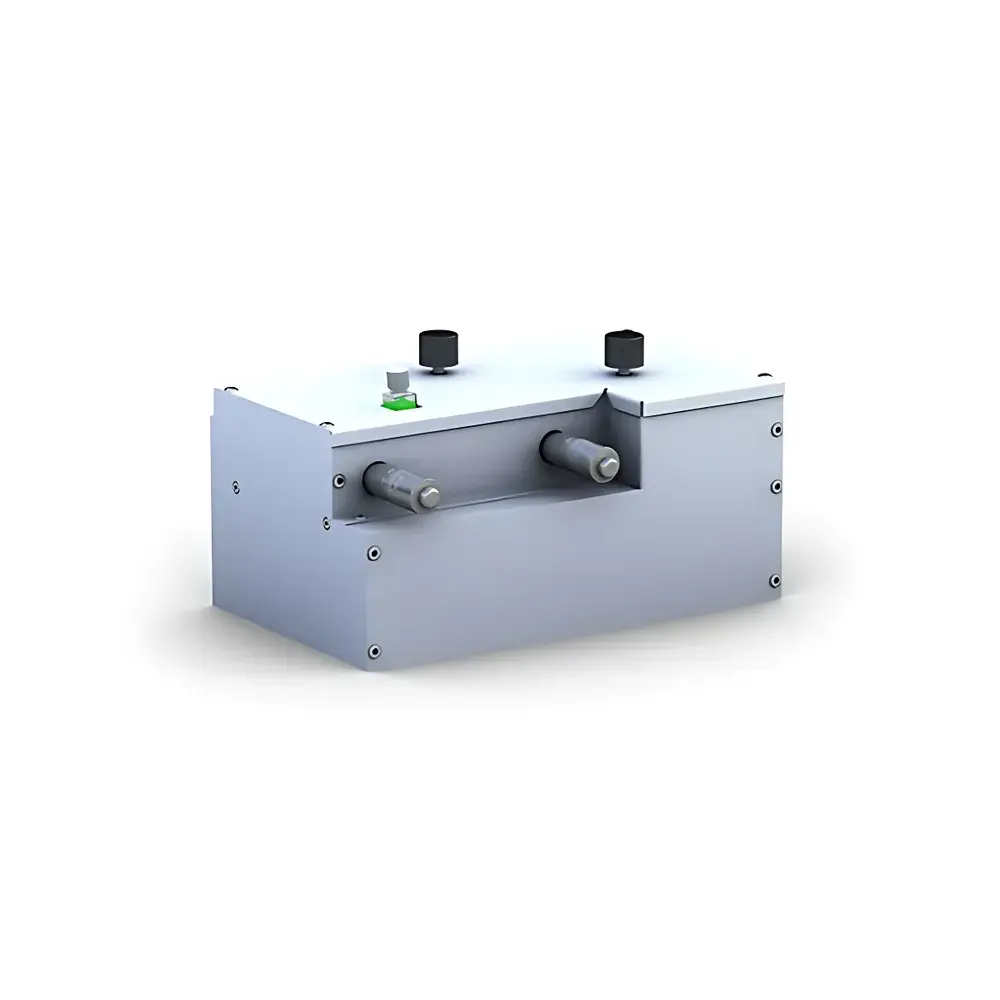
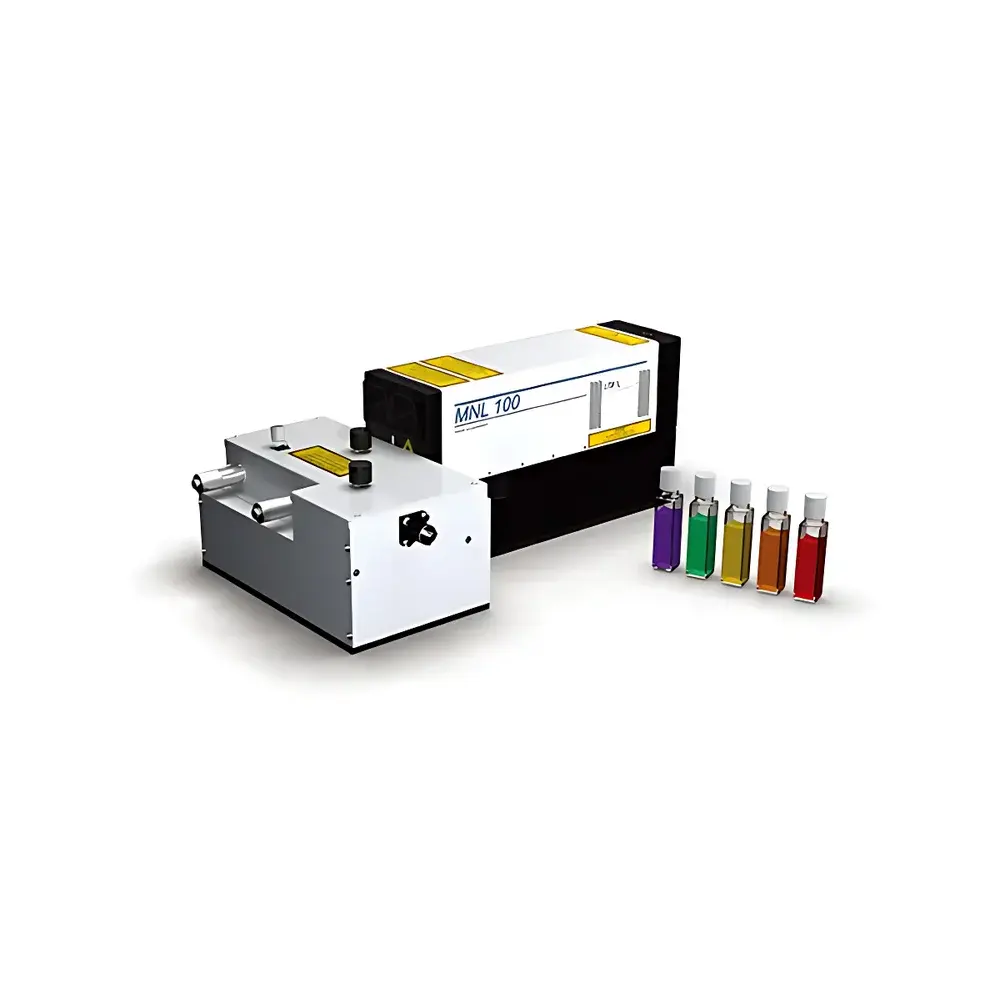
LTB UDL Series Manual Tunable Dye Laser
| Brand | LTB |
|---|---|
| Origin | Germany |
| Manufacturer Type | Authorized Distributor |
| Product Category | Imported |
| Model | UDL |
| Core Technology | Pulsed Dye Laser with Intracavity SHG |
| Pump Compatibility | MNL-series N₂ lasers (337 nm), excimer lasers (308/351 nm), frequency-doubled Nd:YAG (355/266 nm) |
| Tuning Range | 400–950 nm (fundamental), 225–400 nm (SHG) |
| Output Bandwidth | UDL100: 5–8 nm |
| UDL200 | ≤2 nm |
| Conversion Efficiency | up to 30% (UDL100, dye only), 6% (UDL200 + SHG) |
| Repetition Rate | up to 50 Hz |
| Beam Diameter | 1.5 mm |
| Beam Divergence (v × h) | 1 × 2 mrad |
| Dimensions | 115 × 250 × 170 mm |
| Weight | 1.5 kg |
| Warranty | 1 year |
Overview
The LTB UDL Series Manual Tunable Dye Laser is a compact, solid-state-pumped pulsed laser system engineered for precise spectral coverage across the deep ultraviolet (DUV), visible (VIS), and near-infrared (NIR) regions. Based on intracavity dye amplification and optional second-harmonic generation (SHG) in a BBO crystal, the UDL leverages proven transverse-pumped dye laser architecture—eliminating the need for external dye circulation or active cooling. Its core design principle relies on optical parametric tuning via mechanical adjustment of cavity alignment (UDL100) or Littrow-mounted diffraction grating rotation (UDL200), enabling reproducible, user-controlled wavelength selection without electronic actuation. Optimized for integration with LTB’s industrial-grade MNL-series nitrogen lasers (337 nm), the system also supports customization for alternative pump sources including KrF (308 nm), ArF (351 nm), and frequency-doubled Nd:YAG (355 nm and 266 nm). With peak powers reaching kilowatt-level pulses and nanosecond temporal profiles (FWHM ≈ 3 ns), the UDL delivers high signal-to-noise excitation critical for time-resolved spectroscopic techniques requiring narrowband, tunable, pulsed illumination.
Key Features
- Ultra-compact modular footprint (115 × 250 × 170 mm) suitable for OEM integration into process control, analytical instrumentation, or vacuum-compatible laser spectrometers
- Robust mechanical construction with all-aluminum housing and precision-machined kinematic mounts ensuring long-term alignment stability under thermal and vibrational stress
- Two distinct configurations: UDL100 (broadband, 5–8 nm FWHM, dye-cell exchange tuning) and UDL200 (narrowband, ≤2 nm FWHM, continuous manual tuning via micrometer-driven Littrow grating)
- No external dye recirculation or chiller required—dye cells are sealed, pre-filled, and thermally stabilized via passive conduction
- Integrated SHG module (SHG-1) extends tunability into the DUV (225–400 nm) with phase-matching controlled by calibrated micrometer translation of the BBO crystal
- High optical-to-optical conversion efficiency: up to 30% from 337 nm pump to dye output (UDL100); up to 6% from dye output to SHG UV (UDL200)
- Standard beam parameters: 1.5 mm diameter, 1 × 2 mrad (vertical × horizontal) divergence, collimated free-space output
Sample Compatibility & Compliance
The UDL Series is designed for laboratory and industrial environments where regulatory traceability and operational reliability are essential. While the laser itself does not carry CE or FDA clearance as a standalone medical device, its optical architecture complies with IEC 60825-1:2014 Class 4 laser safety requirements when operated within specified pulse energy and repetition rate limits. All models meet RoHS Directive 2011/65/EU for hazardous substance restriction. For applications in regulated analytical workflows—including MALDI-TOF mass spectrometry, pharmaceutical photostability testing (ICH Q1B), or GLP-compliant fluorescence lifetime measurement—the UDL supports audit-ready operation when paired with calibrated pump lasers (e.g., MNL 100HP, certified per ISO 17025-accredited calibration reports). Optional fiber coupling enables seamless interfacing with commercial spectrometers compliant with ASTM E275, ISO 13406-2, or USP optical characterization standards.
Software & Data Management
The UDL operates as a manually tuned instrument and does not include embedded firmware or digital control interfaces. Wavelength calibration is performed using LTB-provided reference spectra and traceable wavemeters (e.g., Burleigh WA-1000 or HighFinesse WS-U series). Users maintain full experimental metadata—including pump energy, dye type, grating angle, SHG crystal position, and ambient temperature—in lab notebooks or LIMS-integrated electronic records. For automated data capture in time-resolved experiments, the UDL synchronizes via TTL trigger outputs (BNC) compatible with standard digitizers (e.g., Keysight Infiniium, Tektronix MSO5 Series) and timing controllers supporting IEEE 1588 PTP or GPS-synchronized acquisition. All mechanical adjustments are engraved with metric scales and referenced to factory-verified calibration curves included in the technical documentation package.
Applications
- Laser-Induced Fluorescence (LIF) spectroscopy for combustion diagnostics, plasma monitoring, and environmental gas sensing
- Time-Resolved Fluorescence (TRF) and fluorescence lifetime imaging (FLIM) in biomedical research and drug discovery
- Pump-probe transient absorption spectroscopy in photochemistry and ultrafast materials science
- Matrix-Assisted Laser Desorption/Ionization (MALDI) source for time-of-flight mass spectrometry requiring tunable UV-VIS excitation
- Calibration of monochromators, spectroradiometers, and hyperspectral imaging systems across 225–950 nm
- OEM integration into inline process analyzers for real-time composition monitoring in semiconductor fabrication or polymer synthesis lines
FAQ
Is the UDL laser compatible with non-LTB pump sources?
Yes—while optimized for LTB’s MNL-series nitrogen lasers, the UDL platform accepts custom optical interface modifications for excimer (308 nm, 351 nm) or frequency-doubled solid-state lasers (355 nm, 266 nm) upon request and optical safety review.
What is the expected lifetime of the dye cell?
Sealed dye cells exhibit >1 × 10⁶ shots at rated repetition rate (≤50 Hz) and typical pulse energy. Lifetime varies with dye type, pump fluence, and ambient temperature; LTB provides degradation curves per dye formulation in the specification supplement.
Can the UDL be upgraded to motorized tuning?
No—mechanical tuning is intentionally manual to preserve compactness, eliminate EMI-sensitive electronics, and ensure compatibility with high-voltage or magnetic-field-intensive environments (e.g., NMR-coupled setups).
Does the SHG module require realignment after wavelength changes?
No—phase matching in the SHG-1 module is maintained across the full 225–400 nm range via linear micrometer translation; alignment is factory-locked and verified per ISO 10110-7 surface quality standards.
Are calibration certificates provided with shipment?
Each unit ships with a factory alignment report, wavelength verification data against NIST-traceable emission lines (e.g., Hg/Ne lamps), and mechanical tolerance documentation compliant with DIN EN ISO 9001:2015 manufacturing protocols.





