
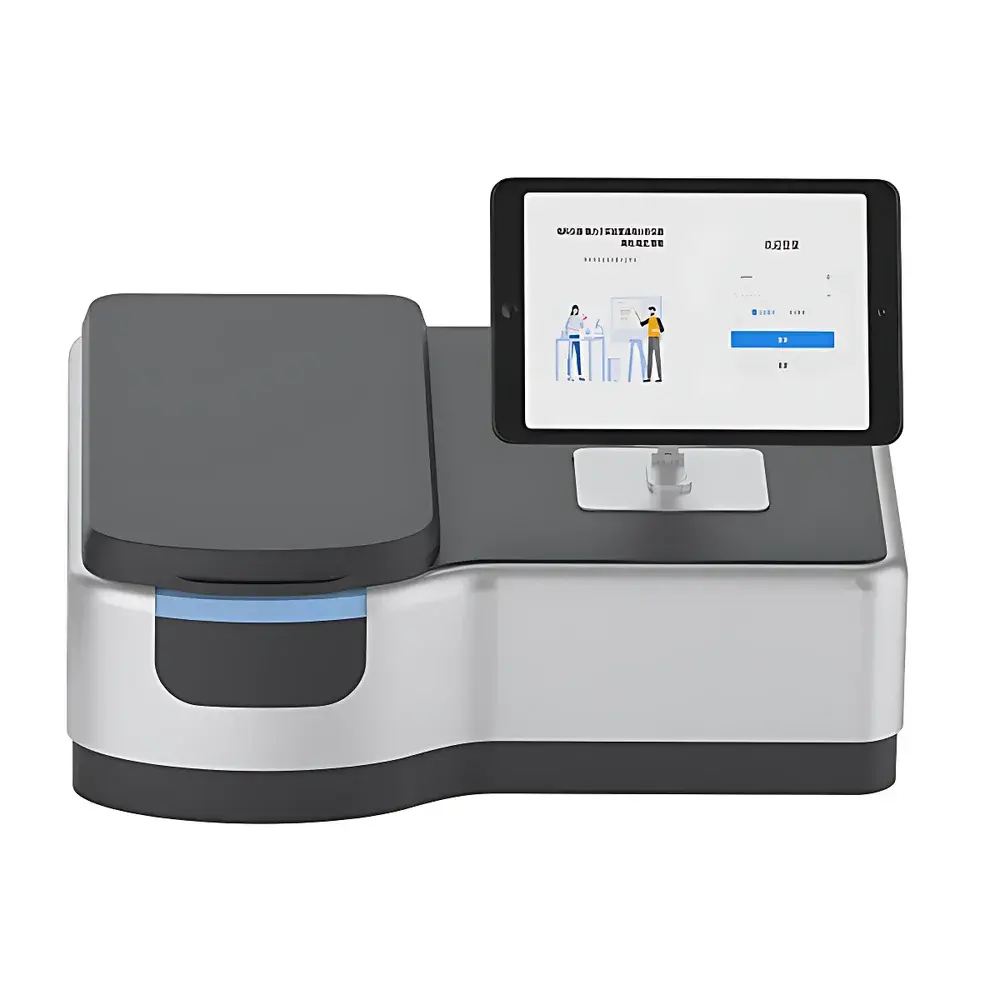
Luban Instruments M6S UV-Vis Spectrophotometer
| Brand | Yoke |
|---|---|
| Origin | Shanghai, China |
| Manufacturer Type | Direct Manufacturer |
| Region of Origin | Domestic (China) |
| Model | M6S |
| Quotation | Upon Request |
| Optical Design | Pseudo-Double-Beam |
| Detector | Photodiode Array (PDA) |
| Wavelength Range | 190–1100 nm |
| Automation Level | Automatic Wavelength Scanning |
| Display | 11-inch 2.8K Resolution Tablet PC |
| Light Sources | Deuterium Lamp + Tungsten Halogen Lamp |
| Spectral Bandwidth | Adjustable (0.1 / 0.2 / 0.5 / 1 / 2 / 4 / 5 nm) |
| Absorbance Resolution | 0.00001 Abs |
Overview
The Luban Instruments M6S UV-Vis Spectrophotometer is a high-performance pseudo-double-beam spectrophotometric system engineered for precision quantitative and qualitative analysis across research laboratories, quality control environments, and regulatory-compliant manufacturing facilities. Based on the fundamental principle of Beer–Lambert law absorption spectroscopy, the M6S measures sample transmittance and absorbance by comparing light intensity through a reference and sample path simultaneously—minimizing drift and enhancing photometric stability over extended measurement sessions. Its dual-source optical architecture (deuterium lamp for UV, tungsten halogen lamp for visible/NIR) ensures seamless spectral coverage from 190 nm to 1100 nm, supporting applications ranging from nucleic acid quantification at 260 nm to colorimetric assays in the near-infrared region. The instrument integrates a high-density photodiode array detector, enabling rapid full-spectrum acquisition without mechanical scanning, and delivers an absorbance resolution of 0.00001 Abs—critical for low-concentration analyte detection and high-fidelity kinetic profiling.
Key Features
- Pseudo-double-beam optical design with real-time reference beam correction, ensuring baseline stability and minimizing thermal and electronic drift during prolonged operation.
- Integrated 11-inch 2.8K-resolution tablet PC with capacitive touch interface; supports automatic bilingual display (English/Chinese), Bluetooth 5.0 connectivity, and responsive multi-touch navigation optimized for glove-compatible lab use.
- Adjustable spectral bandwidth (0.1–5 nm in seven discrete steps), allowing users to balance resolution and signal-to-noise ratio according to application requirements—e.g., narrow bandwidth for sharp peak discrimination in pharmaceutical impurity profiling, wider bandwidth for high-throughput environmental screening.
- Intelligent diagnostics engine embedded in firmware: performs automated wavelength accuracy verification, photometric linearity checks, and stray light assessment; logs results with timestamped reports for internal audit or ISO/IEC 17025 traceability.
- Configurable lamp management system: deuterium and tungsten lamps can be toggled independently via software, reducing unnecessary wear and extending source lifetime beyond 2,000 hours under typical usage conditions.
- IoT-ready architecture with secure HTTPS-based data transmission; supports scheduled remote calibration alerts, firmware update notifications, and encrypted cloud backup of method files and measurement history.
Sample Compatibility & Compliance
The M6S accommodates diverse sample formats through its modular accessory ecosystem: standard 10-mm quartz/cuvette holders, motorized 8-position auto-cuvette changers, temperature-controlled cell holders (±0.1 °C stability), integrating spheres for diffuse reflectance/transmittance of powders and films, variable-pathlength cells (0.1–100 mm), and angle-adjustable solid-sample stages for anisotropic materials. All optical components comply with ISO 9001-certified manufacturing protocols. Data integrity features—including user role-based access control (administrator, analyst, viewer), electronic signature support, and audit trail generation—align with FDA 21 CFR Part 11 requirements for regulated industries. Method validation parameters (wavelength accuracy ±0.3 nm, photometric accuracy ±0.002 Abs at 0.5 Abs, repeatability <0.001 Abs RSD) meet ASTM E275 and ISO 6060 standards for spectrophotometric performance verification.
Software & Data Management
The proprietary SpectraLink™ software suite provides a unified platform for instrument control, data acquisition, processing, and reporting. It supports GLP/GMP workflows with mandatory electronic signatures, version-controlled method storage, and immutable audit logs recording every parameter change, measurement event, and user login. Raw spectral data is saved in vendor-neutral CSV and JCAMP-DX formats; processed reports export to PDF with embedded metadata (instrument ID, operator, timestamp, calibration status). Cloud synchronization enables cross-site collaboration while maintaining local data sovereignty—data remains on-premise unless explicitly uploaded. Software updates are delivered via signed OTA packages verified against SHA-256 checksums to prevent unauthorized modification.
Applications
- Pharmaceutical QC: Active pharmaceutical ingredient (API) assay, dissolution testing, excipient compatibility studies, and USP endotoxin interference screening.
- Environmental monitoring: Nitrate/nitrite, phosphate, COD, and heavy metal speciation (e.g., Cr(VI) via diphenylcarbazide method) in wastewater and surface water per EPA Methods 353.2 and 365.1.
- Biochemistry: DNA/RNA quantification (A260/A280 ratio), Bradford/Lowry/BCA protein assays, enzyme kinetics (e.g., NADH oxidation at 340 nm), and thermal denaturation profiling.
- Materials science: Thin-film thickness estimation via interference fringe analysis, bandgap determination of semiconductors, and pigment dispersion stability assessment.
- Food & beverage: Color index (CIE L*a*b*), anthocyanin content in berries, sulfite residue detection, and ethanol concentration via refractive index correlation.
FAQ
What is the wavelength accuracy specification of the M6S, and how is it verified?
Wavelength accuracy is ±0.3 nm across the 190–1100 nm range, verified using NIST-traceable holmium oxide and didymium oxide filters during factory calibration and user-performed performance qualification.
Does the M6S support compliance with 21 CFR Part 11 for electronic records?
Yes—through configurable user roles, biometric or PIN-based electronic signatures, tamper-evident audit trails, and secure data encryption both at rest and in transit.
Can the instrument operate without the integrated tablet PC?
No—the tablet serves as the primary control interface and embedded computing unit; remote operation via external PC is not supported in standard configuration.
Is the photodiode array detector cooled, and what is its dynamic range?
The PDA operates at ambient temperature with 16-bit analog-to-digital conversion, delivering a photometric dynamic range of 0–3.5 Abs (equivalent to 0.0003–99.9% T) under default settings.
How does the IoT functionality ensure data security during remote transmission?
All outbound communications use TLS 1.2+ encryption; device authentication employs X.509 certificates; no raw spectral data is transmitted without explicit user consent or preconfigured policy rules.






