
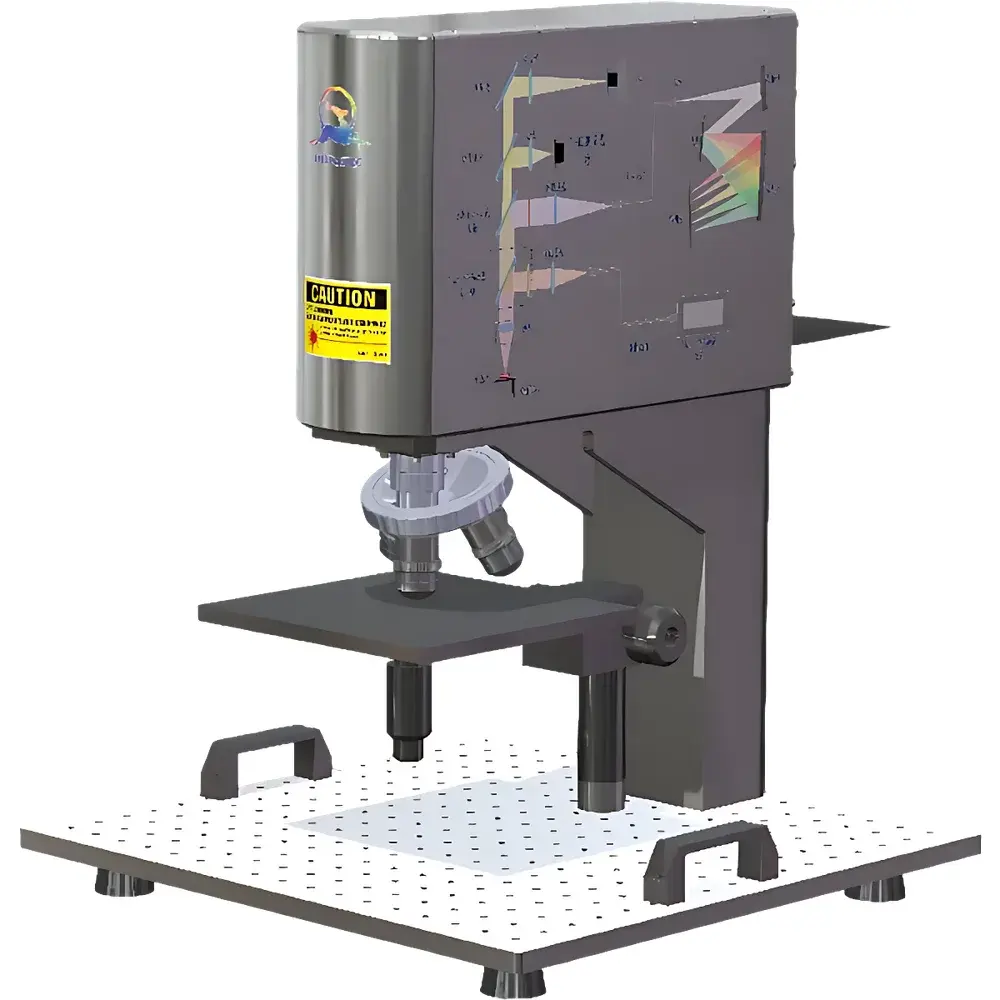
Luchu Tech SEER Educational Micro-Raman Imaging Spectrometer
| Brand | Luchu Tech |
|---|---|
| Model | SEER |
| Type | Confocal Micro-Raman Spectrometer |
| Excitation Wavelengths | 532 nm / 785 nm |
| Raman Shift Range | SEER-532: 150–3600 cm⁻¹ |
| SEER-785 | 200–2500 cm⁻¹ |
| Spectral Resolution | SEER-532: 7 cm⁻¹ (25 µm slit, measured) |
| SEER-785 | 6 cm⁻¹ (25 µm slit, measured) |
| Wavenumber Accuracy | ±3 cm⁻¹ |
| Detector Integration Time | 9.5 ms – 20 s |
| SNR | 600:1 |
| Dynamic Range | 79,000:1 |
| Laser Linewidth | <0.1 nm |
| Laser Output | Multimode/Single-mode options at 100 mW or 500 mW |
| Microscope Spot Size | 3 µm @ 100× (532 nm, measured) |
| Objective Lenses | Interchangeable 10×/20×/50×/100× |
| Illumination | LED white-light coaxial illumination |
| Tube Lens Focal Length | 180 mm |
| Software | RudeerTek RamanSoft (Windows 32/64-bit, Win7/10/11) |
| Interface | USB 2.0 |
Overview
The Luchu Tech SEER Educational Micro-Raman Imaging Spectrometer is a purpose-built confocal micro-Raman system engineered for undergraduate and graduate spectroscopy education in physics, chemistry, and materials science laboratories. Unlike conventional “black-box” commercial Raman instruments, the SEER adopts a semi-open optical architecture that exposes critical optical pathways—including excitation laser routing, dichroic filtering, spectrometer entrance slit alignment, and CCD detector coupling—enabling students to physically trace and verify fundamental principles of Raman scattering, wavelength dispersion, and spectral calibration. The system operates on the physical basis of inelastic photon scattering (Raman effect), where monochromatic laser light interacts with molecular vibrational modes, generating Stokes and anti-Stokes shifts proportional to bond energies and symmetry. Its dual-wavelength platform (532 nm and 785 nm) allows comparative study of fluorescence suppression, resonance enhancement, and penetration depth trade-offs across diverse sample classes—from inorganic crystals to organic pharmaceuticals.
Key Features
- Semi-transparent optical bench design with labeled beam paths, facilitating hands-on instruction in laser alignment, filter selection, and spectrometer calibration.
- Confocal microscopy integration enabling spatially resolved Raman mapping with diffraction-limited lateral resolution (~3 µm at 100× magnification, 532 nm).
- Dual-excitation capability: switchable 532 nm (higher Raman cross-section, higher fluorescence risk) and 785 nm (reduced fluorescence, optimal for biological and polymer samples) diode lasers, both with selectable multimode/single-mode operation and calibrated power output (100 mW / 500 mW).
- High-fidelity spectral acquisition: 6–7 cm⁻¹ spectral resolution (measured at 25 µm slit width), ±3 cm⁻¹ wavenumber accuracy, and 600:1 signal-to-noise ratio under standard integration conditions.
- Real-time co-registration of white-light microscope imaging and Raman point-spectrum acquisition—supporting intuitive region-of-interest selection and morphological correlation.
- Bundled pedagogical resources: annotated optical layout diagrams, step-by-step lab protocols, instructor guides, and video-based training modules aligned with ASTM E1840 and ISO/IEC 17025-aligned teaching objectives.
Sample Compatibility & Compliance
The SEER accommodates solid, powder, thin-film, and liquid samples mounted on standard glass slides or SERS substrates. Its modular objective turret (10×, 20×, 50×, 100×) supports variable working distances and numerical apertures appropriate for both bulk characterization and micro-domain analysis. The system meets essential safety requirements per IEC 60825-1 (Class 3B laser product) and incorporates interlock-enabled shutter control and key-switched laser activation. While not certified for GMP or FDA 21 CFR Part 11 environments, its software architecture supports audit-trail-ready data logging (timestamped spectra, operator ID, instrument parameters), making it suitable for GLP-compliant academic research and method development labs.
Software & Data Management
RudeerTek RamanSoft is a native Windows application (32/64-bit compatible, Windows 7–11) designed specifically for educational workflows. It provides real-time spectrum preview, automated baseline correction (Asymmetric Least Squares), peak identification using built-in reference libraries (e.g., RRUFF, ICDD), and multi-point spectral mapping with export to CSV, TXT, and JCAMP-DX formats. All acquired spectra retain full metadata—including laser wavelength, power, integration time, objective used, and stage coordinates—ensuring traceability and reproducibility. The software supports batch processing for comparative analysis (e.g., mineral phase identification, counterfeit drug screening) and exports publication-ready figures with SI-compliant axis labeling (cm⁻¹, intensity counts).
Applications
- Mineralogy and geoscience education: identification of quartz polymorphs (α-quartz vs. cristobalite), carbon allotropes (graphite, diamond, nanotubes), and sulfide ores via characteristic lattice mode fingerprints.
- Pharmaceutical quality control: verification of active pharmaceutical ingredient (API) crystallinity, polymorphic form (e.g., ritonavir Form I vs. II), and excipient compatibility.
- Forensic and authenticity testing: differentiation of natural vs. synthetic jadeite based on Mg/Fe substitution bands; detection of adulterants in herbal medicines.
- SERS pedagogy: quantitative analysis of trace analytes (e.g., rhodamine 6G, melamine) using Luchu Tech’s Au/Ag nanostructured substrates, illustrating enhancement mechanisms and limit-of-detection determination.
- Emerging energy materials: characterization of perovskite crystal degradation (PbI₂ formation), grain boundary phonons in polycrystalline thin films, and interfacial charge-transfer signatures.
- Narcotics screening: rapid identification of fentanyl analogues, methamphetamine, and cocaine hydrochloride through diagnostic C–H, C=O, and aromatic ring vibrations.
FAQ
Is the SEER suitable for quantitative analysis?
Yes—when paired with internal standards and calibrated reference materials, the SEER supports semi-quantitative concentration estimation within ±10% RSD for homogeneous solid samples under controlled acquisition conditions.
Can third-party software (e.g., MATLAB, Python) interface with the SEER?
Yes—the instrument provides documented DLL APIs and raw binary data access, enabling custom scripting for advanced spectral preprocessing, machine learning classification, or real-time feedback control.
What maintenance is required for long-term stability?
The system requires no consumables; periodic verification of laser alignment and grating calibration (recommended annually) ensures sustained spectral fidelity and resolution performance.
Does the SEER support time-resolved or polarization-resolved measurements?
Not natively—but optional add-ons include motorized half-wave plates and gated acquisition modules for polarization anisotropy and lifetime-gated Raman studies.
How is spectral calibration performed?
The SEER includes pre-installed neon and silicon reference lines; users may perform one-point or multi-point calibration using either built-in routines or external NIST-traceable standards.





