
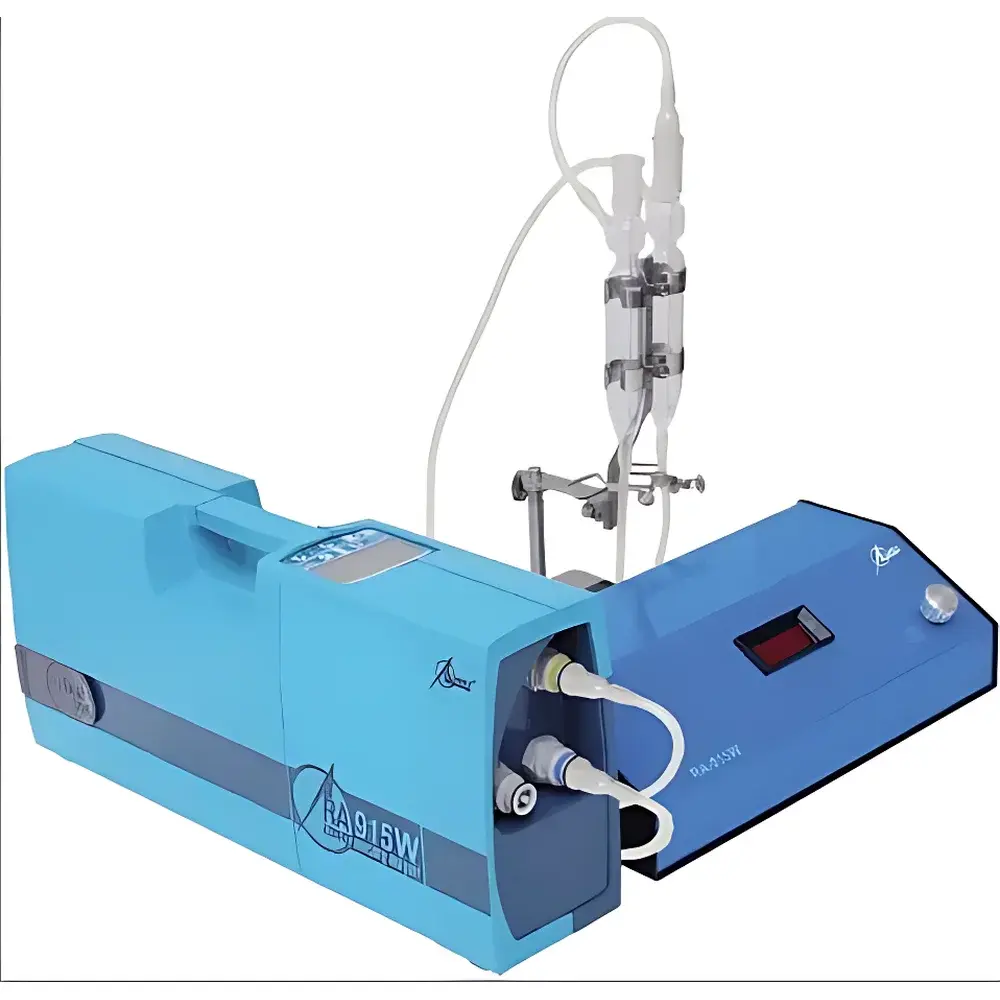
LUMEX RA-915W Mercury Analyzer for Liquid Samples
| Brand | LUMEX |
|---|---|
| Origin | Canada |
| Model | RA-915W |
| Instrument Type | Portable |
| Measurement Principle | Cold Vapor Atomic Absorption Spectrometry (CVAAS) with High-Frequency Zeeman Background Correction (ZAAS-HFM) |
| Detection Limit | 0.5 ng/L |
| Repeatability | ±1% RSD |
| Linearity Error | ±1% |
| Compliance | EPA Method 1631, EPA SW-846, EN 1483 & EN 13806, HJ 543–2009, HJ 597–2011, GB 3838–2002, GB 5009.17–2014, WS/T 25–1996, GB/T 15555.1–1995, GB/T 17136–1997 |
Overview
The LUMEX RA-915W Mercury Analyzer is a portable, laboratory-grade instrument engineered for direct, real-time quantification of total mercury in liquid matrices using Cold Vapor Atomic Absorption Spectrometry (CVAAS) coupled with High-Frequency Zeeman Background Correction (ZAAS-HFM). Unlike conventional mercury analyzers requiring gold amalgamation pre-concentration, the RA-915W employs a chemical reduction–atomic vapor generation approach: mercury ions in solution are reduced to elemental mercury vapor using stannous chloride or sodium borohydride, and the resulting atomic vapor is swept into a quartz absorption cell where absorbance at the 253.7 nm resonance line is measured. This physical principle enables sub-part-per-quadrillion (ng/L) sensitivity without derivatization, matrix separation, or carrier gas dependency—making it suitable for trace-level environmental monitoring, clinical toxicology, and regulatory compliance workflows.
Key Features
- Direct liquid analysis without gold trap preconcentration, eliminating consumables such as gold-coated traps, argon or nitrogen carrier gases, and acid reagents
- High-frequency Zeeman background correction (ZAAS-HFM) ensures exceptional selectivity and immunity to spectral interferences from chloride, iron, copper, and organic matter commonly present in wastewater, biological fluids, and surface waters
- Dynamic linear range spanning six orders of magnitude—from 0.5 ng/L to ≥1 mg/L—enabling single-instrument deployment across ultra-trace environmental screening and high-concentration industrial effluent verification
- Robust optical architecture with temperature-stabilized hollow cathode lamp and dual-beam photometric design ensures long-term baseline stability and measurement reproducibility (±1% RSD)
- Compact, shock-resistant housing rated IP54; operational in ambient temperatures from 5 °C to 40 °C and relative humidity up to 80% non-condensing—validated for field use in mobile labs, emergency response vehicles, and remote monitoring stations
- Integrated USB interface supports direct communication with Windows-based host PCs; no external data loggers or proprietary docking stations required
Sample Compatibility & Compliance
The RA-915W is validated for aqueous and semi-aqueous samples including drinking water, surface water, wastewater, seawater, urine, whole blood lysates, and acid-digested extracts from soils and solid waste. Its analytical protocol aligns with internationally recognized regulatory methods: U.S. EPA Method 1631 (for water), EPA SW-846 7471B (for solids), EU EN 1483 and EN 13806 (for water and biota), China’s HJ 543–2009 (stack gas), HJ 597–2011 (water), GB 5009.17–2014 (food), WS/T 25–1996 (urine), and GB/T 17136–1997 (soil). All measurements adhere to GLP-compliant documentation standards when paired with LUMEX Mercury Control Software (v5.x), which maintains full audit trails, user access logs, and electronic signatures compliant with FDA 21 CFR Part 11 requirements.
Software & Data Management
Mercury Control Software provides intuitive instrument control, method setup, calibration management, and report generation. It supports multi-point calibration curves with forced zero intercept, automatic blank subtraction, and real-time signal visualization. Raw absorbance traces, peak integration parameters, and QC metrics (e.g., recovery spikes, duplicate precision) are stored in encrypted SQLite databases. Export formats include CSV, PDF, and XML for LIMS integration. The software includes built-in validation tools for system suitability testing per ISO/IEC 17025:2017 Clause 7.7, enabling laboratories to demonstrate ongoing measurement reliability during accreditation audits.
Applications
- Environmental monitoring: routine surveillance of municipal water supplies, river basins, and remediation sites under national water quality standards (e.g., GB 3838–2002 Class I–III limits)
- Clinical toxicology: occupational health screening of urinary mercury in chlor-alkali plant workers or dental professionals per WHO biological exposure indices
- Regulatory enforcement: verification of mercury removal efficiency in flue gas desulfurization (FGD) scrubbers and activated carbon injection (ACI) systems via Ontario Hydro Method–derived protocols
- Food safety laboratories: determination of total mercury in fish tissue digests and infant formula extracts in accordance with GB 5009.17–2014
- Research applications: kinetic studies of mercury methylation/demethylation in sediment porewater and speciation support via hyphenated coupling with HPLC-CVAAS (external configuration)
FAQ
Does the RA-915W require carrier gas or gold traps during operation?
No. The instrument uses chemical reduction–vapor generation and does not rely on inert gas flow or amalgamation traps, significantly reducing operational cost and complexity.
Can the RA-915W analyze solid samples directly?
No. Solid matrices (soil, tissue, sludge) must first undergo acid digestion (e.g., HNO₃/H₂SO₄/KMnO₄ or microwave-assisted digestion per GB/T 15555.1–1995) to solubilize mercury prior to analysis.
Is method validation documentation available for regulatory submissions?
Yes. LUMEX provides a comprehensive Validation Package including system suitability test protocols, detection limit verification reports (MDL/IDL), and interlaboratory comparison data aligned with ISO 11352 and ASTM D3695.
What maintenance intervals are recommended for field-deployed units?
Optical alignment verification every 6 months; quartz cell cleaning after every 200 analyses; lamp replacement every 5,000 hours of operation. Full preventive maintenance is supported by certified LUMEX Field Service Engineers globally.
How is data integrity ensured during unattended operation?
All measurements include embedded timestamps, operator ID, method version, and raw spectral data. The software enforces role-based access control and generates immutable audit trails compliant with GLP and 21 CFR Part 11 Annex 11 requirements.




