
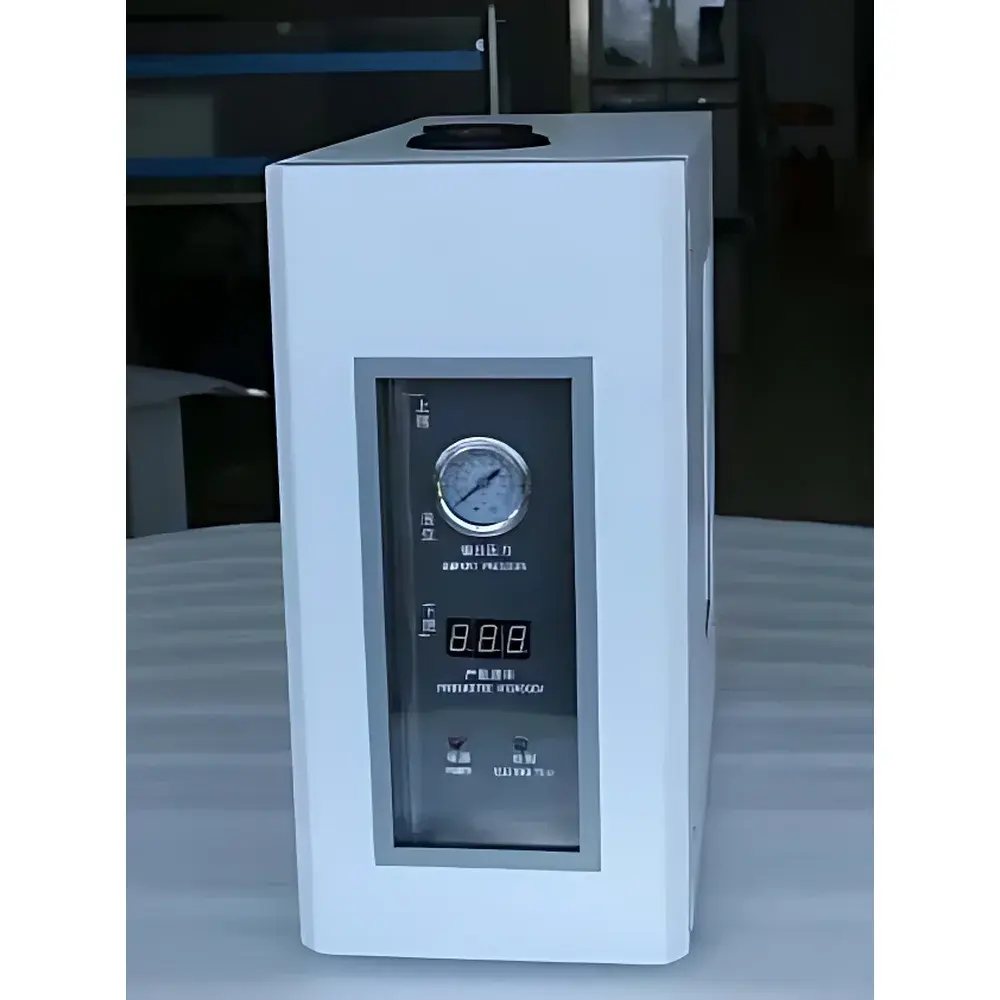
Lunan Ruihong RHH-300 / RHH-500 Hydrogen Generator
| Brand | Lunan Ruihong |
|---|---|
| Model | RHH-300 / RHH-500 |
| Output Flow Rate | 0–300 mL/min (RHH-300) / 0–500 mL/min (RHH-500) |
| Output Pressure | 0.4 MPa |
| Hydrogen Purity | 99.999% (relative to oxygen content) |
| Power Consumption | 150 W (RHH-300) / 170 W (RHH-500) |
| Dimensions (L×W×H) | 420 × 180 × 380 mm |
| Weight | 12 kg (RHH-300) / 13 kg (RHH-500) |
| Operating Temperature | 0–40 °C |
| Relative Humidity | <85% |
| Input Voltage | 220 V, 50 Hz |
| Electrolysis Principle | PEM-free alkaline water electrolysis |
| Water Requirement | Deionized or distilled water |
Overview
The Lunan Ruihong RHH-300 and RHH-500 Hydrogen Generators are compact, laboratory-grade on-site hydrogen production systems engineered for reliable, continuous supply of high-purity hydrogen gas in analytical and research environments. These generators utilize alkaline water electrolysis—without proton exchange membrane (PEM) components—to split deionized water into hydrogen and oxygen gases. The process occurs within an integrated electrolytic cell where hydrogen is selectively separated, dried, and delivered at a regulated pressure of 0.4 MPa. With purity specified at 99.999% (relative to oxygen content), the output meets stringent requirements for gas chromatography (GC) carrier gas, fuel cell testing, and hydrogenation reaction support. Designed for stable operation under ambient lab conditions (0–40 °C, <85% RH), both models feature passive thermal management, low-temperature cell operation, and fail-safe liquid-level monitoring to ensure long-term durability and minimal maintenance.
Key Features
- On-demand hydrogen generation: Flow rate automatically adjusts to real-time consumption—0–300 mL/min (RHH-300) or 0–500 mL/min (RHH-500)—eliminating storage risks and gas wastage.
- Digital LED flow display provides immediate, accurate visual feedback of instantaneous output, enabling precise method setup and reproducible instrument calibration.
- Integrated electrolyte reservoir, electrolysis chamber, and oxygen venting system minimize footprint and simplify installation—no external water feed or drain lines required.
- Non-return liquid design prevents backflow into the electrolytic cell, enhancing operational safety and protecting internal components from contamination or corrosion.
- Low-power operation (150 W / 170 W) reduces energy load and heat dissipation; optimized cell architecture ensures consistent performance across intermittent or continuous usage cycles.
- Compact benchtop form factor (420 × 180 × 380 mm) accommodates space-constrained labs while maintaining accessibility for routine water replenishment and visual inspection.
Sample Compatibility & Compliance
These generators are compatible with standard GC systems requiring ultra-high-purity hydrogen as carrier or detector fuel gas—including flame ionization detectors (FID), thermal conductivity detectors (TCD), and pulsed discharge helium ionization detectors (PDHID). The 99.999% H2 purity (oxygen-equivalent basis) complies with ASTM D7165 and ISO 8573-1:2010 Class 1 compressed air/gas quality specifications for particulate, moisture, and oil content—when used with recommended inlet water quality (resistivity ≥ 15 MΩ·cm, TOC < 10 ppb). While not certified to UL/CE or ATEX standards out-of-the-box, the RHH series conforms to general electrical safety principles per IEC 61010-1 for laboratory equipment. For GLP/GMP-regulated workflows, users may implement supplementary audit trails via external data loggers, as the unit itself does not include FDA 21 CFR Part 11-compliant electronic records functionality.
Software & Data Management
The RHH-300 and RHH-500 operate as standalone hardware units with no embedded microcontroller-based software interface or remote connectivity. All controls are electromechanical: a single power switch initiates startup, and pressure stabilization is managed by an internal mechanical regulator and proportional flow control valve. No firmware updates, configuration menus, or digital diagnostics are provided. This design prioritizes operational simplicity, electromagnetic compatibility (EMC) robustness, and immunity to cyber vulnerabilities—making it suitable for environments where IT infrastructure integration is restricted or undesirable. Users record operational parameters manually or integrate flow/pressure readings into existing LIMS or SCADA platforms via analog 0–5 V or 4–20 mA signal outputs (optional accessories, not included).
Applications
- Gas chromatography: Primary carrier gas source for capillary columns and packed columns in environmental, pharmaceutical, and petrochemical analysis.
- Hydrogenation reactors: On-demand feed for small-scale catalytic hydrogenation studies requiring precise stoichiometric control.
- Fuel cell R&D: Low-flow hydrogen supply for single-cell testing, membrane electrode assembly (MEA) characterization, and durability cycling.
- Calibration laboratories: Stable, traceable H2 source for sensor validation and gas analyzer verification protocols.
- Educational labs: Demonstrable electrolysis platform for teaching electrochemistry fundamentals, gas laws, and clean energy concepts.
FAQ
What type of water must be used?
Deionized or distilled water with resistivity ≥ 15 MΩ·cm and total organic carbon (TOC) < 10 ppb is mandatory. Tap water, tap-deionized water, or water containing chlorides or metal ions will degrade electrolyte stability and shorten cell life.
Can output pressure be adjusted beyond 0.4 MPa?
No. The mechanical pressure regulator is factory-set to 0.4 MPa. Custom pressure configurations require factory modification prior to shipment and may affect warranty coverage.
How often does the unit require water refilling?
Under continuous operation at maximum flow, the RHH-300 requires replenishment every ~48 hours; the RHH-500 every ~36 hours. Refill intervals scale inversely with average flow demand and ambient temperature.
Is oxygen venting safe in enclosed spaces?
Oxygen is discharged continuously through a dedicated vent port. Ensure adequate room ventilation—minimum 6 air changes per hour—as per OSHA 29 CFR 1910.103 guidelines for non-flammable gas byproduct management.
Does the generator include automatic shutdown on low water?
Yes. An integrated float-level sensor interrupts power to the electrolysis cell when water falls below operational threshold, preventing dry-run damage.



