
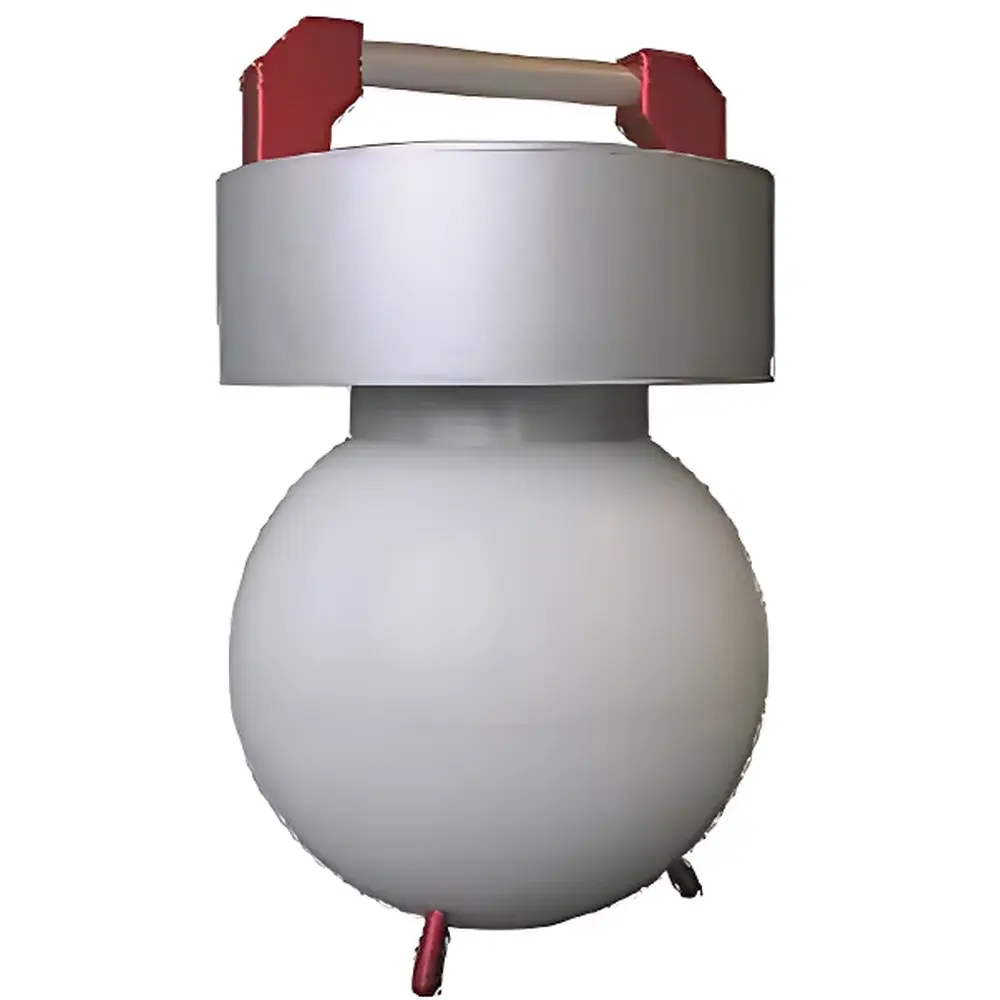
LUPIN 5401 Neutron Ambient Dose Equivalent Rate Meter
| Origin | Italy |
|---|---|
| Manufacturer Type | Authorized Distributor |
| Origin Category | Imported |
| Model | LUPIN 5401 |
| Instrument Category | Ambient Dose Equivalent Rate Meter |
| Instrument Type | Laboratory-Grade |
| Detection Medium | Gas-Filled Proportional Counter |
| Detector Technology | He-3 or BF₃ Thermal-to-Fast Neutron Converter |
| Energy Range | 0.025 eV – 5 GeV |
| Sensitivity | 1 cps per µSv/h (He-3), 0.6 cps per µSv/h (BF₃) |
| Dose Equivalent Rate Range | 10 nSv/h – 100 mSv/h |
| Pulse Field Tolerance | ≤10% deviation at 2 µSv incident dose per pulse |
| Compliance | IEC 61000-4-3 (EMC), IEC 60846-2:2014 (Radiation Protection Instrumentation – Part 2: Ambient and Directional Dose Equivalent Meters for Neutrons) |
Overview
The LUPIN 5401 is a laboratory-class ambient dose equivalent rate meter engineered for precise, real-time measurement of neutron radiation fields across an exceptionally broad energy spectrum—from thermal neutrons (0.025 eV) up to relativistic fast neutrons (5 GeV). Designed in collaboration with European nuclear research institutions—including CERN, ENEA, and the Joint Research Centre (JRC)—the instrument implements dual-gas proportional counter technology using either helium-3 (³He) or boron trifluoride (BF₃) fill gas, enabling high-efficiency thermal neutron detection while maintaining adequate response to epithermal and fast neutrons via polyethylene moderation and optimized geometry. Its core metrological function complies with IEC 60846-2:2014, which defines performance requirements for neutron ambient dose equivalent (H*(10)) meters used in radiation protection applications. Unlike conventional survey meters, the LUPIN 5401 integrates pulse-shape discrimination algorithms and dead-time-corrected counting electronics to ensure accurate dose rate estimation even in pulsed neutron environments—such as those encountered during accelerator-based neutron source operation, reactor start-up transients, or pulsed irradiation facilities—where dose rate linearity must be preserved under transient flux conditions.
Key Features
- Modular detector head with interchangeable ³He or BF₃ proportional tubes, each pre-calibrated against traceable neutron reference fields at PTB (Physikalisch-Technische Bundesanstalt) and NPL (National Physical Laboratory)
- Active moderation assembly composed of high-density polyethylene (HDPE) and cadmium shielding, optimized for flat energy response from thermal to 20 MeV, extended to 5 GeV via secondary particle detection principles
- Digital pulse processing unit with real-time dead-time correction, pulse-height analysis, and configurable counting gate windows for pulsed field synchronization
- Integrated temperature and pressure compensation algorithms to maintain H*(10) conversion accuracy across operational ambient conditions (−10 °C to +50 °C, 70–106 kPa)
- USB-C and RS-485 interfaces supporting both standalone logging and integration into facility-wide radiation monitoring networks (IEC 62582-2 compliant)
- Battery-powered operation (up to 16 h continuous use) with low-power sleep mode and automatic wake-on-radiation-event functionality
Sample Compatibility & Compliance
The LUPIN 5401 does not require sample preparation or physical contact with irradiated materials; it operates as an ambient field monitor. It is validated for use in mixed neutron–photon fields where photon contribution to H*(10) is below 10% of total reading—additional photon rejection is achieved through pulse-shape discrimination and spectral filtering. The instrument meets the functional and metrological criteria defined in ISO 8529-1 (Reference neutron radiations), IEC 60846-2:2014 (Type H*(10) neutron dose rate meters), and EURATOM Directive 2013/59/Euratom Annex VIII requirements for workplace monitoring. Calibration certificates are issued with traceability to national standards (NIST, PTB, NPL) and include uncertainty budgets per GUM (Guide to the Expression of Uncertainty in Measurement). It supports GLP-compliant audit trails when connected to certified data acquisition software.
Software & Data Management
The LUPIN Control Suite (v3.2+) provides firmware update capability, spectral acquisition, dose rate trending, and event-triggered logging. All raw count data, timestamped with GPS-synchronized UTC, are stored in HDF5 format with embedded metadata (detector ID, calibration date, environmental sensor readings). Export options include CSV, XML (for integration with LIMS), and DICOM-RT Radiation Dose Structured Reports (per IEC 61334-3). Audit trail functionality complies with FDA 21 CFR Part 11 requirements when deployed with electronic signature modules and role-based access control. Remote configuration and alarm threshold management are supported via TLS-secured HTTP API.
Applications
- Neutron beam characterization at spallation sources (e.g., ESS, ISIS, J-PARC) and accelerator-driven systems
- In-situ H*(10) monitoring during reactor refueling, criticality experiments, and fuel handling operations
- Validation of Monte Carlo neutron transport simulations (MCNP, GEANT4) against measured ambient dose rates
- Radiation protection surveys in medical neutron therapy facilities (e.g., BNCT beamlines)
- Long-term environmental neutron background studies at high-altitude laboratories and underground sites
- Calibration reference transfer between national metrology institutes and secondary standard laboratories
FAQ
What neutron energy ranges does the LUPIN 5401 cover, and how is response uniformity ensured across that range?
The instrument covers 0.025 eV to 5 GeV via a combination of thermal neutron capture (in ³He/BF₃), resonance scattering in HDPE moderator, and detection of secondary charged particles from high-energy neutron interactions. Response uniformity is maintained through multi-point calibration using monoenergetic and quasi-monoenergetic neutron reference fields, with interpolation verified per IEC 60846-2 Annex B.
Can the LUPIN 5401 be used in pulsed neutron fields, and what is its maximum tolerable pulse frequency?
Yes—it is specifically designed for pulsed environments. With configurable gate timing and live dead-time correction, it maintains ≤10% deviation in H*(10) reading for pulses delivering ≤2 µSv per pulse at repetition rates up to 100 Hz. Performance validation was conducted at the CERN n_TOF facility.
Is factory recalibration required annually, and what documentation accompanies calibration?
Annual recalibration is recommended per ISO/IEC 17025:2017 and IEC 60846-2 Clause 8. Each calibration includes a full uncertainty budget, traceability statement, and comparison against primary standard neutron fields. Certificates conform to EN ISO/IEC 17025:2017 Annex A.3.
Related Products







