
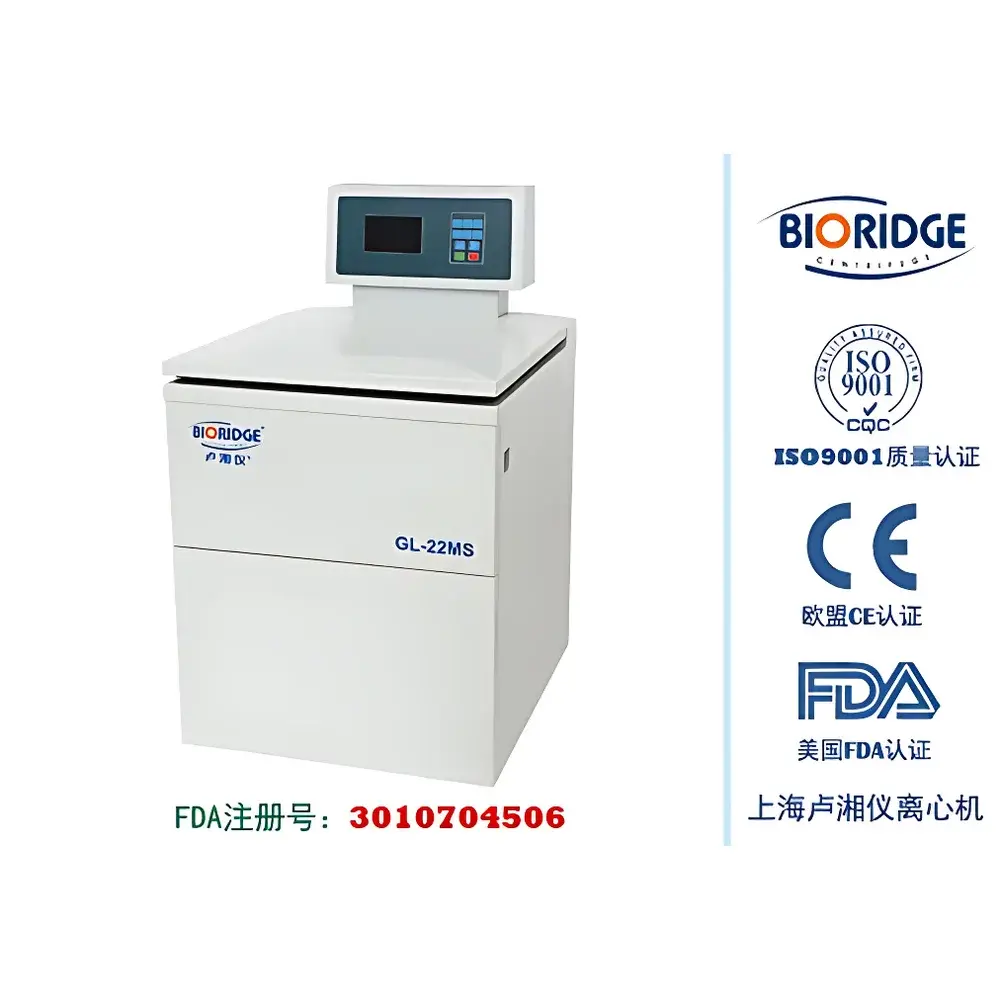
LUXIANGYI GL-22MS High-Speed Continuous-Flow Refrigerated Centrifuge
| Brand | LUXIANGYI / BIORIDGE |
|---|---|
| Origin | Shanghai, China |
| Model | GL-22MS |
| Instrument Type | Benchtop Centrifuge |
| Speed Range | 10,000–30,000 rpm |
| Cooling Function | Refrigerated (−20 °C to +40 °C) |
| Rotor Configuration | Horizontal (Swinging-Bucket) |
| Maximum Capacity | 6 × 600 mL |
| Max Speed | 22,000 rpm |
| Max RCF | 52,000 × g |
| Dimensions (L×W×H) | 710 × 840 × 1200 mm |
| Weight | 290 kg |
| Noise Level | <65 dB(A) |
| Power Supply | AC 220 V, 50 Hz, 30 A |
| Temperature Control Accuracy | ±1 °C |
| Speed Accuracy | ±50 rpm |
| Timer Range | 1 min – 99 h 59 min |
| Refrigerant | R404a (non-ozone-depleting) |
| Compressor | Imported high-performance unit |
| Safety Features | Electronic door lock, overspeed/overtemperature/unbalance detection, automatic fault alarm |
| Acceleration/Deceleration Profiles | 10 programmable ramp curves |
| Display | Large LCD screen with real-time rpm/RCF conversion |
| Data Retention | Auto-save of user-defined protocols |
Overview
The LUXIANGYI GL-22MS High-Speed Continuous-Flow Refrigerated Centrifuge is an engineered solution for high-throughput, temperature-sensitive separation tasks in modern life science laboratories. Designed around the principles of sedimentation equilibrium and differential centrifugation, the GL-22MS delivers precise control over rotational dynamics and thermal environment—critical for preserving labile biomolecular integrity during isolation of nucleic acids, viral particles, subcellular organelles, and protein complexes. Its continuous-flow architecture enables scalable processing of large-volume samples (up to 3 L/min with optional titanium rotors), eliminating batch limitations inherent in fixed-angle or swinging-bucket batch centrifuges. The system operates within a rigorously controlled refrigerated chamber (−20 °C to +40 °C), maintaining sample stability across extended run durations—a requirement for compliant workflows in clinical diagnostics, biopharmaceutical process development, and academic structural biology.
Key Features
- High-performance AC brushless frequency-controlled motor delivering stable operation at up to 22,000 rpm with ±50 rpm speed accuracy and <65 dB(A) acoustic emission.
- Imported high-efficiency compressor system using environmentally compliant R404a refrigerant, ensuring consistent thermal regulation with ±1 °C precision across the full operating range.
- Large-format LCD interface supporting real-time rpm/RCF dual-unit display, intuitive parameter programming, and automatic protocol storage for GLP-aligned repeatability.
- Comprehensive safety architecture including electronic lid interlock, overspeed cutoff, rotor imbalance detection, overtemperature shutdown, and self-diagnostic fault reporting.
- 10 independently configurable acceleration/deceleration profiles, enabling optimization of shear-sensitive separations (e.g., membrane vesicle isolation or ribosome purification).
- Modular rotor library supporting both batch and continuous-flow configurations—including stainless steel and titanium continuous-flow rotors rated for 1,000 mL and 3,000 mL capacities at flow rates of 200–800 mL/min.
Sample Compatibility & Compliance
The GL-22MS accommodates a broad spectrum of sample formats—from microcentrifuge tubes (0.2–2.2 mL) to large-volume bottles (up to 750 mL)—via interchangeable rotors certified to ISO 15197 and IEC 61010-2-020 safety standards. Its validated temperature control and traceable speed calibration support compliance with FDA 21 CFR Part 11 requirements when paired with audit-trail-enabled software (available as optional module). The system meets essential performance criteria outlined in ASTM F1578 (standard specification for refrigerated centrifuges) and supports GMP-aligned documentation through programmable run logs and user-accessible calibration certificates. All rotors undergo dynamic balancing verification per ISO 21501-4 and are supplied with individual serial-numbered certification of mechanical integrity.
Software & Data Management
While the base GL-22MS operates via embedded firmware with local parameter storage, optional PC-based control software provides extended functionality: remote monitoring, multi-user access control, electronic signature support, and export of time-stamped run reports in CSV/PDF format. Data integrity safeguards include write-protected method libraries, immutable audit trails for all parameter changes, and automatic timestamping of rotor usage cycles—facilitating routine maintenance scheduling and regulatory review. Firmware updates are delivered via secure USB interface with version rollback capability, ensuring continuity during validation maintenance.
Applications
- Clinical laboratories: High-volume plasma fractionation, PBMC isolation, and exosome enrichment from serum or ascites fluid.
- Biopharmaceutical manufacturing: Clarification of mammalian cell culture harvests, intermediate purification of monoclonal antibodies, and virus-like particle (VLP) concentration.
- Genomics core facilities: Large-scale plasmid DNA purification, chromatin immunoprecipitation (ChIP) sample preparation, and CRISPR ribonucleoprotein complex isolation.
- Academic research: Subcellular fractionation (mitochondria, lysosomes, nuclei), synaptic vesicle purification, and cryo-EM sample prep requiring ice-cold, low-shear processing.
- Vaccine development: Adjuvant formulation support, antigen recovery from fermentation broths, and sterile filtration integration via inline flow-path design.
FAQ
What continuous-flow rotor options are available for the GL-22MS?
Stainless steel rotors (1,000 mL and 3,000 mL capacity) and titanium variants (1,000 mL and 3,000 mL) are offered, each rated for maximum speeds of 14,000–16,000 rpm and flow rates of 200–800 mL/min.
Is the GL-22MS compliant with international electrical safety standards?
Yes—the instrument conforms to IEC 61010-2-020 for laboratory centrifuges and carries CE marking under the EU Low Voltage and EMC Directives.
Can rotor calibration data be exported for internal QA records?
Calibration certificates—including speed verification, temperature uniformity mapping, and RCF validation—are provided with each rotor and may be archived digitally via optional software.
Does the system support 21 CFR Part 11 compliance out-of-the-box?
The base configuration supports ALCOA+ data integrity principles; full 21 CFR Part 11 compliance requires the optional software module with electronic signatures and audit-trail logging.
What maintenance intervals are recommended for the refrigeration system?
Compressor performance verification and refrigerant pressure checks are advised every 12 months or after 1,000 operational hours—whichever occurs first—per manufacturer service bulletin GL-22MS-SV-2023.



