
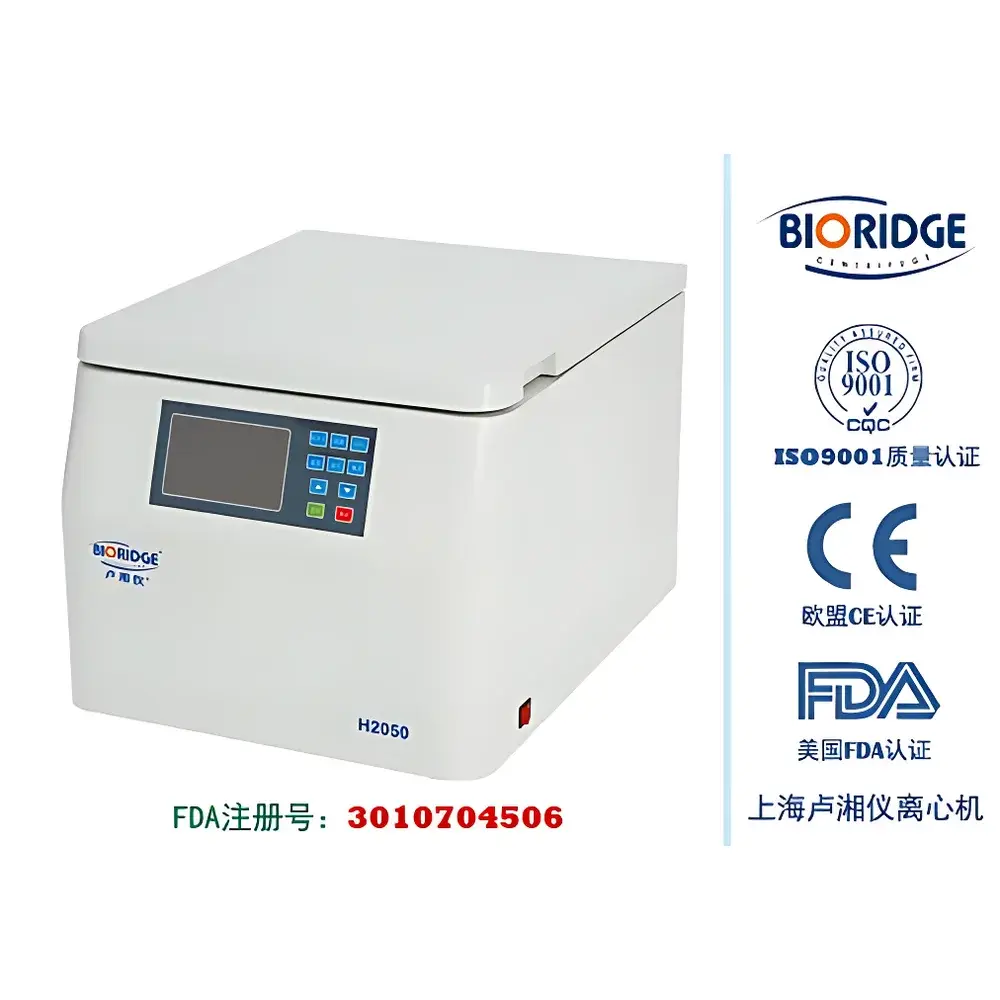
LUXIANGYI H2050 Benchtop High-Speed High-Capacity Centrifuge
| Brand | LUXIANGYI / BIORIDGE |
|---|---|
| Origin | Shanghai, China |
| Model | H2050 |
| Type | Benchtop Centrifuge |
| Speed Range | 10,000–30,000 rpm (Max. 20,500 rpm) |
| Max. RCF | 29,200 × g |
| Max. Capacity | 4 × 750 mL |
| Dimensions (L×W×H) | 545 mm × 660 mm × 490 mm |
| Weight | 72 kg |
| Noise Level | <65 dB(A) |
| Power Supply | AC 220 V, 50 Hz, 20 A |
| Speed Accuracy | ±50 rpm |
| Timer Range | 1 min–99 h 59 min (or 1–99 min) |
| Acceleration/Deceleration Profiles | 10 programmable ramp curves |
Overview
The LUXIANGYI H2050 Benchtop High-Speed High-Capacity Centrifuge is engineered for precision separation of biological and clinical samples under demanding laboratory conditions. Utilizing a high-torque AC brushless frequency-controlled motor, the H2050 delivers stable rotational dynamics across its full operational range—up to 20,500 rpm and 29,200 × g—enabling efficient pelleting of subcellular organelles, viral particles, macromolecular complexes, and suspended cells. Its robust mechanical architecture, combined with microprocessor-based control logic, ensures consistent rotor kinetics, minimal thermal drift, and low-vibration operation (<65 dB[A]), making it suitable for continuous use in shared core facilities, clinical diagnostics labs, and academic research environments where throughput, reproducibility, and operator safety are critical.
Key Features
- Microprocessor-controlled system with real-time RPM/RCF interconversion displayed on a high-contrast LCD interface for intuitive parameter monitoring and adjustment.
- Programmable touch-panel interface supporting up to 10 user-defined acceleration and deceleration profiles—essential for optimizing sedimentation integrity of shear-sensitive samples such as exosomes or protein aggregates.
- Electronic door lock mechanism with automatic lid interlock, overspeed protection, imbalance detection, and fault-triggered audible/visual alarms compliant with IEC 61010-2-020 safety standards.
- High-efficiency heat dissipation design minimizes temperature rise during extended runs, supporting protocols requiring thermal stability (e.g., nucleic acid isolation, plasma fractionation).
- Pre-stored rotor recognition logic prevents incompatible speed settings; each rotor configuration is validated against maximum rated parameters to enforce operational safety limits.
Sample Compatibility & Compliance
The H2050 accommodates a broad spectrum of sample formats via interchangeable rotors—including fixed-angle, horizontal, and microplate carriers—supporting volumes from 0.2 mL tubes to 750 mL bottles. Standard configurations include 4 × 750 mL horizontal buckets (4,000 rpm / 3,500 × g), 6 × 50 mL fixed-angle rotors (13,000 rpm / 17,940 × g), and 24-position microcentrifuge adapters (16,500 rpm / 24,890 × g). All rotors are certified to ISO 15195:2018 for calibration traceability and designed to meet GLP/GMP documentation requirements. The centrifuge complies with CE marking directives (2014/30/EU EMC, 2014/35/EU LVD) and supports audit-ready operation under FDA 21 CFR Part 11 when integrated with validated LIMS or ELN platforms.
Software & Data Management
While the H2050 operates as a standalone instrument with embedded firmware, its programmable memory stores up to 10 user protocols—including time, speed, RCF, acceleration/deceleration ramps, and auto-brake selection—with non-volatile retention. Event logs capture run start/stop timestamps, error codes, and rotor ID verification for internal QA review. Optional RS-232 or USB-to-serial interfaces enable integration with laboratory information systems for automated data export and electronic record archiving. Firmware updates are performed via secure USB key to maintain regulatory alignment with evolving ISO/IEC 17025 documentation practices.
Applications
- Clinical microbiology: Separation of serum, plasma, and whole blood components prior to PCR or immunoassay workflows.
- Cell biology: Harvesting adherent and suspension mammalian cells, mitochondrial isolation, and nuclear fractionation.
- Molecular diagnostics: Clarification of lysates, precipitation of DNA/RNA, and purification of CRISPR ribonucleoprotein complexes.
- Virology: Concentration of lentiviral and AAV vectors at scalable volumes without compromising infectivity.
- Biochemistry: Differential centrifugation of membrane proteins, lipoprotein profiling, and enzyme activity assays requiring rapid phase separation.
FAQ
What is the maximum relative centrifugal force (RCF) achievable with the H2050?
The H2050 achieves a maximum RCF of 29,200 × g using the 1.5/2.2 mL fixed-angle rotor at 20,500 rpm.
Can the H2050 be used for temperature-sensitive samples?
The unit does not feature active refrigeration; however, its low-noise motor and optimized airflow reduce ambient heat generation—making it suitable for short-duration, room-temperature separations. For thermally labile applications, pre-chilling samples and rotors is recommended.
Is rotor NO.5 (4 × 750 mL) compatible with all speed settings?
No—rotor NO.5 is rated for a maximum speed of 4,000 rpm (3,500 × g); exceeding this limit violates safety certification and voids warranty.
Does the H2050 support compliance with FDA 21 CFR Part 11?
Yes, when operated with validated external software and audit-trail-enabled peripherals, the device’s event logging and protocol storage align with electronic record integrity requirements.
How is calibration verified for this centrifuge?
Calibration follows ISO 15195:2018 guidelines using NIST-traceable tachometers and RCF calculators; annual third-party verification is advised for GLP-regulated environments.



