
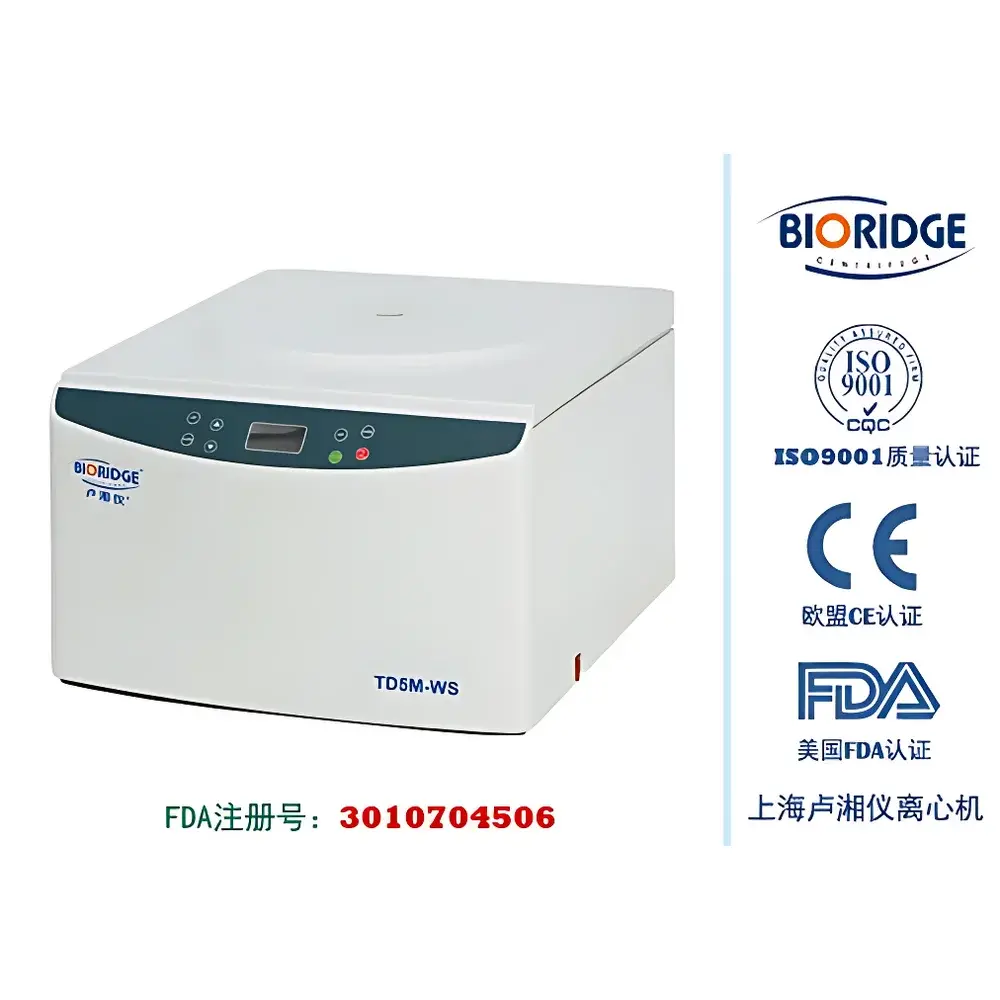
LUXIANGYI TD5M-WS Benchtop Low-Speed High-Capacity Centrifuge
| Brand | LUXIANGYI / BIORIDGE |
|---|---|
| Origin | Shanghai, China |
| Manufacturer Type | Authorized Distributor |
| Product Category | Domestic |
| Model | TD5M-WS |
| Instrument Type | Benchtop Centrifuge |
| Speed Range | 0–5000 rpm |
| Max RCF | 5030 × g |
| Max Capacity | 4 × 500 mL |
| Rotor Configuration | Horizontal (Swinging-Bucket) |
| Application Class | Biological Macromolecules |
| Dimensions (L×W×H) | 460 mm × 540 mm × 340 mm |
| Weight | 31 kg |
| Noise Level | <65 dB(A) |
| Power Supply | AC 220 V, 50 Hz, 10 A |
| Speed Accuracy | ±50 rpm |
| Timer Range | 1–99 min |
Overview
The LUXIANGYI TD5M-WS is a microprocessor-controlled, benchtop low-speed centrifuge engineered for high-capacity sedimentation and separation tasks in routine laboratory workflows. Designed around a high-torque AC brushless frequency-converter motor, the system delivers stable rotational performance with minimal mechanical vibration and acoustic emission (<65 dB[A]). Its operating principle relies on sedimentation force generation via horizontal swinging-bucket rotors, enabling uniform pelleting of large-volume biological samples—including cell suspensions, serum, plasma, whole blood, and crude subcellular fractions—without shear-induced damage typical of high-speed or fixed-angle configurations. With a maximum speed of 5000 rpm and a peak relative centrifugal force (RCF) of 5030 × g, the TD5M-WS meets standard requirements for preparative centrifugation in clinical diagnostics, bioprocessing support, and academic life science labs where reproducible, scalable separation of low-density macromolecular complexes (e.g., ribosomes, lipoproteins, viral particles) is required.
Key Features
- AC brushless frequency-converter motor ensures consistent torque delivery across the full speed range (0–5000 rpm), minimizing thermal drift and extending service life.
- Intuitive 4.3-inch TFT-LCD touchscreen interface supports multi-step programmable protocols, including speed, time, acceleration/deceleration ramping, and automatic parameter recall.
- Real-time dual-display mode shows concurrent rpm and RCF values, with instantaneous conversion based on selected rotor radius—eliminating manual calculation errors during method transfer.
- Integrated electronic safety interlock system includes lid auto-locking, overspeed protection, imbalance detection, and rotor recognition logic to prevent unauthorized or mismatched rotor operation.
- Self-diagnostic firmware logs operational anomalies and triggers audible/visual alarms; fault codes are displayed directly on screen for rapid troubleshooting.
- Structural chassis features reinforced steel housing and vibration-damping feet, certified for continuous-duty operation under ISO 13485-aligned environmental conditions (20–30°C, ≤70% RH).
Sample Compatibility & Compliance
The TD5M-WS accommodates a broad spectrum of sample containers through five standardized rotor configurations: 4 × 500 mL conical tubes (4000 rpm / 3220 × g), 8 × 50 mL tubes (5000 rpm / 5030 × g), 4 × 250 mL bottles (4300 rpm / 3582 × g), 32 × 10 mL tubes (4300 rpm / 3582 × g), 72 × 7 mL microtubes (4300 rpm / 3582 × g), and 8 × 96-well microplates (4000 rpm / 2200 × g). All rotors comply with IEC 61010-2-020 safety standards for laboratory centrifuges and are validated for use with common polypropylene, polycarbonate, and glass vessels rated for ≥5000 rpm. The instrument supports GLP-compliant documentation practices via timestamped run logs and optional external data export (RS232/USB). While not FDA 21 CFR Part 11–certified out-of-the-box, its audit trail functionality aligns with pre-analytical traceability requirements in ISO 15189-accredited clinical laboratories.
Software & Data Management
The embedded control firmware stores up to 100 user-defined protocols with name-tagged identifiers, each retaining independent settings for speed, time, acceleration profile, and brake mode (soft/hard/off). Run history is retained for the last 500 cycles, including start/stop timestamps, actual RCF achieved, and any triggered safety events. Data export is supported via USB flash drive (CSV format) or RS232 serial connection for integration into LIMS environments. No proprietary software installation is required; raw logs are human-readable and compatible with Excel-based QA review workflows. Firmware updates are delivered via downloadable .bin files and applied locally using the onboard menu—no cloud dependency or vendor remote access.
Applications
- Preparative isolation of peripheral blood mononuclear cells (PBMCs) from whole blood using Ficoll density gradients (4 × 500 mL capacity enables batch processing of donor units).
- Serum/plasma harvesting from clinical specimens prior to ELISA, PCR, or mass spectrometry analysis.
- Clarification of bacterial and yeast lysates in protein purification pipelines (e.g., His-tagged recombinant expression systems).
- Removal of cellular debris from tissue homogenates during organelle enrichment protocols (mitochondria, nuclei, lysosomes).
- High-throughput plate centrifugation for cell culture supernatants, antibody purification plates, or bead-based immunoassays.
- Stabilization and concentration of extracellular vesicles (EVs) and exosomes in biomarker discovery studies.
FAQ
What rotor types are included with the base TD5M-WS configuration?
The standard delivery includes one 4-position horizontal rotor for 500 mL bottles (rotor NO.1). Additional rotors (NO.2–NO.5) are available as optional accessories and must be ordered separately.
Is the TD5M-WS suitable for centrifuging radioactive or biohazardous samples?
Yes—when used with sealed, certified biosafety rotors and appropriate secondary containment (e.g., sealed buckets with O-ring gaskets), it complies with WHO Laboratory Biosafety Manual (4th ed.) Level 2 containment guidelines for low-risk agents.
Can I calibrate the speed or RCF readings in-house?
Speed calibration requires a certified tachometer and must be performed by authorized service personnel per ISO/IEC 17025 procedures; end users may verify accuracy using traceable reference standards but cannot modify firmware calibration constants.
Does the centrifuge support continuous operation mode?
No—the timer is mandatory and non-bypassable; maximum runtime per cycle is 99 minutes. For extended runs, sequential programmed cycles may be initiated manually or via external automation interfaces.
What maintenance intervals are recommended?
Rotor inspection every 6 months or 500 runs (whichever occurs first); full preventive maintenance—including bearing lubrication, motor brush inspection, and door latch calibration—every 12 months by certified technicians.



