
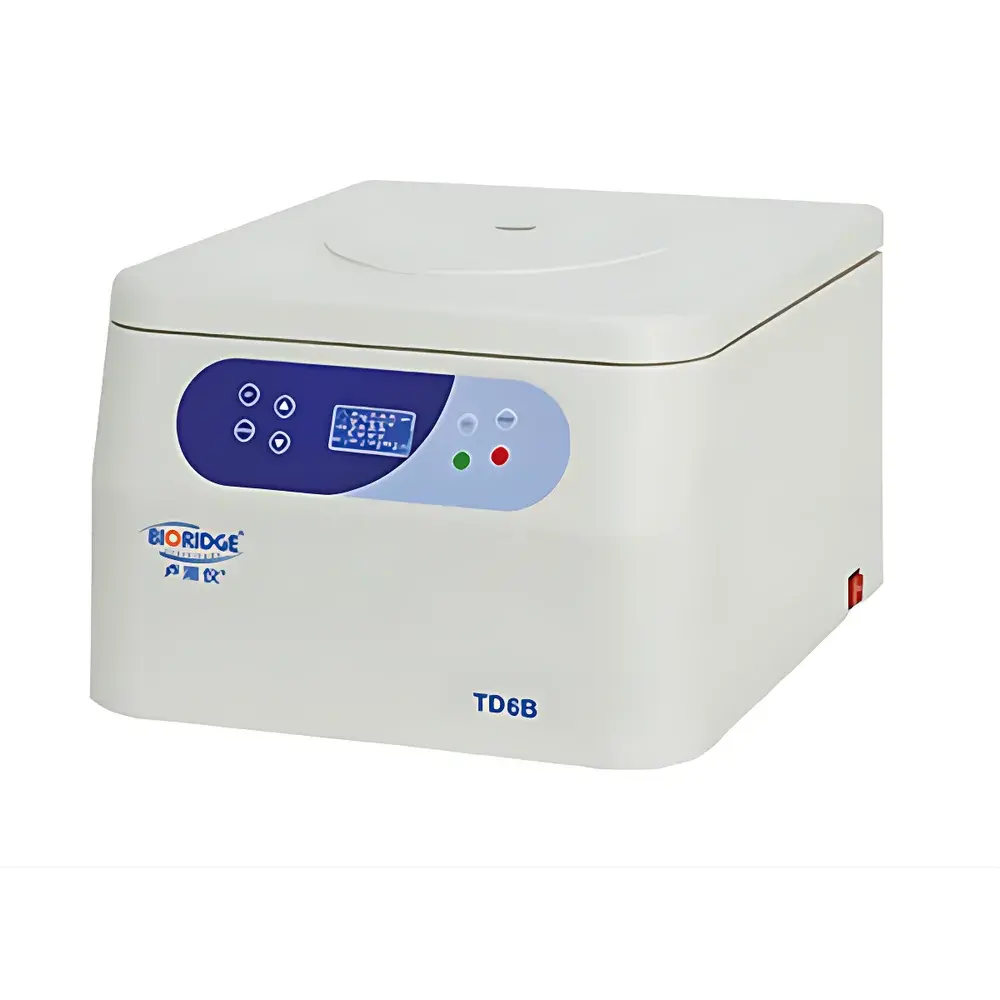
LUXIANGYI TD6B Benchtop Low-Speed Centrifuge
| Brand | LUXIANGYI / BIORIDGE |
|---|---|
| Origin | Shanghai, China |
| Model | TD6B |
| Instrument Type | Benchtop Centrifuge |
| Speed Range | Up to 6,000 rpm |
| Max RCF | 5,120 × g |
| Max Capacity | 16 × 15 mL |
| Rotor Configuration | Horizontal and Fixed-Angle Rotors |
| Control System | Microprocessor-Controlled, Brushless DC Motor |
| Display | LCD with Real-Time rpm/RCF Conversion |
| Safety Features | Electronic Lid Lock, Overspeed Protection, Imbalance Detection, Auto-Alarm |
| Construction | Stainless Steel Rotor Chamber & Food-Grade Silicone Sealing Ring (GMP Compliant) |
| Regulatory Compliance | FDA-Cleared |
| Dimensions (L×W×H) | 410 × 490 × 310 mm |
| Weight | 22 kg |
| Noise Level | <65 dB(A) |
| Power Supply | AC 220 V, 50 Hz, 10 A |
| Power Consumption | 300 W |
| Timer Range | 1 s – 99 min 59 s |
| Speed Accuracy | ±30 rpm |
Overview
The LUXIANGYI TD6B Benchtop Low-Speed Centrifuge is a microprocessor-controlled, brushless DC motor-driven instrument engineered for routine separation tasks in clinical diagnostics, biochemistry, immunology, and molecular biology laboratories. Designed to meet stringent operational requirements in regulated environments, it operates on the principle of sedimentation under centrifugal force—enabling differential separation of cellular components, precipitates, and macromolecular complexes based on density, size, and shape. Its maximum rotational speed of 6,000 rpm and corresponding relative centrifugal force (RCF) of 5,120 × g provide sufficient acceleration for pelleting erythrocytes, leukocytes, platelets, subcellular organelles, and large biomolecules such as plasmids and genomic DNA fragments—without inducing excessive shear stress or thermal denaturation common at higher speeds. The unit’s low-noise (<65 dB[A]) operation, compact footprint (410 × 490 × 310 mm), and energy-efficient 300 W power draw make it suitable for high-throughput benchtop deployment in ISO-certified cleanrooms, CLIA-accredited clinical labs, and GLP-compliant research facilities.
Key Features
- Brushless DC motor ensures stable rotation, extended service life, and minimal maintenance—eliminating carbon brush wear and associated electrical noise.
- Microprocessor-based control system with real-time rpm/RCF interconversion and automatic parameter retention across power cycles.
- Intuitive touch-panel interface with backlit LCD display supports programmable run profiles—including speed, time, acceleration/deceleration ramps, and auto-restart after power interruption.
- Electronic lid lock mechanism prevents operation unless the rotor chamber is fully sealed; integrated overspeed and imbalance detection triggers immediate shutdown and audible/visual alarm.
- Stainless steel rotor chamber and GMP-compliant food-grade silicone sealing ring resist corrosion and support cleaning validation protocols required under cGMP and ISO 13485.
- Optional three-axis gyroscope-based imbalance sensor offers adjustable sensitivity thresholds, enabling dynamic calibration to rotor mass distribution and damping characteristics—critical for reproducible runs with variable tube loads.
Sample Compatibility & Compliance
The TD6B accommodates a range of standard laboratory tubes, including 5–50 mL conical and round-bottom formats, with interchangeable rotors supporting configurations up to 16 × 15 mL (horizontal) or 12 × 15 mL (fixed-angle). Its design aligns with key international standards for medical device safety and performance: FDA 510(k) clearance confirms conformity with 21 CFR Part 820 (Quality System Regulation) and IEC 61010-1 (Safety Requirements for Electrical Equipment for Measurement, Control, and Laboratory Use). The instrument supports audit-ready documentation through optional timestamped event logging, compatible with laboratory information management systems (LIMS) for traceability in CAP-accredited or ISO/IEC 17025 environments. All rotors are precision-balanced per ISO 21501-4 and validated for cyclic loading endurance exceeding 10,000 runs.
Software & Data Management
While the TD6B operates as a standalone instrument, its embedded firmware supports export of run logs (timestamp, setpoint, actual rpm, RCF, duration, error codes) via USB interface for integration into electronic lab notebooks (ELN) or quality management software. Firmware updates are performed offline using signed binary files to ensure integrity and prevent unauthorized modification—meeting baseline requirements for FDA 21 CFR Part 11 compliance when paired with institutional access controls and audit trail policies. No cloud connectivity or remote telemetry is implemented, preserving data sovereignty and minimizing cybersecurity attack surface in sensitive healthcare settings.
Applications
- Clinical hematology: Separation of whole blood into plasma, buffy coat, and packed red cells per CLSI H26-A3 guidelines.
- Diagnostic serology: Clarification of serum/plasma samples prior to ELISA, chemiluminescence immunoassay (CLIA), or lateral flow testing.
- Cell culture processing: Harvesting adherent or suspension cells at low g-forces to maintain viability and surface marker integrity.
- Viral vector purification: Preliminary clarification steps in AAV or lentivirus workflows before ultracentrifugation or chromatography.
- Environmental microbiology: Concentration of waterborne pathogens (e.g., Cryptosporidium oocysts) from large-volume filtration eluates.
- Pharmaceutical QC: Routine particulate removal from parenteral formulations during stability studies per USP .
FAQ
Is the TD6B compliant with FDA 21 CFR Part 11 for electronic records?
The instrument itself does not generate electronic signatures, but its USB-exported run logs—when managed within a validated LIMS or ELN with appropriate access controls, audit trails, and retention policies—can satisfy Part 11 requirements.
Can the TD6B be used for centrifuging infectious samples?
Yes, provided biosafety level-appropriate rotors and sealed buckets are employed, and the unit is operated inside a certified biosafety cabinet or dedicated containment area per BMBL 6th edition recommendations.
What rotor configurations are validated for 15 mL conical tubes?
Two horizontal rotor options are certified: 12-position and 16-position, both rated for 4,200 rpm and 2,760 × g with 15 mL tubes; fixed-angle rotor (12 × 15 mL) is validated up to 6,000 rpm and 5,120 × g.
Does the imbalance detection system require recalibration?
No—the gyroscope-based sensor is factory-calibrated and self-diagnosing; threshold adjustment is software-configurable without physical intervention, supporting long-term reliability across varying load conditions.
Is routine preventive maintenance documented in the user manual?
Yes, the manual includes a maintenance schedule aligned with ISO 13485 Annex C, specifying lubrication intervals, seal inspection criteria, rotor lifetime tracking, and verification procedures for speed accuracy and temperature stability.



