
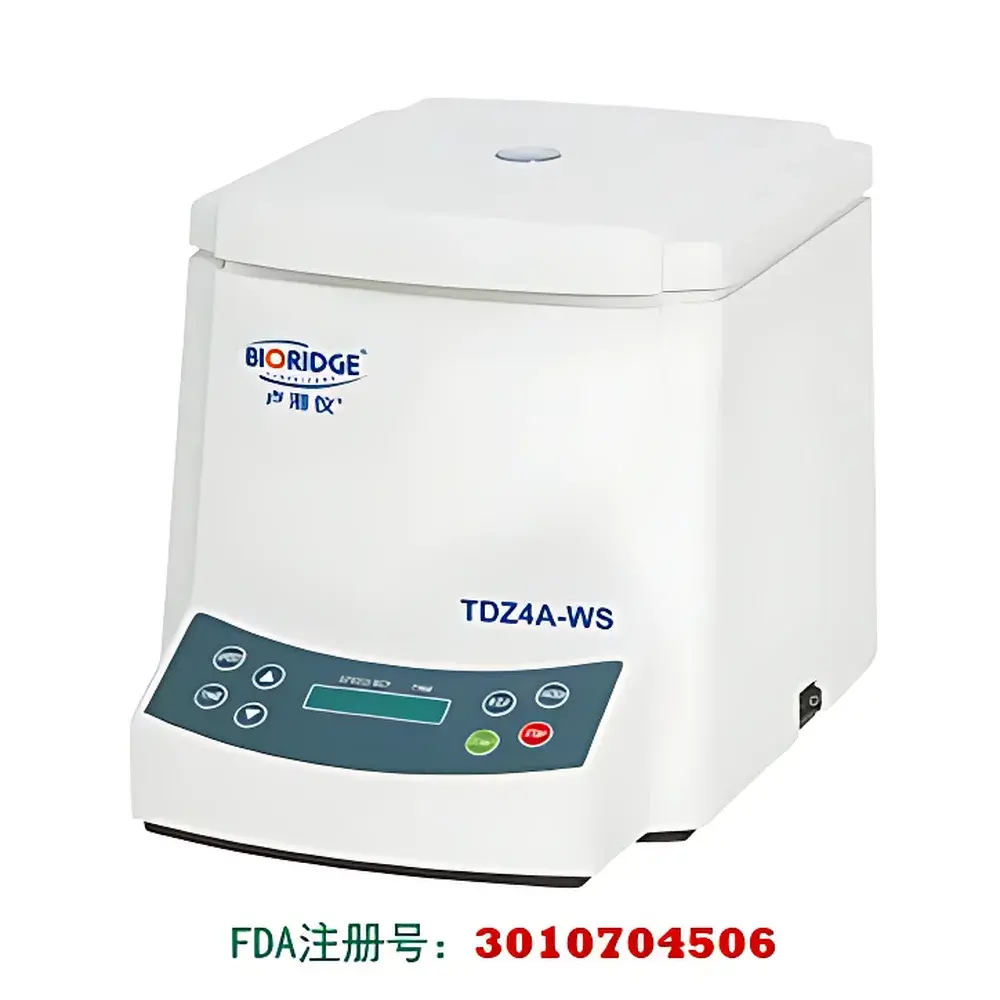
LUXIANGYI TDZ4A-WS Benchtop Low-Speed Centrifuge
| Brand | LUXIANGYI / BIORIDGE |
|---|---|
| Origin | Shanghai, China |
| Manufacturer Type | Authorized Distributor |
| Product Category | Domestic |
| Model | TDZ4A-WS |
| Instrument Type | Benchtop Centrifuge |
| Speed Range | Up to 4000 rpm |
| Max RCF | 1700 × g |
| Max Capacity | 8 × 20 mL |
| Rotor Configuration | Fixed-angle rotor |
| Application Class | Biological Macromolecules |
| Dimensions (L×W×H) | 230 mm × 310 mm × 240 mm |
| Weight | 9 kg |
| Speed Accuracy | ±30 rpm |
| Timer Range | 1–99 min |
| Noise Level | <65 dB(A) |
| Power Supply | AC 220 V, 50 Hz, 5 A |
Overview
The LUXIANGYI TDZ4A-WS is a microprocessor-controlled, benchtop low-speed centrifuge engineered for routine separation tasks in clinical laboratories, academic research settings, and quality control environments. It operates on a brushless DC motor architecture, delivering stable rotational dynamics with minimal mechanical wear and acoustically optimized performance (<65 dB[A]). Designed specifically for applications requiring gentle yet reproducible sedimentation—such as cell pelleting, serum/plasma separation, and precipitation of large biomolecular complexes—the TDZ4A-WS achieves a maximum speed of 4000 rpm and generates up to 1700 × g relative centrifugal force. Its fixed-angle rotor configuration supports standardized tube formats, including 8 × 20 mL or 12 × 10 mL, ensuring compatibility with widely adopted laboratory consumables. The instrument complies with general safety requirements for Class II electrical equipment (IEC 61010-1) and incorporates mechanical and electronic safeguards aligned with standard lab safety protocols.
Key Features
- Brushless DC motor drive ensures long service life, consistent torque delivery, and reduced electromagnetic interference compared to brushed alternatives.
- Intuitive touch-panel interface with real-time dual-display of rotational speed (rpm) and relative centrifugal force (RCF), enabling immediate parameter correlation without manual calculation.
- Programmable memory function stores user-defined protocols—including speed, time, and acceleration/deceleration profiles—for repeatable operation across shifts or operators.
- Digital LCD screen provides clear visual feedback of active parameters, elapsed time, remaining time, and system status indicators.
- Integrated safety systems include overspeed protection, imbalance detection, lid interlock mechanism, and automatic fault diagnostics with audible and visual alerts.
- Compact footprint (230 × 310 × 240 mm) and lightweight design (9 kg net) facilitate placement on shared benchtops or mobile carts without structural reinforcement.
Sample Compatibility & Compliance
The TDZ4A-WS accommodates common conical-bottom polypropylene tubes (e.g., 10 mL and 20 mL formats) used in hematology, microbiology, and protein biochemistry workflows. Its rotor geometry supports uniform sample distribution and minimizes vortex formation during deceleration. While not certified for biosafety level (BSL)-3 or aerosol-generating applications, the unit meets baseline requirements for non-hazardous biological sample processing under GLP-aligned laboratory practices. It does not carry ISO 13485 or FDA 21 CFR Part 11 validation out-of-the-box; however, its programmable memory and audit-ready parameter logging support traceability when integrated into documented SOPs.
Software & Data Management
This model operates via embedded firmware without external PC dependency. All operational parameters—including run history, error logs, and rotor usage counters—are retained in non-volatile memory. Time-stamped event records (e.g., “Run completed at 14:22:05, RCF = 1700 × g, duration = 15 min”) can be manually reviewed on-screen but are not exportable via USB or network interface. For laboratories requiring electronic record retention per ALCOA+ principles, integration with local LIMS or ELN systems must occur at the procedural level through operator documentation.
Applications
- Routine blood component separation: isolation of serum, plasma, or buffy coat from whole blood specimens.
- Microbial pellet collection prior to DNA extraction or Gram staining procedures.
- Sedimentation of mammalian cells (e.g., HEK293, CHO) following suspension culture harvest.
- Clarification of crude lysates containing insoluble aggregates or organelles.
- Preparative centrifugation steps in antibody purification workflows involving Protein A/G resin eluates.
- Quality assurance testing of reagent stability, including particle settling assessments in colloidal suspensions.
FAQ
What rotor configurations are supported by the TDZ4A-WS?
The unit ships with two fixed-angle rotor options: one accommodating twelve 10 mL tubes and another supporting eight 20 mL tubes—both operating at identical maximum specifications (4000 rpm / 1700 × g).
Is the centrifuge suitable for use with infectious samples?
It is intended for non-aerosolizing, low-risk biological materials only. Biosafety cabinets or sealed rotors are required for BSL-2+ agents.
Does the TDZ4A-WS meet international regulatory standards for clinical diagnostics?
It conforms to IEC 61010-1 for electrical safety but lacks CE-IVD or FDA 510(k) clearance; validation for diagnostic use must be performed internally per ISO 15189 or CLIA guidelines.
Can runtime be extended beyond 99 minutes?
No—the timer is hardware-limited to 99 minutes; continuous operation requires manual restart or external timing coordination.
What maintenance is recommended for long-term reliability?
Monthly inspection of rotor threads, biannual cleaning of air intake vents, and annual calibration verification of speed and timer accuracy using NIST-traceable tachometry tools.



