
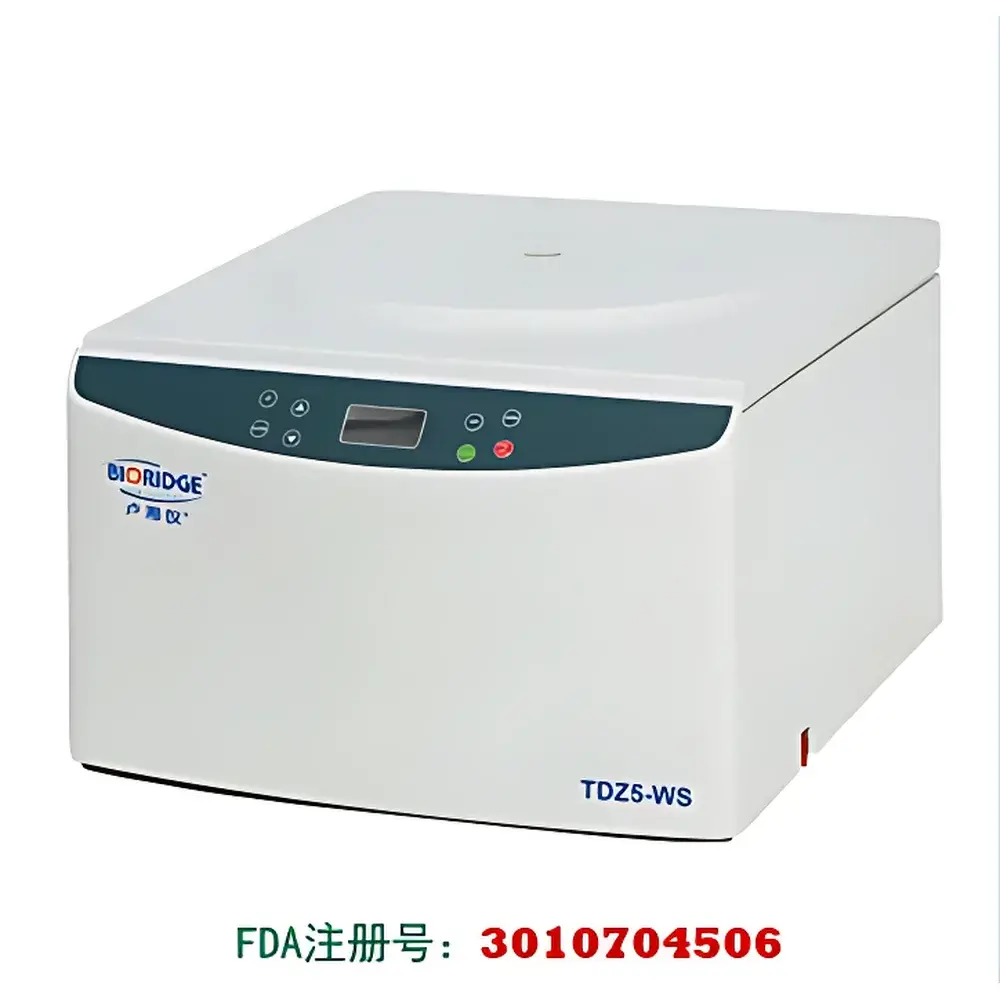
LuXiangYi TDZ5-WS Benchtop Low-Speed Centrifuge
| Brand | LuXiangYi / BIORIDGE |
|---|---|
| Origin | Shanghai, China |
| Manufacturer Type | Authorized Distributor |
| Product Category | Domestic |
| Model | TDZ5-WS |
| Instrument Type | Benchtop Centrifuge |
| Speed Range | 0–5000 rpm |
| Max RCF | 4390 × g |
| Max Capacity | 32 × 15 mL (horizontal rotor) |
| Dimensions (L×W×H) | 460 × 540 × 340 mm |
| Noise Level | <65 dB(A) |
| Power Supply | AC 220 V, 50 Hz, 10 A |
| Net Weight | 28 kg |
| Speed Accuracy | ±50 rpm |
| Timer Range | 1–99 min |
| Drive System | Microprocessor-Controlled DC Brushless Motor |
| Safety Features | Electronic Lid Lock, Overspeed Protection, Automatic Fault Alarm, Lid Interlock |
Overview
The LuXiangYi TDZ5-WS Benchtop Low-Speed Centrifuge is an engineered solution for routine separation tasks in clinical laboratories, academic research facilities, and quality control environments where gentle yet reliable sedimentation of biological suspensions is required. Designed around a microprocessor-controlled DC brushless motor, the instrument delivers stable rotational dynamics with minimal mechanical wear and acoustic emission—critical for shared lab spaces and long-duration protocols. Its operational envelope (0–5000 rpm, up to 4390 × g) aligns with ISO 15195:2018 and CLSI EP15-A3 guidelines for centrifugal validation in diagnostic sample preparation. Unlike high-speed or ultracentrifuge platforms, the TDZ5-WS prioritizes reproducible low-g force application ideal for pelleting whole blood cells, precipitating bacterial cultures, clarifying cell lysates, and harvesting extracellular vesicles without inducing shear-induced aggregation or membrane disruption.
Key Features
- DC brushless motor drive ensures consistent torque delivery across speed ranges, eliminating carbon brush degradation and reducing maintenance intervals.
- Intuitive touch-panel interface with backlit LCD display enables direct parameter entry—including simultaneous rpm and RCF readout—with real-time conversion and storage of up to 10 user-defined protocols.
- Electronic lid lock system complies with IEC 61010-2-020 safety standards; interlock prevents operation unless lid is fully closed and secured, and automatically halts rotation during unexpected lid opening.
- Integrated safety architecture includes overspeed detection, rotor imbalance sensing, and thermal monitoring—each triggering audible/visual alerts and immediate deceleration if thresholds are exceeded.
- Acoustically damped housing maintains sound pressure levels below 65 dB(A) at 1 m distance, meeting WHO-recommended ambient noise limits for continuous operator exposure in multi-station labs.
- Robust cast-aluminum chassis and precision-balanced horizontal rotor assembly ensure mechanical stability during extended runs (up to 99 minutes), minimizing vibration transmission to adjacent instrumentation.
Sample Compatibility & Compliance
The TDZ5-WS accommodates standard laboratory consumables including polypropylene conical tubes (15 mL, 50 mL), microtiter plates (96-well), and specialized carriers for hematocrit or urinalysis tubes. Its maximum capacity of 32 × 15 mL positions it as a high-throughput alternative to floor-standing units in resource-constrained settings. All rotors are certified to ISO 21501-4 for dimensional tolerance and dynamic balance. The centrifuge meets CE marking requirements under Directive 2014/30/EU (EMC) and 2014/35/EU (LVD), and supports GLP-compliant documentation via timestamped run logs stored internally. While not FDA 21 CFR Part 11–validated out-of-the-box, audit trails generated through optional USB data export satisfy internal QA traceability needs per ISO/IEC 17025:2017 clause 7.7.
Software & Data Management
No external software installation is required—the TDZ5-WS operates autonomously via embedded firmware. All run parameters (start time, set rpm/RCF, duration, final speed, error codes) are logged in non-volatile memory with automatic timestamping. Data export is supported via USB 2.0 port to FAT32-formatted drives, generating CSV files compatible with LIMS integration or Excel-based trend analysis. Firmware updates are delivered via encrypted USB image files, preserving configuration integrity during version upgrades. No cloud connectivity or remote access functionality is implemented, ensuring data sovereignty and alignment with institutional IT security policies.
Applications
- Clinical hematology: Separation of serum/plasma from whole blood using 15 mL or 50 mL tubes at 3000–4000 rpm (1500–2800 × g) for routine biochemistry panels.
- Microbiology: Harvesting bacterial pellets post-incubation without compromising viability or plasmid integrity—optimized at 4000 rpm for E. coli and S. aureus cultures.
- Cell culture labs: Clarification of conditioned media prior to ELISA or cytokine array analysis; compatible with low-adhesion tube formats.
- Veterinary diagnostics: Processing avian or equine blood samples requiring lower g-forces to preserve fragile erythrocyte morphology.
- Pharmaceutical QC: Centrifugation of suspension formulations for particle settling assessment per USP light obscuration methodology.
FAQ
What rotor configurations are factory-certified for the TDZ5-WS?
Four horizontal rotor variants are supplied with full calibration certificates: (1) 4 × 50 mL, (2) 8 × 50 mL, (3) 48 × 7 mL (12-position × 4 tiers), and (4) 8 × 96-well microplates.
Does the centrifuge support continuous operation mode?
No—it operates in timed mode only (1–99 min); however, sequential runs can be programmed manually without cooldown interruption between cycles.
Is rotor balancing required before each run?
Yes—symmetrical loading is mandatory per ISO 15195:2018 Annex B; the unit does not include auto-balancing compensation.
Can the TDZ5-WS be integrated into a networked lab environment?
It lacks Ethernet/Wi-Fi interfaces, but USB-exported CSV logs may be ingested by third-party LIMS or ELN systems via scheduled batch import.
What is the recommended service interval for preventive maintenance?
Annual inspection is advised per manufacturer guidelines, focusing on motor bearing integrity, lid seal compression, and electronic control board thermal performance.



