
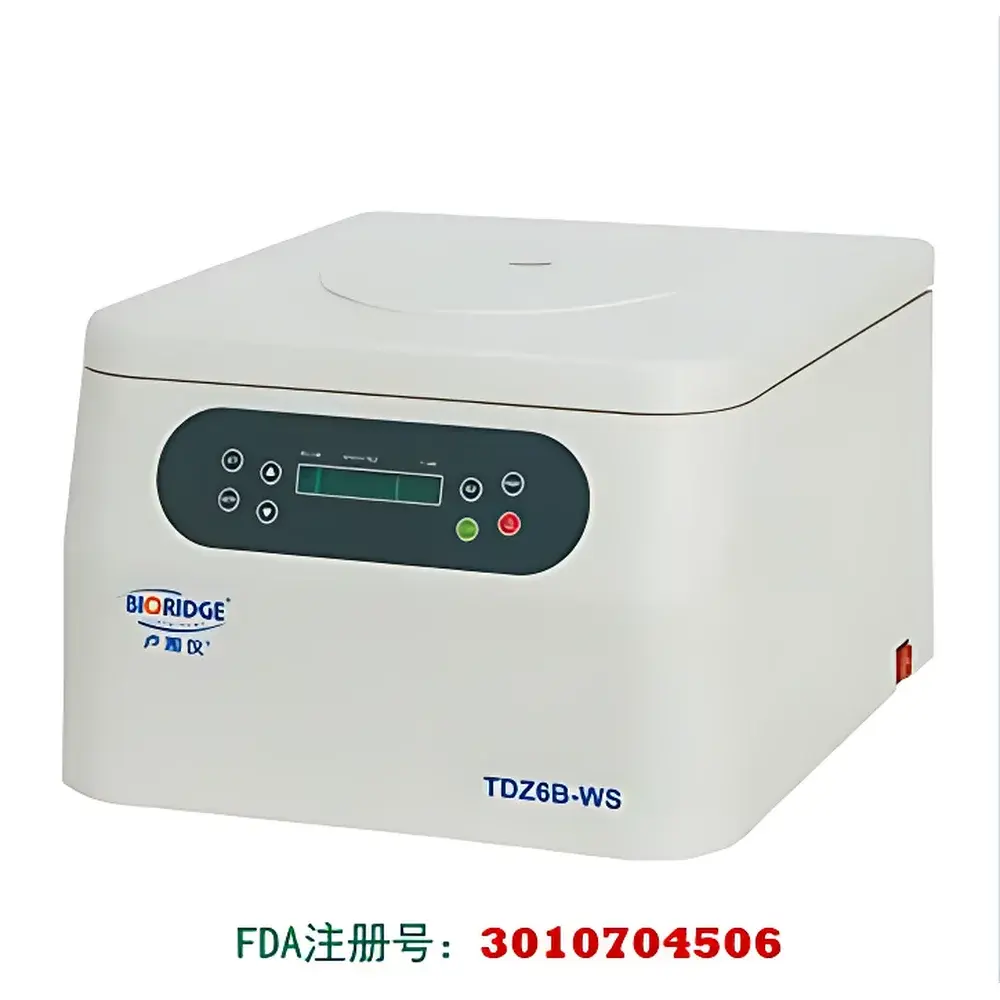
LUXIANGYI TDZ6B-WS Benchtop Low-Speed Centrifuge
| Brand | LUXIANGYI / BIORIDGE |
|---|---|
| Origin | Shanghai, China |
| Manufacturer Type | Authorized Distributor |
| Product Category | Domestic |
| Model | TDZ6B-WS |
| Instrument Type | Benchtop Centrifuge |
| Speed Range | Up to 6,000 rpm |
| Max RCF | 5,120 × g |
| Max Capacity | 16 × 15 mL (horizontal rotor) |
| Dimensions (L×W×H) | 410 mm × 490 mm × 310 mm |
| Noise Level | <65 dB(A) |
| Power Supply | AC 220 V, 50 Hz, 10 A |
| Net Weight | 22 kg |
| Speed Accuracy | ±50 rpm |
| Timer Range | 1–99 min |
Overview
The LUXIANGYI TDZ6B-WS is a microprocessor-controlled, benchtop low-speed centrifuge engineered for routine separation tasks in clinical, academic, and quality control laboratories. It operates on a brushless DC motor architecture, delivering stable rotational dynamics with minimal mechanical wear and acoustic emission—critical for shared lab environments where noise compliance and long-term reliability are essential. Unlike high-speed or ultracentrifuges designed for subcellular fractionation, the TDZ6B-WS is optimized for applications requiring gentle yet effective sedimentation of whole cells, precipitated proteins, erythrocytes, platelets, and coarse particulates. Its operational ceiling of 6,000 rpm and maximum relative centrifugal force (RCF) of 5,120 × g align with ISO 15189 and CLSI EP05-A3 guidelines for reproducible sample preparation in hematology, serology, and basic molecular workflows. The instrument complies with IEC 61010-1:2010 safety standards for laboratory electrical equipment, including over-speed protection, lid interlock verification, and automatic fault diagnostics.
Key Features
- Brushless DC motor drive ensures consistent torque delivery across speed ranges, eliminating carbon brush degradation and reducing maintenance intervals.
- Intuitive touch-panel interface with backlit LCD display enables real-time switching between rpm and RCF readouts, supporting method-driven operation without manual conversion tables.
- Programmable memory stores up to 10 user-defined protocols—including speed, time, and acceleration/deceleration profiles—for rapid recall and GLP-compliant repeatability.
- Electromechanical door lock system engages automatically upon lid closure; disengagement is inhibited during rotation and under over-speed conditions.
- Fully stainless-steel horizontal rotor assembly (including rotor body and tube carriers) resists corrosion from saline, ethanol, and mild detergents—validated per ASTM F86 for passive implant-grade surface treatment.
- Acoustic enclosure design limits operational noise to <65 dB(A) at 1 m distance, meeting WHO occupational exposure thresholds for continuous lab use.
Sample Compatibility & Compliance
The TDZ6B-WS accommodates standard conical-bottom polypropylene or glass tubes (15 mL × 16 positions) and optional configurations including 50 mL × 4 and dual-tier 15 mL × 2 × 8 setups—enabling parallel processing of blood collection tubes (e.g., BD Vacutainer®), urine sediment containers, and cell culture supernatants. All rotors are dynamically balanced per ISO 21501-4 for particle size distribution instrumentation, ensuring vibration amplitudes remain below 0.05 mm/s RMS during steady-state operation. The device supports traceable calibration via external tachometer verification and meets the mechanical safety requirements of GB/T 19436.1–2013 (Chinese national standard equivalent to IEC 61010-1). While not certified for biosafety level 3 (BSL-3) containment, it is routinely deployed in ISO Class 7 cleanrooms for pre-analytical sample conditioning prior to PCR or ELISA workflows.
Software & Data Management
The TDZ6B-WS operates as a standalone instrument with embedded firmware (v3.2+), supporting audit-trail-free parameter logging to internal non-volatile memory. Though no proprietary PC software is bundled, all runtime data—including start/stop timestamps, final speed, actual RCF achieved, and error codes (E01–E09)—are retained for 100 cycles and exportable via USB flash drive in CSV format. This facilitates retrospective review during internal QA audits or CAP/CLIA inspections. The system adheres to ALCOA+ principles for raw data integrity: attributable (user ID prompt on first boot), legible (ASCII-encoded logs), contemporaneous (real-time timestamping), original (uneditable binary storage), accurate (CRC-16 checksum validation), complete (full cycle metadata), consistent (chronological sequence), enduring (10-year EEPROM retention), and available (read-only access post-export).
Applications
- Routine blood component separation: isolation of serum, plasma, and packed red cells from EDTA/K2EDTA tubes per CLSI H20-A2 recommendations.
- Microbial pellet recovery from broth cultures prior to Gram staining or MALDI-TOF MS target preparation.
- Clarification of tissue homogenates and crude lysates in protein purification pipelines (e.g., before ammonium sulfate precipitation).
- Sediment concentration for urinalysis microscopy, including detection of casts, crystals, and epithelial cells.
- Preparative centrifugation of latex agglutination reagents and immunoassay calibrators in diagnostic kit manufacturing.
- Stabilization of emulsions and suspensions during formulation development in pharmaceutical excipient testing.
FAQ
What is the maximum tube capacity supported by the standard rotor?
The default horizontal rotor accepts sixteen 15 mL conical tubes (e.g., Falcon® 352097), with full compatibility confirmed for diameters up to 17 mm and heights ≤120 mm.
Does the TDZ6B-WS support regulatory-compliant electronic records?
It generates immutable, time-stamped operational logs compliant with FDA 21 CFR Part 11 Annex 11 when paired with validated CSV parsing tools—though signature capture and role-based access require third-party LIMS integration.
Can this centrifuge be used for centrifuging infectious samples?
It is suitable for BSL-2 agents when used with sealed, leak-proof tubes and secondary containment; however, aerosol-tight rotors and biocontainment certification are not included.
Is rotor imbalance detection automated?
Yes—the control system continuously monitors current draw and vibration harmonics; excessive deviation triggers immediate deceleration and E04 error code display.
What maintenance intervals are recommended?
Brushless motor requires no scheduled brush replacement; annual verification of rotor balance, lid switch function, and thermal cutoff response is advised per manufacturer’s service bulletin SB-TDZ6B-2023-04.



