
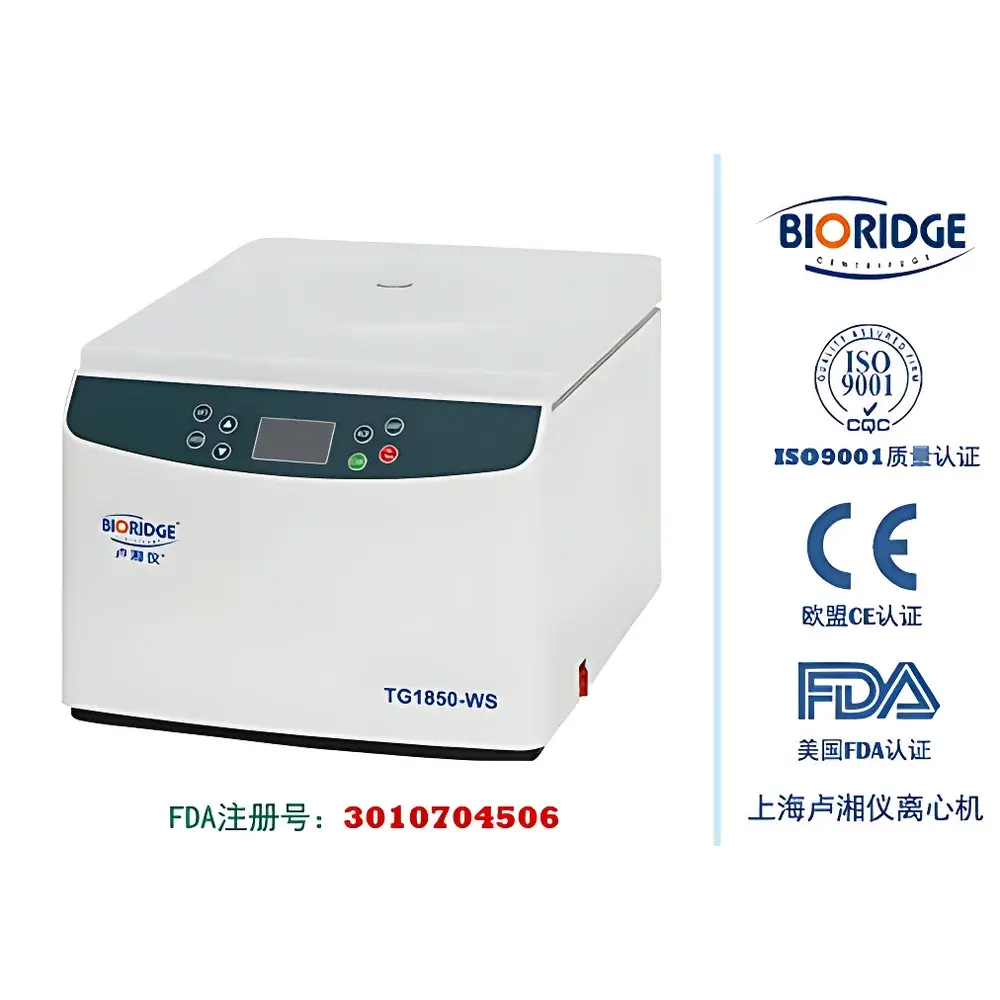
LUXIANGYI TG1650-W Benchtop High-Speed Centrifuge
| Brand | LUXIANGYI / BIORIDGE |
|---|---|
| Origin | Shanghai, China |
| Manufacturer Type | Authorized Distributor |
| Product Category | Domestic |
| Model | TG1650-W |
| Instrument Type | Benchtop Centrifuge |
| Speed Range | 10,000–30,000 rpm (Max. 16,500 rpm) |
| Rotor Type | Fixed-Angle & Swinging-Bucket Compatible |
| Max Capacity | 5 mL × 12 |
| Max RCF | 18,360 × g |
| Dimensions (W×D×H) | 320 mm × 410 mm × 320 mm |
| Net Weight | 12 kg |
| Noise Level | <62 dB(A) |
| Speed Accuracy | ±30 rpm |
| Timer Range | 1–99 min |
| Power Supply | AC 220 V, 50 Hz, 3 A |
| Safety Features | Electronic lid lock, overspeed protection, imbalance detection, automatic fault alarm |
| Display | Digital LCD with real-time rpm/RCF conversion |
| Control | Microprocessor-based, brushless DC motor drive, programmable touch interface |
Overview
The LUXIANGYI TG1650-W Benchtop High-Speed Centrifuge is an engineered solution for routine and research-grade centrifugal separation in compact laboratory environments. Designed around a brushless DC motor and microprocessor-controlled drive system, it delivers stable rotational dynamics with minimal mechanical wear and thermal drift—critical for reproducible sedimentation of biological macromolecules, cellular organelles, and particulate suspensions. Its operational envelope spans up to 16,500 rpm and generates a maximum relative centrifugal force (RCF) of 18,360 × g, positioning it within the high-speed centrifuge classification per ISO 15195:2018 and IEC 61010-2-020 safety standards. The unit’s compact footprint (320 × 410 × 320 mm) and low acoustic signature (<62 dB[A]) make it suitable for shared lab spaces, biosafety cabinets, and quality control laboratories where spatial efficiency and operator comfort are prioritized.
Key Features
- Brushless DC motor with closed-loop speed regulation ensures long-term torque consistency and eliminates carbon brush maintenance.
- Programmable touch interface with non-volatile memory stores up to 10 user-defined protocols—including speed, time, acceleration/deceleration profiles, and RCF/rpm interconversion.
- Digital LCD display provides simultaneous real-time readouts of actual rpm, calculated RCF, elapsed time, and remaining runtime.
- Integrated electronic lid lock prevents operation unless the rotor chamber is fully sealed; automatically disengages during deceleration to avoid sample disturbance.
- Multi-layer safety architecture includes dynamic imbalance sensing, overspeed cutoff, rotor recognition logic (via mechanical keying), and self-diagnostic error reporting with alphanumeric fault codes.
- Optimized airflow design and vibration-damping base reduce operational noise and improve mechanical stability across all speed ranges.
Sample Compatibility & Compliance
The TG1650-W supports standardized conical tube formats via interchangeable rotor adapters, including 0.2 mL, 0.5 mL, 1.5 mL, and 2.2 mL microtubes (12-position fixed-angle rotor), as well as 5 mL tubes (12-position swinging-bucket rotor). All rotors comply with ISO 21501-4 for particle size distribution validation and are validated for use under GLP-compliant workflows. The instrument meets IEC 61010-1 (Safety Requirements for Electrical Equipment for Measurement, Control, and Laboratory Use) and carries CE marking for conformity with EU Directive 2014/30/EU (EMC) and 2014/35/EU (LVD). It supports audit-ready operation when integrated into FDA 21 CFR Part 11–enabled environments through external data logging interfaces (RS-232 or optional USB).
Software & Data Management
While the TG1650-W operates autonomously via its embedded firmware, it supports external data capture via serial communication (RS-232) for integration into centralized laboratory information management systems (LIMS). Protocol parameters—including run ID, date/time stamp, setpoints, actual performance metrics, and fault logs—are timestamped and exportable in CSV format. Firmware updates are performed offline using manufacturer-provided utilities; version history and calibration records are retained in internal flash memory for traceability. No cloud connectivity or proprietary software installation is required, aligning with institutional cybersecurity policies restricting networked instrumentation.
Applications
- Precipitation of nucleic acids and proteins from clarified lysates (e.g., plasmid prep, antibody purification).
- Separation of subcellular fractions including mitochondria, nuclei, and microsomes from homogenized tissues.
- Routine clinical centrifugation of serum, plasma, and urine samples prior to immunoassay or HPLC analysis.
- Pre-concentration of viral particles, exosomes, and nanoscale colloids in virology and extracellular vesicle research.
- Quality assurance testing of suspension stability in pharmaceutical formulations and cosmetic emulsions.
FAQ
What rotor configurations are certified for use with the TG1650-W?
The instrument is validated for two primary rotor types: a 12-place fixed-angle rotor (for microtubes up to 2.2 mL) and a 12-place swinging-bucket rotor (for 5 mL conical tubes). Adapter sets for 0.2 mL, 0.5 mL, and 1.5 mL tubes are included and mechanically keyed to prevent misloading.
Is the TG1650-W compliant with Good Laboratory Practice (GLP) requirements?
Yes—its programmable protocol storage, timestamped run logs, electronic lid interlock, and fault-traceable diagnostics support GLP documentation standards. Full audit trails require integration with validated third-party LIMS or electronic lab notebook (ELN) systems.
Can this centrifuge be used for blood banking applications?
It is suitable for routine serum/plasma separation at speeds up to 13,000 rpm (11,400 × g) with the 5 mL swinging-bucket rotor, meeting CLSI GP44-A6 recommendations for clinical centrifugation. However, it is not designed for continuous-flow or large-volume processing typical of blood bank separators.
Does the unit include rotor balancing assistance?
No automatic balancing mechanism is present; users must manually balance tube loads to within ±0.1 g per position, as specified in the operator manual. Imbalance detection triggers immediate shutdown before reaching critical vibration thresholds.
What is the recommended service interval for preventive maintenance?
Annual verification of rotor integrity, motor calibration, and safety interlock functionality is advised. Rotor lifetime is tracked by cumulative run hours and stored in non-volatile memory; replacement is mandated after 1,000 hours or 5 years, whichever occurs first, per ISO 15195 Annex B guidelines.
Related Products



