
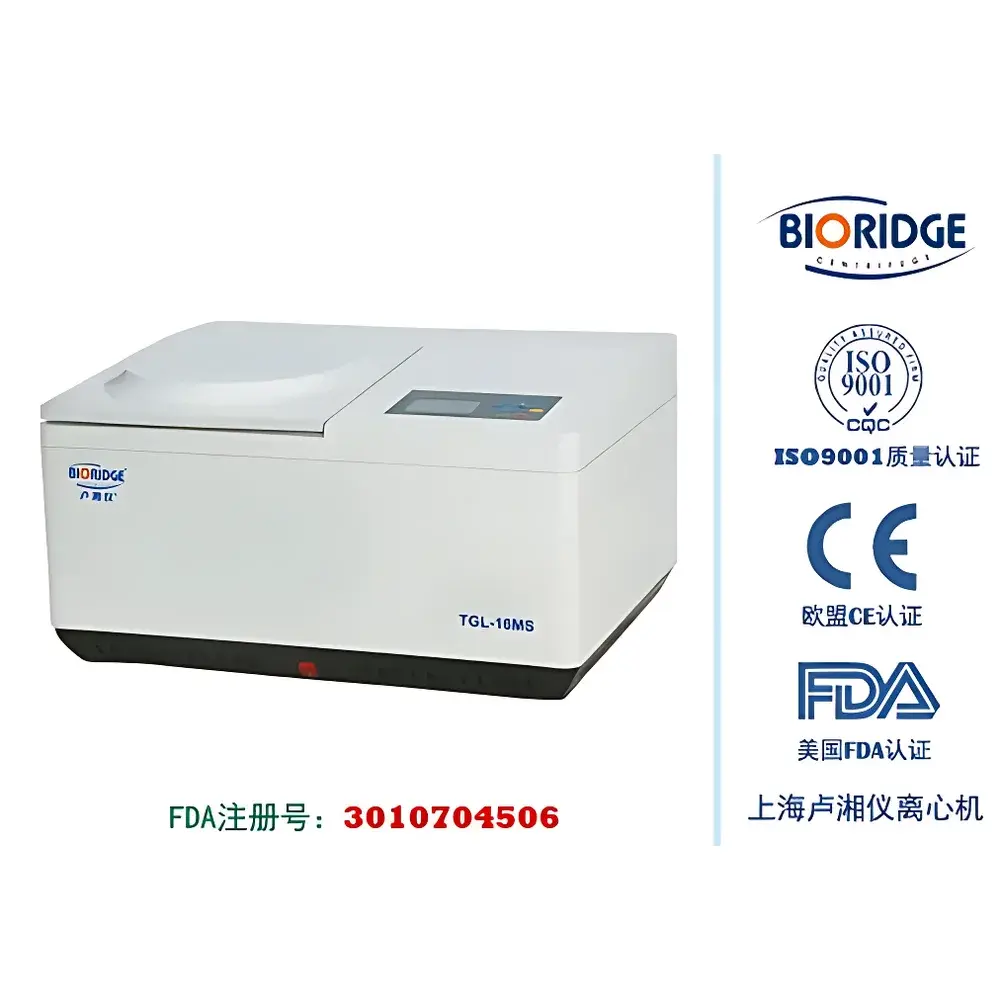
LuXiangYi TGL-16MS Benchtop High-Speed Refrigerated Centrifuge
| Brand | LuXiangYi / BIORIDGE |
|---|---|
| Origin | Shanghai, China |
| Model | TGL-16MS |
| Type | Benchtop Refrigerated Centrifuge |
| Speed Range | 10,000–16,000 rpm |
| Max RCF | 17,800 × g |
| Max Capacity | 6 × 50 mL |
| Temperature Range | −20 °C to +40 °C |
| Temp. Accuracy | ±1 °C |
| Dimensions (L×W×H) | 600 mm × 470 mm × 330 mm |
| Noise Level | <65 dB(A) |
| Power Supply | AC 220 V, 50 Hz, 15 A |
| Net Weight | 50 kg |
Overview
The LuXiangYi TGL-16MS Benchtop High-Speed Refrigerated Centrifuge is engineered for precision separation of biological macromolecules—including nucleic acids, proteins, subcellular organelles, and viral particles—under precisely controlled thermal conditions. Utilizing a brushless DC motor and microprocessor-based control architecture, the system delivers high rotational stability, low mechanical vibration, and consistent speed accuracy (±30 rpm) across extended operational cycles. Its refrigeration system employs a high-efficiency imported compressor with environmentally compliant R134a refrigerant, enabling rapid temperature equilibration and sustained thermal uniformity within the rotor chamber—even during prolonged high-speed runs. Designed for routine use in clinical diagnostics laboratories, academic research facilities, and biotechnology QA/QC environments, the TGL-16MS meets fundamental requirements for reproducible, GxP-aligned sample preparation workflows where temperature-sensitive integrity and centrifugal force fidelity are critical.
Key Features
- Microprocessor-controlled operation with intuitive touch-panel interface and large backlit LCD display for real-time monitoring of rpm, RCF, time, and temperature.
- Programmable multi-step protocols: up to 9 user-defined acceleration/deceleration rate profiles to minimize shear stress on delicate samples such as plasmid DNA or exosomes.
- Comprehensive safety architecture including electronic lid lock, overspeed protection, overtemperature cutoff, imbalance detection, and automatic fault diagnostics with audible/visual alerts.
- Brushless DC motor ensures maintenance-free operation, reduced electromagnetic interference, and superior torque consistency at high rotational speeds (up to 16,000 rpm).
- Optimized acoustic design achieves noise levels below 65 dB(A) at maximum speed—suitable for shared laboratory spaces without dedicated acoustic enclosures.
- Auto-memory function retains last-used parameters and up to 9 stored programs, supporting standardized operating procedures (SOPs) and operator-independent reproducibility.
Sample Compatibility & Compliance
The TGL-16MS supports a broad range of tube formats and microplate configurations via interchangeable rotors and adapters—including 1.5/2.2 mL × 12 or × 24, 5 mL × 12, 15 mL × 8, 10 mL × 12, 0.5 mL × 48, 50 mL × 6, and 48-well microtiter plates. All rotors are dynamically balanced and certified for use at rated speeds and loads per ISO 15195:2018 (clinical laboratory centrifuges) and IEC 61010-2-020 (safety requirements for laboratory equipment). While not pre-certified for FDA 21 CFR Part 11 compliance out-of-the-box, the instrument’s audit-trail-capable parameter logging (with timestamped run records) provides foundational traceability for GLP/GMP environments when integrated with validated LIMS or ELN systems.
Software & Data Management
The TGL-16MS operates independently without proprietary PC software; all configuration and execution occur via the onboard controller. However, it supports manual documentation of run parameters—including date/time stamp, rotor ID, speed, RCF, duration, set temperature, and final chamber temperature—for inclusion in laboratory notebooks or electronic records. Optional RS-232 or USB data export modules (available upon request) enable transfer of run logs to external databases. The system’s deterministic behavior—repeatable ramp profiles, stable thermal regulation, and precise speed control—facilitates validation per ASTM E2500-13 (verification of laboratory equipment) and supports IQ/OQ protocols required for regulated laboratories.
Applications
- Purification of genomic DNA, plasmid DNA, and RNA from lysates using differential centrifugation and density gradient protocols.
- Isolation of mitochondria, nuclei, lysosomes, and other subcellular fractions from mammalian and plant tissues.
- Clarification of bacterial and yeast cultures prior to protein expression analysis or fermentation downstream processing.
- Preparation of serum, plasma, and cerebrospinal fluid (CSF) specimens for clinical immunoassays and biomarker profiling.
- Concentration and pelleting of extracellular vesicles (exosomes, microvesicles) for proteomic and transcriptomic characterization.
- Routine quality control of monoclonal antibody preparations, vaccine suspensions, and nanoparticle formulations requiring cold-conditioned sedimentation.
FAQ
What is the minimum and maximum operating temperature range?
The chamber temperature can be set between −20 °C and +40 °C, with typical stabilization achieved within 15 minutes of startup at −10 °C or higher setpoints.
Does the TGL-16MS support rotor auto-recognition?
No—rotor identification is manual; users must select the appropriate rotor type and load configuration from the menu prior to run initiation to ensure correct RCF calculation and safety interlock activation.
Can this centrifuge be used for blood banking applications?
Yes, provided the selected rotor and tube configuration comply with local blood product handling guidelines (e.g., AABB standards); however, it is not CE-marked for in vitro diagnostic (IVD) use under EU MDR.
Is the refrigeration system serviceable in the field?
The sealed R134a compressor unit requires certified refrigeration technician intervention; routine maintenance includes condenser coil cleaning and door seal inspection every 6 months.
Are calibration certificates available for metrological traceability?
Factory calibration reports (speed, temperature, timer) are included with each unit; third-party accredited calibration services (e.g., ISO/IEC 17025) can be arranged separately through authorized service partners.



