
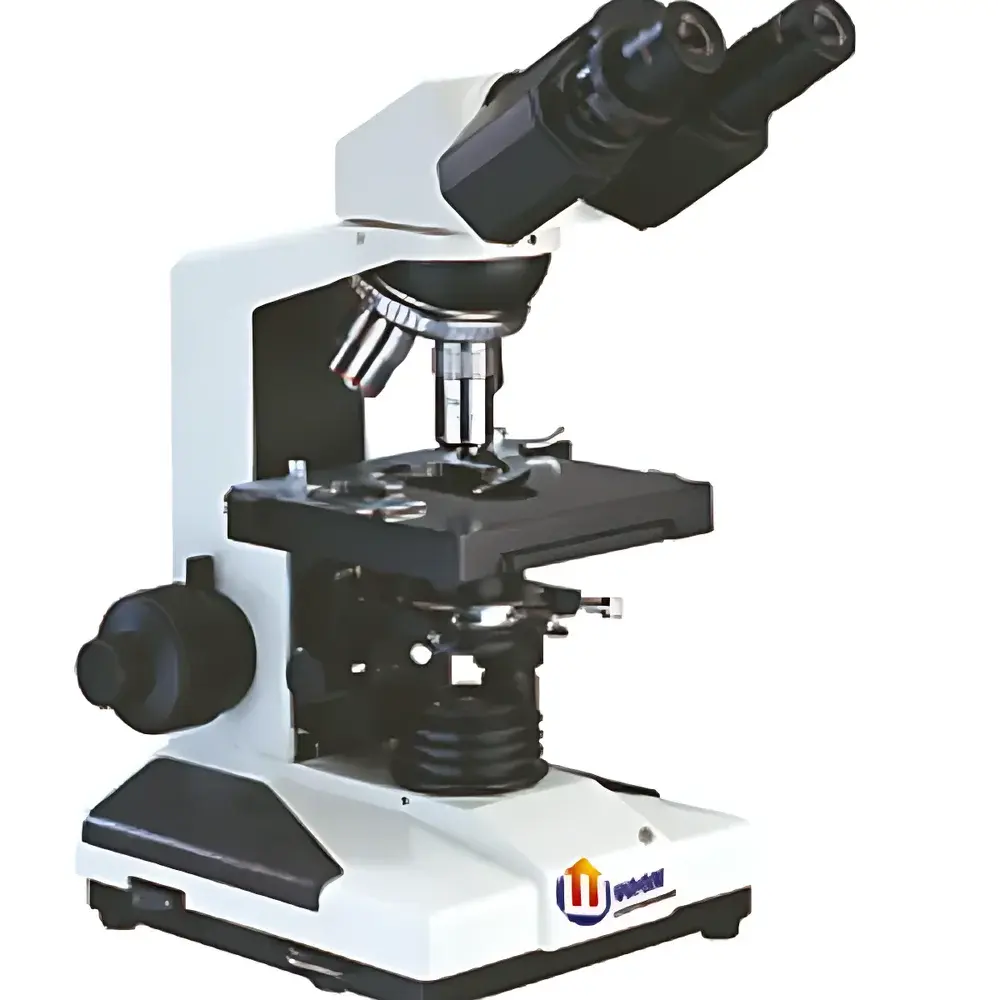
YANRUN BI-17 Biological Inverted Microscope
| Brand | YANRUN |
|---|---|
| Origin | Shanghai, China |
| Manufacturer Type | Direct Manufacturer |
| Product Category | Domestic (China-Made) |
| Model | BI-17 Biological Inverted Microscope |
| Instrument Classification | Inverted Microscope |
| Eyepiece Configuration | Binocular |
| Magnification Range | 40×–1000× |
| Eyepieces | Wide-Field WF10× (Φ18 mm) |
| Objectives | Achromatic 4×/0.10, 10×/0.25, 40×/0.65 (spring-loaded), 100×/1.25 (spring-loaded, oil-immersion) |
| Nosepiece | Four-position inward-rolling ball bearing turret |
| Stage | Dual-layer mechanical stage (135 mm × 125 mm), travel range 75 mm × 35 mm |
| Condenser | Abbe condenser, N.A. 1.25, vertically adjustable |
| Filters | Blue filter, ground glass |
| Illuminator | 6 V / 20 W halogen lamp with brightness control |
| Focusing Mechanism | Coaxial coarse/fine focus |
| fine focus graduation | 2 µm |
| Optional Accessories | Phase contrast kits (PH-I/PH-II turret, PHP objectives), LED illuminator (9 V / 500 mA), polarizing components, infinity-corrected optical path upgrade, USB/VIDEO trinocular port, plan achromat objectives, darkfield condensers, wide-field and reticle eyepieces |
Overview
The YANRUN BI-17 Biological Inverted Microscope is engineered for routine and advanced life science applications requiring stable, high-contrast observation of live cells, adherent cultures, and tissue specimens in standard Petri dishes, multi-well plates, and flasks. Its inverted optical architecture positions the objective lenses beneath the specimen stage and the condenser above—enabling unobstructed access to culture vessels during real-time imaging and manipulation. The system employs a finite-conjugate achromatic optical design optimized for Köhler illumination, delivering consistent resolution and color fidelity across the full 40×–1000× magnification range. Designed for laboratory durability and ergonomic operation, the BI-17 features a rigid cast-aluminum base, precision-ground mechanical stage, and thermally stable halogen illumination—making it suitable for extended daily use in academic teaching labs, QC environments, and preclinical research settings where reproducibility and operator comfort are critical.
Key Features
- Binocular inclined head (30° tilt) with interpupillary adjustment and diopter compensation for extended visual fatigue–free observation.
- Coaxial coarse/fine focusing mechanism with 2 µm fine-focus graduation; BI-17B and BI-17C variants incorporate dual-function locking, travel limiters, and user-adjustable coarse-focus resistance to prevent accidental stage overtravel.
- Four-position inward-rolling ball-bearing nosepiece ensures precise, repeatable objective alignment and long-term rotational stability.
- Dual-layer mechanical stage (135 mm × 125 mm) with 75 mm × 35 mm travel range, calibrated vernier scales, and low-profile controls for smooth specimen navigation under high-magnification conditions.
- Abbe condenser (N.A. 1.25) with centering screws and vertical rack-and-pinion adjustment—compatible with brightfield, darkfield (dry/wet), and phase contrast configurations.
- 6 V / 20 W halogen illuminator with continuous intensity control and integrated heat-absorbing filter to minimize thermal load on live specimens.
- Modular optical pathway supports seamless integration of optional accessories—including phase contrast (PH-I/PH-II turret, PHP objectives), polarizing components, LED retrofit kits, and trinocular ports for digital imaging.
Sample Compatibility & Compliance
The BI-17 accommodates standard cultureware including 35 mm–150 mm Petri dishes, T-flasks (T25–T225), 6–96-well plates, and chambered coverglass systems. Its working distance clearance (≥3.5 mm at 40×, ≥0.15 mm at 100× oil) enables compatibility with most commercially available cell culture inserts and microfluidic devices. The microscope conforms to IEC 61000-6-3 (EMC emissions) and IEC 61000-6-2 (immunity) standards. While not certified for ISO 13485 or FDA 21 CFR Part 11 out-of-the-box, its mechanical and optical architecture supports GLP/GMP-aligned documentation workflows when paired with validated digital imaging systems and audit-trail-capable software.
Software & Data Management
The BI-17 does not include proprietary acquisition software; however, its USB/VIDEO trinocular output (available as optional configuration) is compatible with industry-standard imaging platforms—including Olympus cellSens, Zeiss ZEN Blue, and open-source tools such as Fiji/ImageJ. When equipped with a compliant CMOS camera (e.g., 5 MP or higher resolution), the system supports time-lapse capture, z-stack acquisition, and basic morphometric analysis. Metadata embedding (objective ID, magnification, exposure time) is preserved via standard AVI/TIFF export protocols. For regulated environments, users may integrate third-party validation packages to establish electronic record integrity per ALCOA+ principles.
Applications
- Live-cell monitoring of proliferation, migration, and morphological changes in mammalian, insect, and stem cell lines.
- Routine quality control of hybridoma cultures, primary isolates, and bioproduction batches.
- Phase contrast imaging of unstained, low-contrast specimens—including neurons, fibroblasts, and organoids—without fixation or staining artifacts.
- Support for transfection efficiency assessment, co-culture interaction studies, and drug-response assays in multi-well formats.
- Teaching laboratories: Ideal for undergraduate instruction in cell biology, microbiology, and histology due to intuitive ergonomics and modular expandability.
- Preclinical assay development: Compatible with endpoint assays involving trypan blue exclusion, neutral red uptake, and calcein-AM/EthD-1 viability staining.
FAQ
Is the BI-17 suitable for oil immersion work?
Yes—the 100×/1.25 NA achromatic objective is spring-loaded and designed for use with Type A immersion oil (n = 1.515). Proper cleaning and storage protocols must be followed to maintain lens integrity.
Can the BI-17 be upgraded to infinity-corrected optics?
Yes—optional infinity-corrected eyepieces, objectives (including plan achromats and PHP phase contrast variants), and matching tube lens assemblies are available to enhance flatness of field and chromatic correction.
What power supply options are available for LED illumination retrofit?
Two AC input variants are offered: 230 V ±10 %, 50/60 Hz and 110 V ±10 %, 50/60 Hz—both delivering regulated 9 V DC / 500 mA output for stable white-light LED performance.
Does the microscope support darkfield imaging?
Yes—dry and wet darkfield condensers are available as optional accessories and mechanically compatible with the Abbe condenser mount.
Is technical documentation provided in English?
Yes—comprehensive English-language user manuals, mechanical drawings, optical schematics, and CE Declaration of Conformity are supplied with each unit upon request.




