
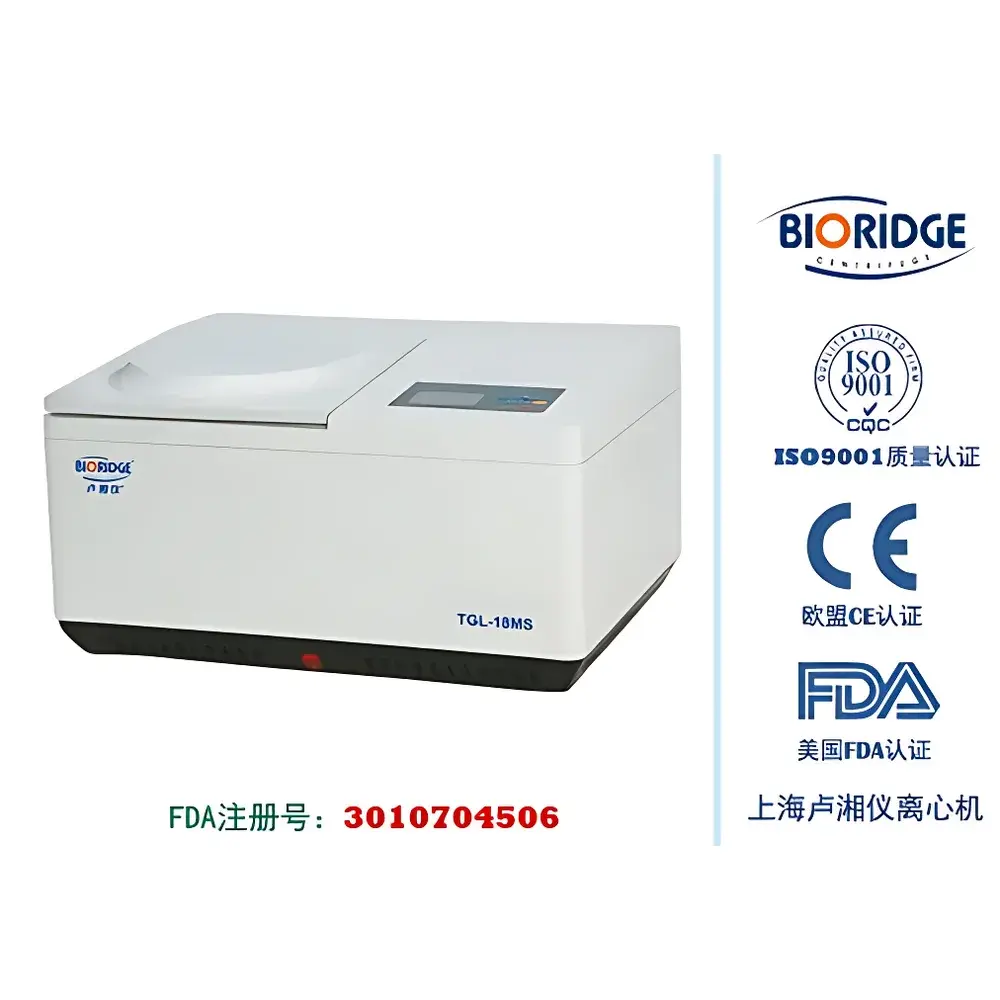
LuXiangYi TGL-18M Benchtop High-Speed Refrigerated Centrifuge
| Brand | LuXiangYi / BIORIDGE |
|---|---|
| Origin | Shanghai, China |
| Model | TGL-18M |
| Instrument Type | Benchtop Centrifuge |
| Cooling Function | Refrigerated (−20 °C to +40 °C) |
| Max Speed | 18,000 rpm |
| Max RCF | 23,755 ×g |
| Max Capacity | 4 × 100 mL |
| Rotor Configuration | Horizontal (Swinging-Bucket) |
| Application Class | Biomolecular Separation |
| Dimensions (L×W×H) | 600 mm × 470 mm × 330 mm |
| Noise Level | <65 dB(A) |
| Power Supply | AC 220 V, 50 Hz, 15 A |
| Net Weight | 50 kg |
| Motor | High-Torque AC Frequency-Controlled Motor |
| Control Interface | Digital Display (TGL-18M) / LCD (TGL-18MS variant) |
| Programmability | 9 User-Defined Acceleration/Deceleration Profiles |
| Safety Features | Electronic Lid Lock, Overspeed Protection, Overtemperature Protection, Automatic Fault Alert |
| Refrigeration System | Imported Compressor with R134a Refrigerant |
| Temperature Accuracy | ±1 °C |
| Speed Accuracy | ±30 rpm |
| Timer Range | 1 min – 9 h 59 min (or 1–99 min in short-mode) |
Overview
The LuXiangYi TGL-18M Benchtop High-Speed Refrigerated Centrifuge is an engineered solution for precise, reproducible separation of temperature-sensitive biological samples in regulated laboratory environments. Designed around the principles of sedimentation centrifugation under controlled thermal conditions, the TGL-18M achieves high-resolution fractionation of subcellular components—including organelles, nucleic acids, and protein complexes—by applying a maximum relative centrifugal force (RCF) of 23,755 × g at 18,000 rpm. Its integrated refrigeration system maintains sample integrity across a wide operational temperature range (−20 °C to +40 °C), making it suitable for applications requiring cold-chain continuity—from plasmid purification and viral pellet recovery to membrane protein isolation and cryopreserved cell processing. The unit’s compact benchtop footprint (600 × 470 × 330 mm) and low acoustic signature (<65 dB[A]) enable deployment in shared core facilities, clinical diagnostics labs, and teaching laboratories without compromising workflow efficiency or ambient noise compliance.
Key Features
- High-torque AC frequency-controlled motor ensures stable rotational dynamics, minimal speed drift (±30 rpm), and extended service life under repeated high-load cycles.
- Digital control interface with real-time rpm/RCF interconversion simplifies protocol translation and eliminates manual calculation errors during method transfer.
- Programmable acceleration and deceleration profiles (9 user-defined curves) allow optimization of shear-sensitive separations—critical for intact ribosome isolation or extracellular vesicle enrichment.
- Electronic lid lock with automatic engagement prevents rotor operation unless the chamber is fully sealed, satisfying IEC 61010-2-020 safety requirements for centrifuge equipment.
- Multi-layer protection architecture includes overspeed detection, overtemperature cutoff, rotor imbalance sensing, and self-diagnostic fault logging—all compliant with ISO 13485-aligned quality assurance frameworks.
- Energy-efficient refrigeration system using R134a refrigerant delivers rapid cool-down (<15 min from +25 °C to −20 °C) and tight thermal stability (±1 °C) throughout prolonged runs.
Sample Compatibility & Compliance
The TGL-18M supports a broad spectrum of sample formats via interchangeable horizontal rotors and certified adapters—validated for use with microtubes (0.2–2.2 mL), conical tubes (5–100 mL), enzymatic assay plates (48-well), and specialized containers for density gradient centrifugation. All rotor configurations are CE-marked and meet EN 61010-1 mechanical safety standards. For regulated environments, the instrument’s non-volatile parameter memory, timestamped run logs, and error-event traceability support GLP/GMP documentation workflows. While not natively 21 CFR Part 11 compliant, its audit-ready data export (via USB) enables integration into validated LIMS or ELN systems when paired with appropriate procedural controls.
Software & Data Management
The TGL-18M operates independently without proprietary software dependency; all parameters—including speed, time, temperature, and ramp profiles—are configured directly on-device and retained in non-volatile memory after power cycling. Run history (last 100 cycles) is stored locally with timestamps, RCF values, and fault codes. Data export is supported via standard USB-A port, enabling CSV-formatted reports compatible with Excel, LabArchives, or internal QA databases. No cloud connectivity or remote access capability is included—consistent with institutional cybersecurity policies governing lab instrumentation.
Applications
- Clinical diagnostics: Serum/plasma separation, PBMC isolation, pathogen concentration from low-volume specimens.
- Molecular biology: Plasmid DNA purification, RNA precipitation, cDNA library preparation, CRISPR ribonucleoprotein complex pelleting.
- Cell biology: Mitochondrial and lysosomal fractionation, exosome isolation via differential ultracentrifugation (with optional rotor upgrades).
- Biopharmaceutical QC: Clarification of monoclonal antibody harvests, removal of host cell proteins, aggregate analysis prep.
- Academic research: Teaching protocols in biochemistry labs, standardized centrifugation modules for undergraduate capstone projects.
FAQ
What is the maximum allowable imbalance tolerance for the TGL-18M?
The unit features automatic imbalance detection calibrated to ≤2 g difference between opposing buckets—within ISO 15856-1 specifications for horizontal rotor safety.
Can the TGL-18M be used for continuous operation at −20 °C?
Yes, the compressor and heat-exchange design permit uninterrupted operation across the full temperature range, provided ambient room temperature remains between 10–30 °C and ventilation clearance (≥10 cm on all sides) is maintained.
Are rotors autoclavable?
Aluminum rotors are not autoclavable; they must be cleaned with ethanol or mild detergent and air-dried. Stainless steel adapters may undergo low-pressure steam sterilization per manufacturer guidelines.
Does the TGL-18M support rotor recognition?
No—rotor identification is manual; users must select the correct rotor type and max speed limit prior to run initiation to prevent over-speed events.
Is service documentation available in English?
Yes, full technical manuals, calibration procedures, and spare parts catalogs are provided in English upon request through authorized BIORIDGE distribution partners.



