
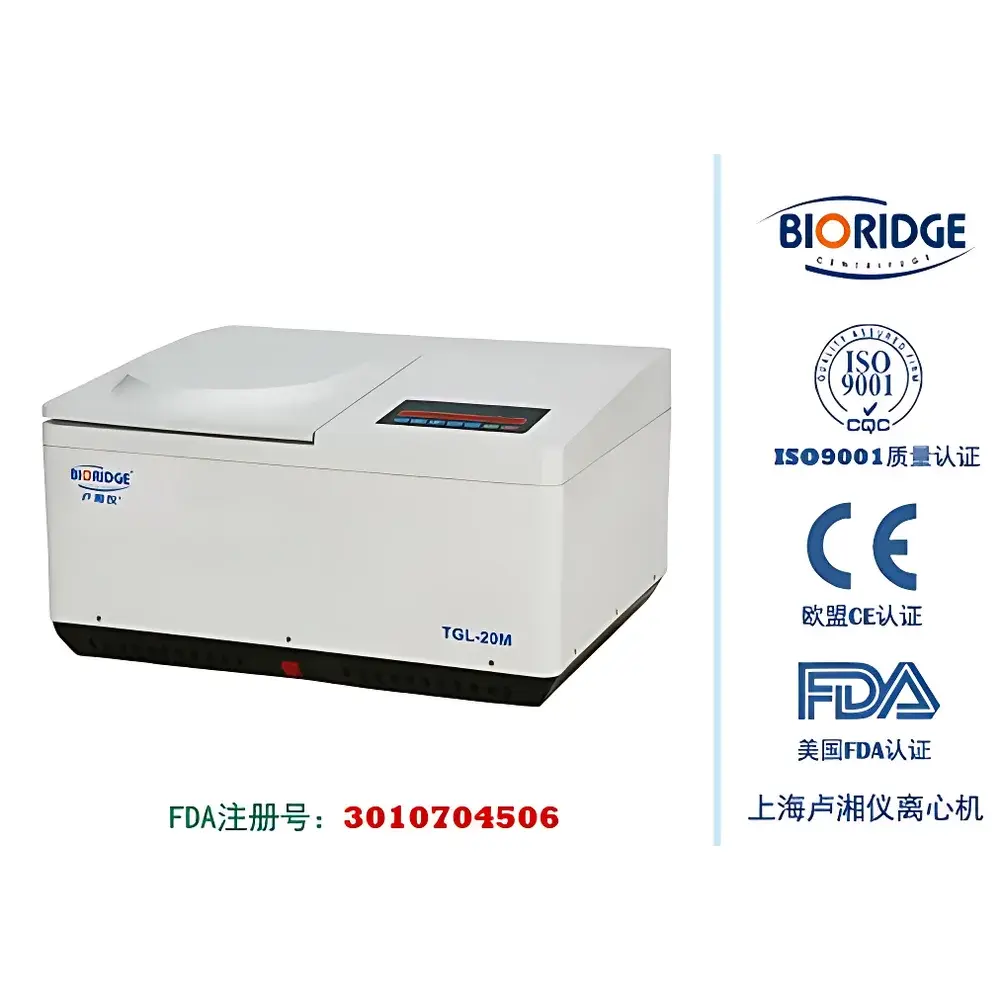
LUXIANGYI TGL-20M Benchtop High-Speed Refrigerated Centrifuge
| Brand | LUXIANGYI / BIORIDGE |
|---|---|
| Origin | Shanghai, China |
| Model | TGL-20M |
| Instrument Type | Benchtop Refrigerated Centrifuge |
| Speed Range | 10,000–20,000 rpm |
| Max RCF | 27,800 × g |
| Max Capacity | 4 × 100 mL |
| Temperature Range | −20 °C to +40 °C |
| Temp. Accuracy | ±1 °C |
| Noise Level | <65 dB(A) |
| Dimensions (L×W×H) | 600 × 470 × 330 mm |
| Net Weight | 50 kg |
| Power Supply | AC 220 V, 50 Hz, 15 A |
| Refrigerant | R134a |
| Motor | Brushless AC Frequency-Controlled Motor |
| Control Interface | Digital Display (TGL-20M) / LCD (TGL-20MS) |
| Safety Features | Electronic Door Lock, Overspeed Protection, Overtemperature Protection, Rotor Imbalance Detection, Auto Fault Alarm |
| Acceleration/Deceleration Profiles | 9 Programmable Ramp Curves |
| Timer Range | 1 min – 9 h 59 min |
| Speed Accuracy | ±30 rpm |
Overview
The LUXIANGYI TGL-20M Benchtop High-Speed Refrigerated Centrifuge is engineered for precise, reproducible separation of biological macromolecules—including nucleic acids, proteins, subcellular organelles, and viral particles—under controlled thermal conditions. Utilizing a brushless AC frequency-controlled motor and microprocessor-based control architecture, the system delivers high torque at elevated rotational speeds while maintaining mechanical stability and low acoustic emission (<65 dB[A]). Its refrigerated operation enables temperature-sensitive protocols such as plasmid DNA purification, mitochondrial isolation, and cold-active enzyme fractionation, with real-time temperature regulation across a range of −20 °C to +40 °C (±1 °C accuracy). Designed for benchtop deployment in resource-constrained environments—including university teaching labs, clinical diagnostics units, and contract research organizations—the TGL-20M balances performance, safety, and operational simplicity without compromising on core centrifugation physics.
Key Features
- Microprocessor-controlled operation with digital display interface (TGL-20M) or optional large-format LCD (TGL-20MS), supporting intuitive parameter entry and recall.
- Programmable acceleration and deceleration profiles: nine distinct ramp curves allow optimization of sedimentation kinetics for fragile samples (e.g., ribonucleoprotein complexes or exosome preparations).
- Real-time interconversion between rpm and RCF values during both setting and runtime—critical for method transfer across instruments and compliance with SOP-driven workflows.
- Integrated electronic door lock with automatic engagement; rotor imbalance detection triggers immediate shutdown to prevent mechanical failure or sample loss.
- Comprehensive safety suite: overspeed protection, overtemperature cutoff, rotor recognition logic (via mechanical coding), and fault logging with audible/visual alarm indicators.
- High-efficiency refrigeration system using environmentally compliant R134a refrigerant and imported compressor assembly, ensuring stable thermal management even during extended runs at maximum speed.
Sample Compatibility & Compliance
The TGL-20M supports a broad spectrum of tube formats and sample volumes via interchangeable rotors and adapters—including 0.2 mL PCR tubes, 1.5–2.2 mL microcentrifuge tubes, 5–100 mL conical tubes, 15–50 mL Falcon-style tubes, and standard 48-well microtiter plates. Its maximum capacity of 4 × 100 mL accommodates preparative-scale applications such as plasma fractionation or cell pellet harvesting. All rotors are dynamically balanced and certified for use at rated speeds per ISO 15195:2021 (Clinical laboratory testing and in vitro diagnostic test systems — Requirements for centrifuges). The instrument meets IEC 61010-1:2010 safety standards for electrical equipment used in laboratory settings and incorporates design elements aligned with GLP and GMP documentation requirements—including non-volatile parameter storage and audit-ready event logs.
Software & Data Management
While the TGL-20M operates as a standalone instrument with embedded firmware, its programmable memory retains up to nine user-defined protocols—including speed, time, temperature, and ramp profiles—with automatic recall upon power-up. All critical operational events—including door cycles, temperature deviations, error codes, and run completion—are timestamped and stored in internal memory for traceability. Though no external PC connectivity is provided, the system’s deterministic behavior and repeatable setpoint execution support validation under FDA 21 CFR Part 11-compliant environments when paired with lab-wide electronic record systems. Method parameters may be documented manually or exported via printed log sheets generated from front-panel history review functions.
Applications
- Clinical diagnostics: serum/plasma separation, PBMC isolation, urine sediment analysis.
- Molecular biology: plasmid DNA miniprep, RNA extraction, genomic DNA precipitation, phage purification.
- Cell biology: nuclear and mitochondrial enrichment, lysosomal fractionation, exosome pelleting (≥100,000 × g equivalent via k-factor calculation).
- Immunology: antibody purification, immune complex sedimentation, antigen-antibody co-pelleting assays.
- Biochemistry: protein purification workflows involving ammonium sulfate precipitation or glycerol gradient centrifugation.
- Quality control: particulate matter analysis in injectables, filter integrity verification, stability-indicating assays.
FAQ
What is the maximum relative centrifugal force (RCF) achievable with the TGL-20M?
The TGL-20M achieves a maximum RCF of 27,800 × g at its top speed of 20,000 rpm with the appropriate fixed-angle rotor configuration.
Does the instrument support continuous temperature monitoring during operation?
Yes—real-time chamber temperature is continuously measured and displayed; deviation beyond ±1 °C from setpoint triggers active cooling/heating correction and, if persistent, initiates safety shutdown.
Can the TGL-20M be validated for regulated environments (e.g., pharmaceutical QC labs)?
It supports IQ/OQ documentation through built-in repeatability checks, parameter retention, and error logging; full PQ requires integration with site-specific calibration and environmental monitoring systems.
Are rotor certifications included with purchase?
Each rotor is supplied with a manufacturer-issued certificate of conformance detailing material composition, balance grade (G6.3 per ISO 1940-1), and maximum allowable speed at specified load conditions.
Is service support available outside mainland China?
Distributor-level technical support and spare parts logistics are coordinated through authorized BIORIDGE regional partners in APAC, EMEA, and LATAM markets; field service contracts require prior agreement with local representative.



