
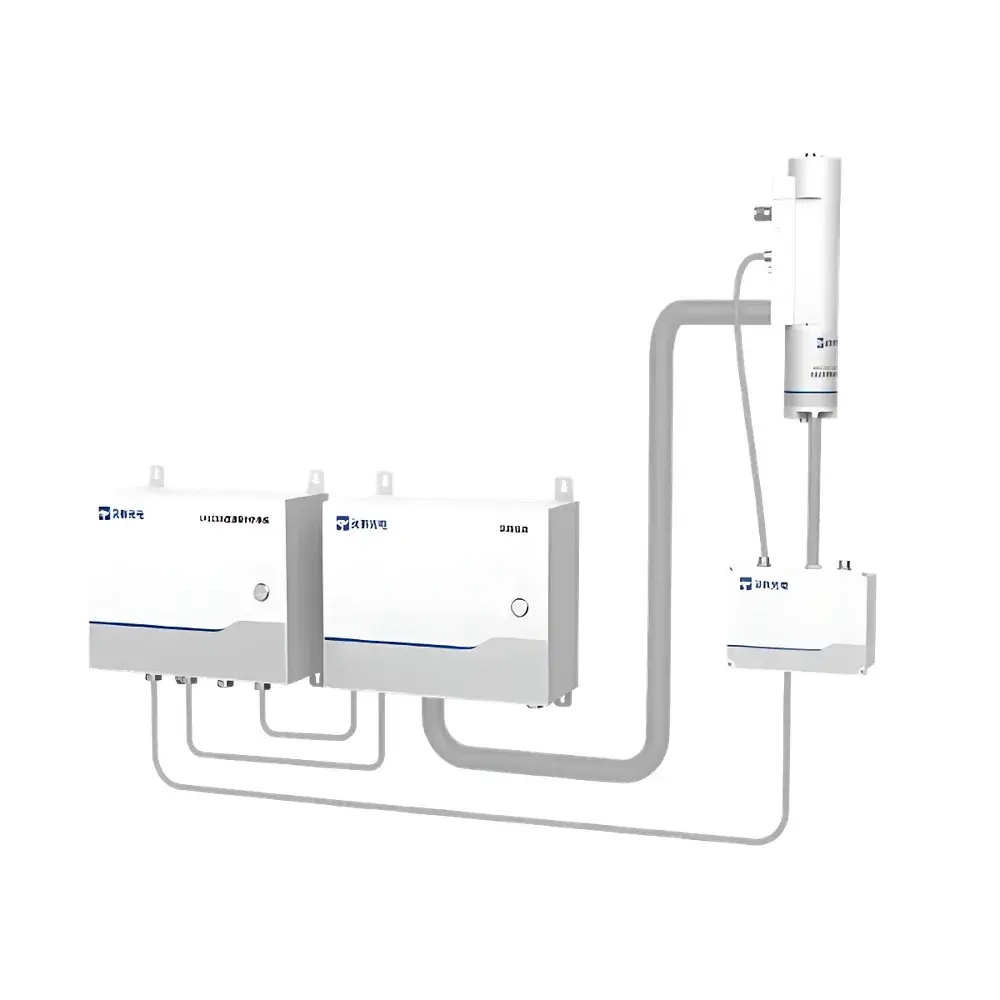
LXEC-210C Closed-Path Eddy Covariance System
| Brand | LINGXI Optoelectronics |
|---|---|
| Origin | Zhejiang, China |
| Model | LXEC-210C |
| Measurement Principle | Non-Dispersive Infrared (NDIR) Spectroscopy |
| Measured Gases | CO₂ and H₂O |
| Gas Path Configuration | Closed-Path |
| Compliance Context | Designed for long-term eddy covariance flux measurements per AmeriFlux/ICOS protocols |
| Data Integrity Features | Automated zero calibration, temperature-stabilized optical bench, high-frequency sampling (up to 20 Hz) |
| Environmental Robustness | IP65-rated enclosure, -25 °C to +50 °C operating range, condensation-resistant sample line heating |
Overview
The LXEC-210C Closed-Path Eddy Covariance System is an engineered solution for high-frequency, continuous measurement of vertical turbulent fluxes of carbon dioxide (CO₂) and water vapor (H₂O) in atmospheric boundary layer research. Built upon non-dispersive infrared (NDIR) spectroscopy, the system quantifies gas concentrations via absorption spectroscopy at characteristic mid-infrared wavelengths—4.26 µm for CO₂ and 2.6 µm for H₂O—within a thermally stabilized, sealed optical cell. Unlike open-path configurations, the closed-path design draws ambient air through a heated, laminar-flow sample line into a precisely controlled measurement cell, eliminating optical path contamination from rain, fog, dust, or snow. This architecture ensures data continuity across all weather conditions while minimizing spectral interference from atmospheric pressure and temperature fluctuations. The system operates at native sampling rates up to 20 Hz, synchronized with a co-located 3D sonic anemometer (not included), enabling direct computation of covariance between vertical wind velocity (w′) and gas concentration (c′) without reliance on post-hoc corrections for density fluctuations.
Key Features
- Thermally regulated NDIR optical bench with active temperature control (±0.05 °C stability) to maintain spectral baseline integrity under diurnal and seasonal ambient shifts.
- Automated zero-gas injection sequence integrated into the flow path unit, triggered at user-defined intervals (e.g., every 2–6 hours) to correct for baseline drift without manual intervention.
- Closed-path configuration eliminates WPL (Webb-Pearman-Leuning) correction requirements when reporting dry-mole-fraction fluxes—reducing uncertainty propagation associated with humidity-dependent density corrections.
- Modular, field-serviceable gas cell with sapphire optical windows; resistant to abrasion and chemical degradation during routine cleaning with ethanol or IPA.
- Heated sample line (60–70 °C) with mass-flow-controlled aspiration (1.2–1.8 L/min) to prevent condensation and ensure representative sampling across RH >95% conditions.
- Embedded intelligent data acquisition unit with onboard timestamping (PTPv2-compatible), real-time quality flagging, and dual SD card redundancy for mission-critical deployments.
Sample Compatibility & Compliance
The LXEC-210C is validated for use in terrestrial ecosystem flux towers, including forest, grassland, agricultural, and wetland sites. Its closed-path architecture meets the operational requirements of major international flux networks—including AmeriFlux, ICOS, and FLUXNET—for long-term, unattended monitoring. All firmware and data processing routines adhere to the QA/QC standards outlined in the AmeriFlux Metadata and Data Processing Guidelines (v3.2). While the instrument itself does not carry CE or FCC certification as a standalone component (it is deployed as part of a larger eddy covariance station), its electrical interface complies with IEC 61000-6-2 (immunity) and IEC 61000-6-4 (emissions) when installed with shielded cabling and proper grounding. Data output conforms to NetCDF-4/HDF5 format with CF-1.8 metadata conventions, supporting interoperability with FluxNet’s central database infrastructure.
Software & Data Management
The system ships with LINGXI EddySoft v2.4—a cross-platform (Windows/Linux) desktop application for configuration, diagnostics, and preliminary flux processing. EddySoft supports automated spike detection, coordinate rotation (double-rotation method), planar fit tilt correction, and high-frequency spectral filtering per standard eddy covariance best practices. Raw time-series data (10–20 Hz) are stored in binary-packed format with embedded GPS-synchronized timestamps and diagnostic flags (e.g., flow fault, temperature excursion, zero failure). For regulatory or audit-trail compliance, optional EddyLog Server enables secure remote access, role-based user permissions, and 21 CFR Part 11–compliant electronic signatures for calibration logs and processing parameters—suitable for GLP-aligned environmental monitoring programs.
Applications
- Quantification of net ecosystem exchange (NEE) and evapotranspiration (ET) in carbon and water budget modeling.
- Validation of satellite-derived land surface models (e.g., MODIS, Sentinel-3 SLSTR) and regional climate simulations.
- Long-term trend analysis of carbon sequestration capacity in managed and natural ecosystems under changing climate regimes.
- Regulatory-grade ambient air quality monitoring where CO₂ and H₂O serve as tracers for urban plume dispersion and biosphere–atmosphere coupling.
- Controlled-environment studies requiring stable, low-drift gas concentration baselines—such as chamber-based soil respiration assays or greenhouse gas mitigation trials.
FAQ
Does the LXEC-210C require external calibration gases for routine operation?
No—automated zero calibration uses certified nitrogen (N₂) or synthetic air; span calibration with certified CO₂/N₂ and H₂O/N₂ mixtures is recommended quarterly or after maintenance.
Can the system operate unattended for more than 30 days?
Yes—field-tested deployments exceed 180 days with scheduled zero cycles, solar-charged power systems, and redundant storage; battery-backed real-time clock maintains synchronization within ±10 ms over 30 days.
Is the raw 20-Hz data stream compatible with EddyPro or TK3 software?
Yes—output files include ASCII and NetCDF formats with standard variable naming (e.g., “co2_mole_fraction”, “h2o_mole_fraction”, “w”) and metadata headers required by third-party flux processors.
What maintenance is required during a 12-month deployment?
Biweekly visual inspection of inlet filter and desiccant cartridge; quarterly cleaning of optical windows; annual verification of flow controller accuracy and zero-gas delivery timing.
How is moisture handled in the sample line to avoid condensation artifacts?
The entire sample path—from inlet to cell—is actively heated to 65 °C ±2 °C, maintaining dew point depression >30 °C under typical field conditions; no membrane dryers or Nafion® tubes are used, preserving true H₂O signal fidelity.
Related Products







