
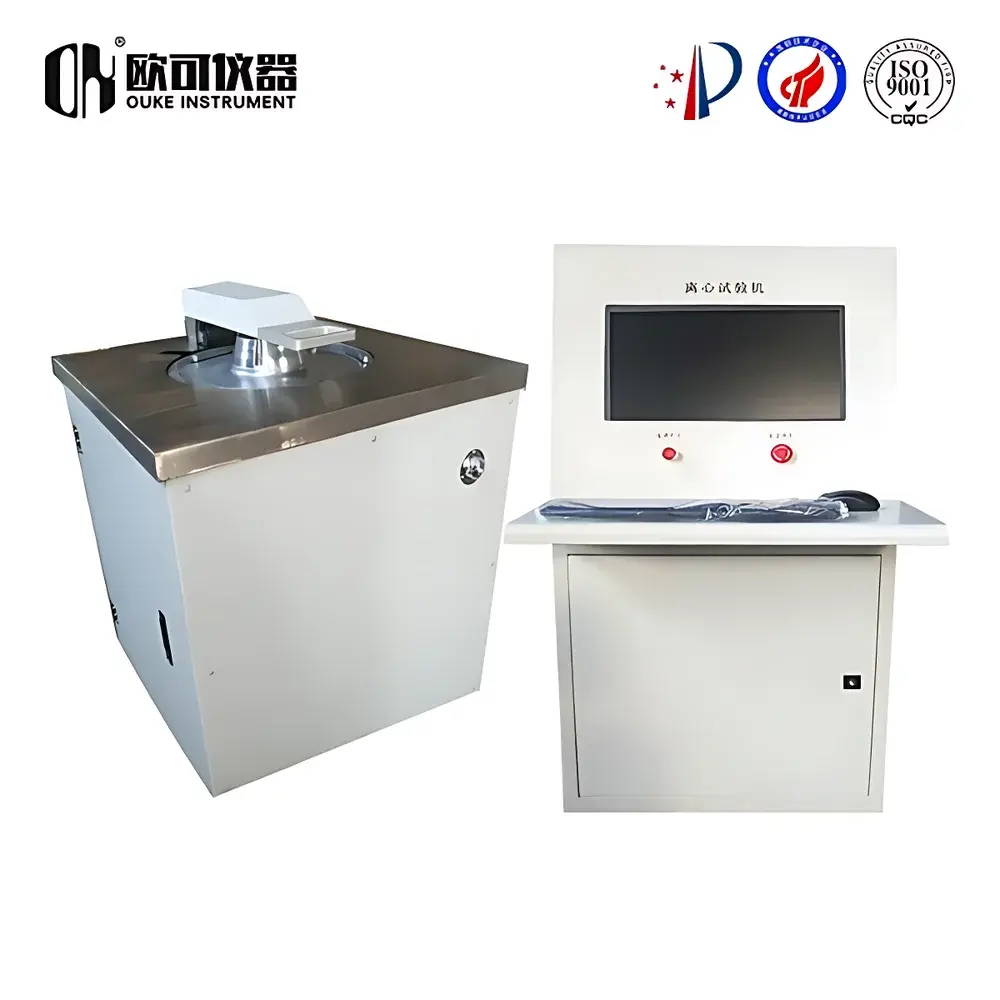
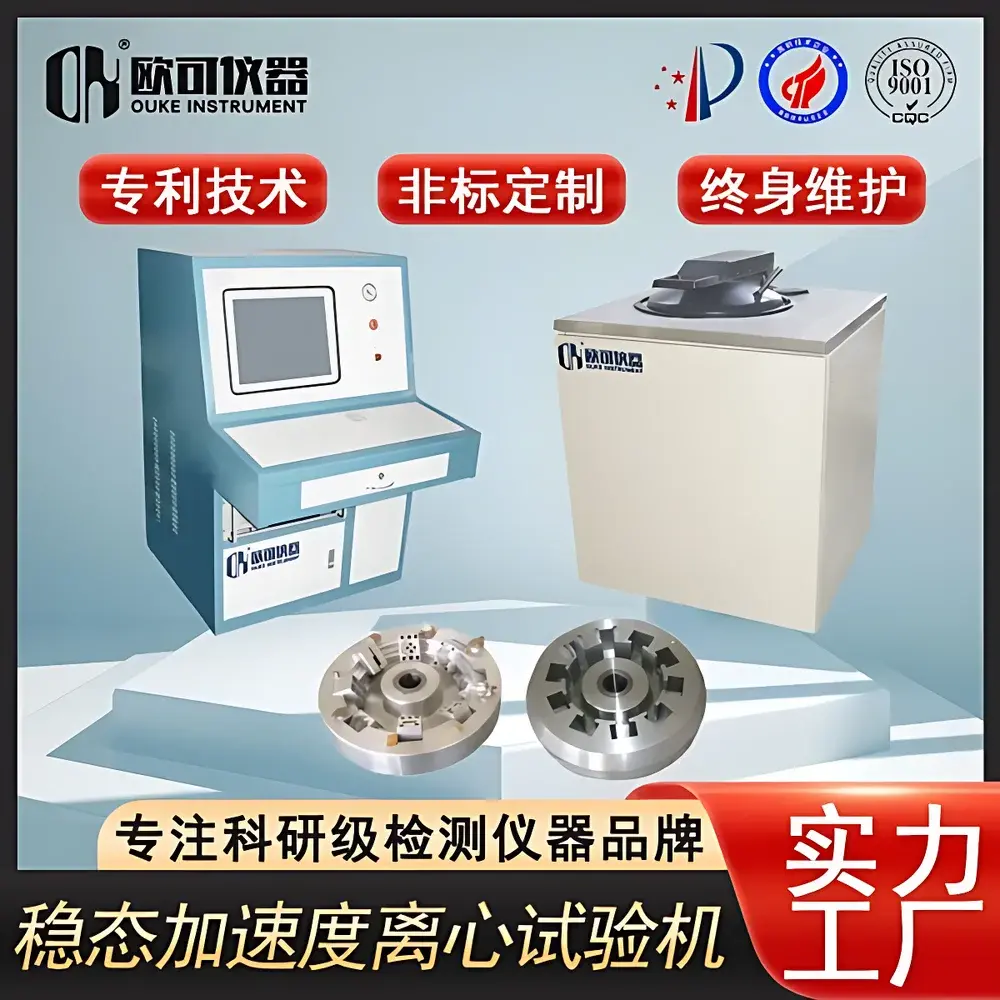
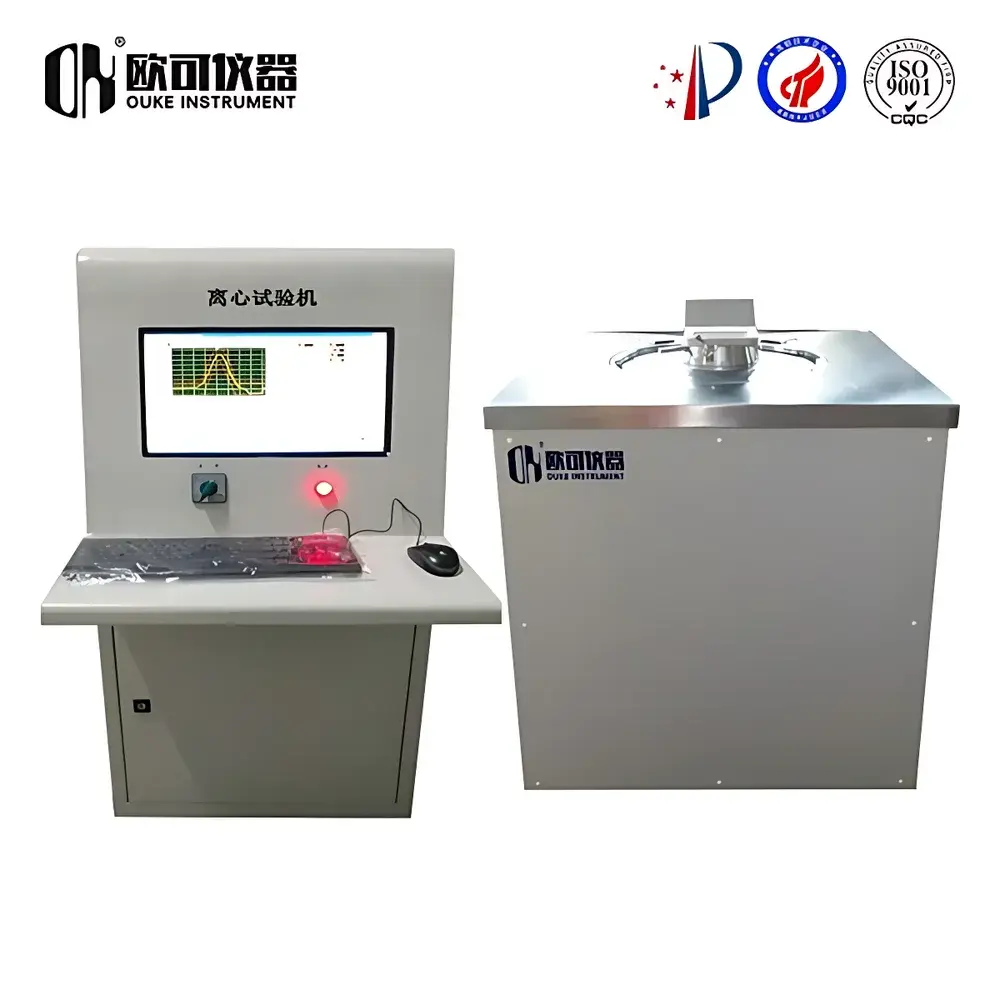
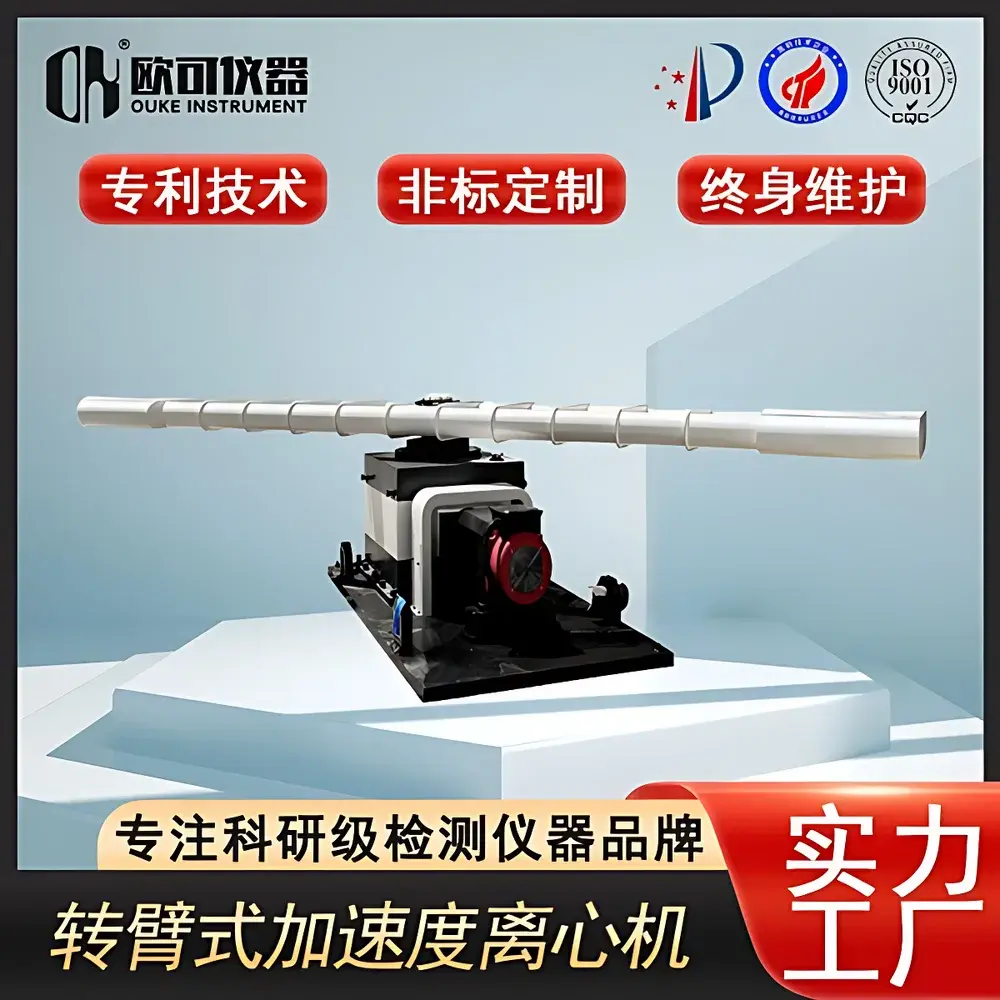
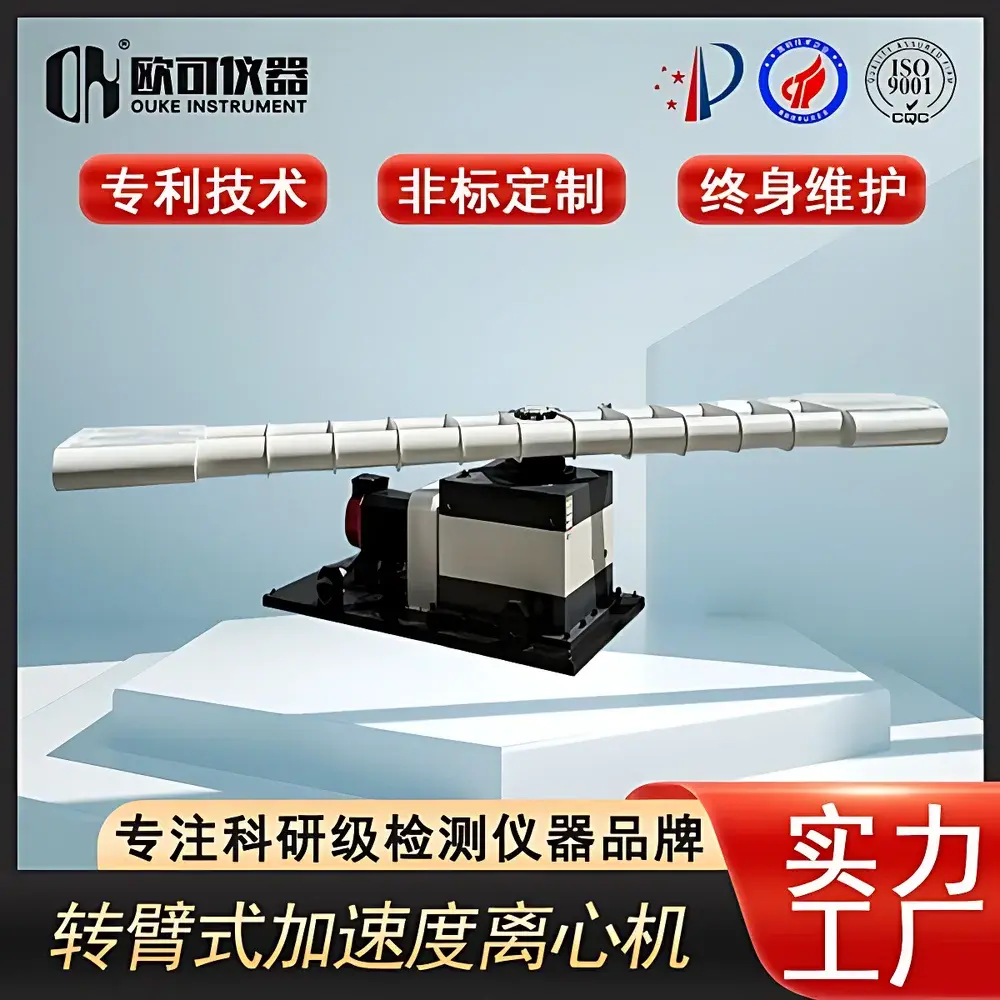
OK-LXJ10 Centrifugal Constant Acceleration Testing Machine
| Brand | OK Instruments |
|---|---|
| Origin | Guangdong, China |
| Manufacturer Type | Direct Manufacturer |
| Country of Origin | China |
| Model | OK-LXJ10 |
| Price | USD 28,000 (FOB Guangdong) |
| Compliance | MIL-STD-810F, MIL-STD-883C, GJB150A, GJB360B, GB/T 2423.15, IEC 60068-2-27 |
| Max Acceleration Range | 30–400,000 g |
| Max Load Capacity | 200 kg |
| Number of Test Stations | 4–64 |
| Specimen Height Limit | 200–300 mm |
| Radial Installation Radius | 200–1000 mm |
| Power Supply | AC 380 V, 1.5–6.5 kVA |
| Continuous Operation Duration | 30–60 min |
| Start-up Time | ≤3–5 min |
| Slip Ring Configuration | 15-channel, 500 V / 5 A |
| Dimensions (L×W×H) | 924×910×1242 mm to 1953×470×993 mm |
| Weight | 1000–2300 kg |
Overview
The OK-LXJ10 Centrifugal Constant Acceleration Testing Machine is an engineering-grade inertial acceleration simulation system designed for structural integrity validation and dynamic overload qualification of electronic components, microelectromechanical systems (MEMS), avionics modules, and compact electro-mechanical assemblies. It operates on the principle of radial centrifugal force generation—where specimens are mounted at a fixed radius from the rotational axis and subjected to precisely controlled, steady-state centripetal acceleration (expressed in multiples of gravitational acceleration, *g*). Unlike transient shock or vibration testing, this platform delivers sustained, unidirectional acceleration loads aligned with the specimen’s radial vector, enabling rigorous assessment of mechanical anchoring, solder joint reliability, internal mass retention, and dimensional stability under prolonged high-*g* stress. The system meets the physical test requirements defined in MIL-STD-810F Method 513.6 (Acceleration), MIL-STD-883C Method 2001 (Centrifuge), GJB150A-2009 Section 15, and IEC 60068-2-27, making it suitable for defense, aerospace, automotive electronics, and high-reliability industrial R&D laboratories operating under GLP or GMP-aligned quality frameworks.
Key Features
- Real-time industrial PC-based control architecture with deterministic timing resolution (<10 ms loop cycle) for precise acceleration ramping, dwell, and step-profile execution.
- Multi-stage acceleration sequencing capability—supports up to six discrete acceleration levels per test program, each with independent duration, tolerance band (±1.5% of setpoint), and directional assignment (radial X/Y/Z orientation via reconfigurable fixture plates).
- Integrated safety interlock system featuring hardware-enforced over-speed cutoff, real-time current monitoring of motor windings, open-circuit detection on slip ring channels, and automatic emergency brake activation upon deviation exceeding ±3% of nominal *g*-level for >500 ms.
- Modular multi-station turntable design accommodating 4 to 64 independently instrumented test positions; each station supports individual torque compensation calibration to maintain uniform acceleration across load distribution.
- Customizable high-fidelity slip ring assembly (15 circuits, rated 500 V / 5 A continuous) enabling live signal telemetry—including thermocouple, strain gauge, and digital I²C/SPI bus data—during active acceleration exposure.
- Full manual override mode with tactile jog controls and emergency stop redundancy compliant with ISO 13850:2015, ensuring operational flexibility during setup, calibration, and failure diagnostics.
Sample Compatibility & Compliance
The OK-LXJ10 accommodates specimens up to 200–300 mm in height and 200 kg in mass, with radial mounting radii configurable between 200 mm and 1000 mm to optimize *g*-level resolution versus rotational speed constraints. Fixture interfaces conform to standard DIN 31632 and MIL-STD-1377 mounting patterns. All mechanical and electrical subsystems are certified to IP54 ingress protection and operate within ambient temperature ranges of 10–35 °C and relative humidity ≤80% non-condensing. The system satisfies electromagnetic compatibility (EMC) per EN 61326-1:2013 and carries CE marking for machinery directive 2006/42/EC. Test reports generated include full audit trails—timestamped acceleration profiles, system health logs, operator ID, and calibration certificate references—supporting FDA 21 CFR Part 11-compliant electronic records when deployed with validated software configuration.
Software & Data Management
Control and analysis are executed via OK-ACCEL v3.2—a Windows 10 IoT Enterprise embedded application built on deterministic RTX64 real-time extension. The software provides ISO/IEC 17025-aligned traceability: every test run generates a digitally signed PDF report containing raw acceleration time-series (sampled at 1 kHz), tolerance envelope overlay, pass/fail status per MIL-STD-810F criteria, and metadata such as environmental chamber readings (if integrated), operator signature, and equipment calibration expiry. Data export supports CSV, HDF5, and MATLAB .mat formats. Audit logging includes all parameter modifications, user login/logout events, and firmware update histories—retained for minimum 12 months with automated archival to network-attached storage (NAS) or cloud S3-compatible repositories.
Applications
- Qualification of MEMS accelerometers, gyroscopes, and pressure sensors under sustained *g*-loading to verify bias stability and scale factor linearity.
- Evaluation of PCB-level solder joint fatigue resistance in automotive ADAS ECUs exposed to engine-bay centrifugal forces.
- Structural verification of satellite reaction wheel housings and optical bench mounts prior to launch vibration and acceleration campaigns.
- Reliability screening of piezoelectric actuators and ultrasonic transducers used in downhole oilfield tools.
- Validation of miniature battery pack mechanical retention under high-*g* flight envelope conditions per DO-160 Section 8.
FAQ
What standards does the OK-LXJ10 natively support for test execution and reporting?
The system implements built-in test templates for MIL-STD-810F Method 513.6, MIL-STD-883C Method 2001, GJB150A-2009 Clause 15, and GB/T 2423.15. All reports include clause-specific pass/fail logic and auto-populated compliance statements.
Can the machine perform bidirectional acceleration sweeps (e.g., +g to –g)?
No—the OK-LXJ10 is optimized for unidirectional, steady-state centrifugal acceleration. Reversal requires mechanical reorientation of the specimen; true alternating acceleration is outside its operational scope and must be addressed via separate shock or shaker table systems.
Is remote operation and monitoring supported?
Yes—via secure TLS 1.2-enabled web interface (HTTPS port 443) allowing real-time dashboard access, historical data retrieval, and limited parameter adjustment by authorized users with role-based permissions.
What maintenance intervals are recommended for long-term repeatability?
Critical calibration of the optical encoder feedback loop and torque sensor zero offset is required every 12 months or after 500 operational hours, whichever occurs first. Preventive maintenance includes bearing lubrication (every 2000 h), slip ring brush inspection (every 500 h), and dynamic balancing verification (annually).



