
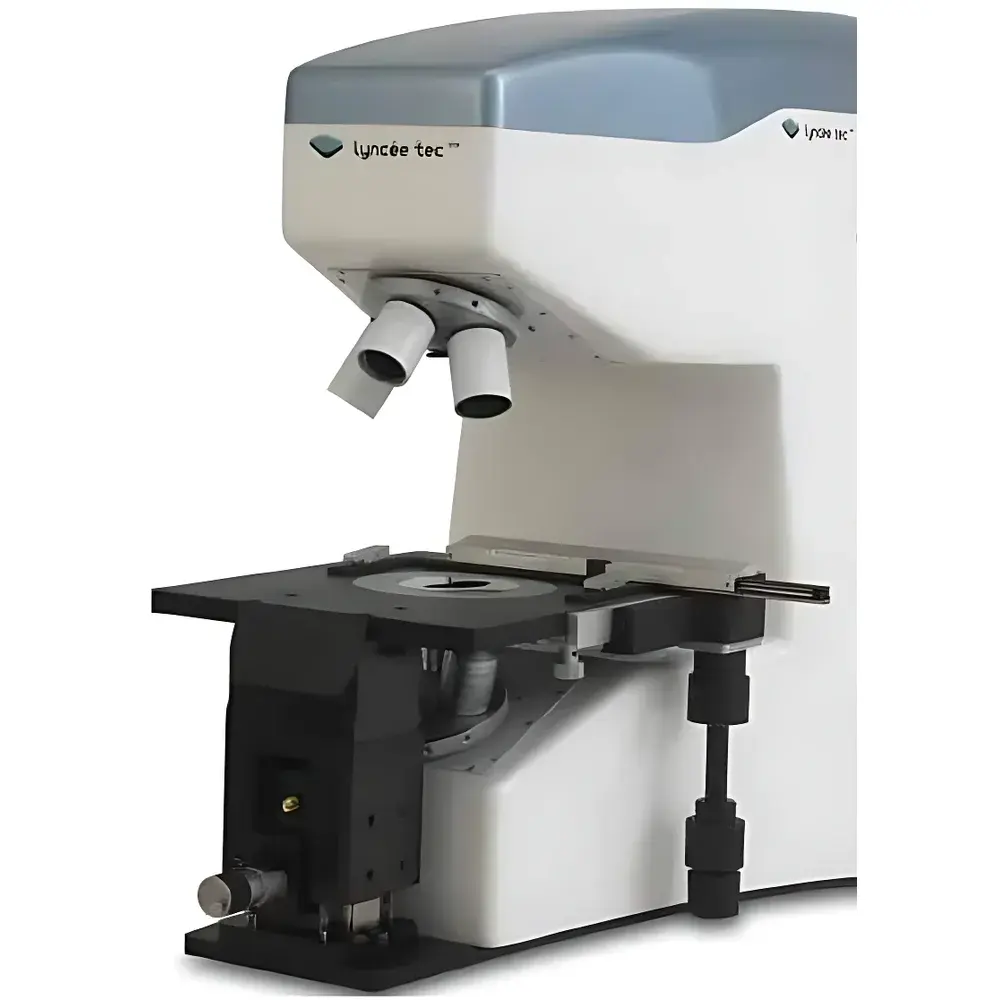
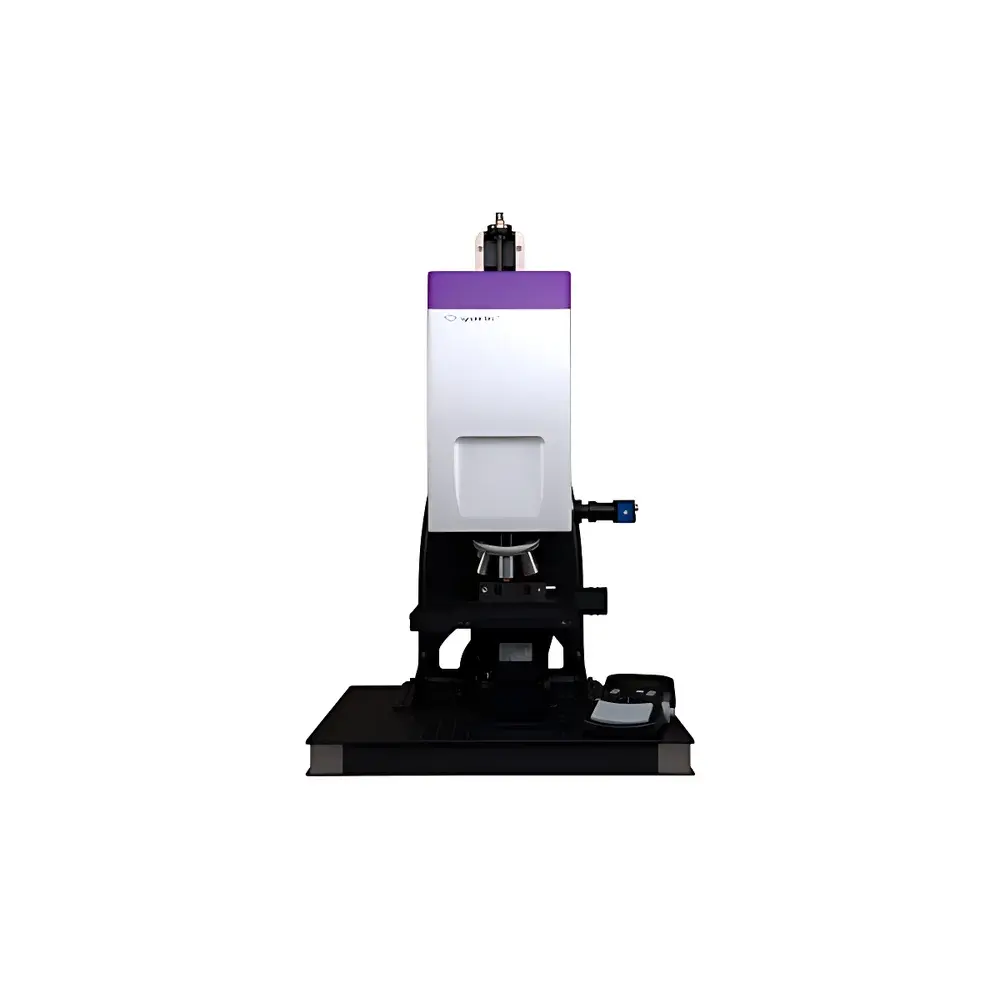
Lyncee Tech DHM™ R2100 Dual-Wavelength Reflective Digital Holographic Microscope
| Brand | Lyncee Tech |
|---|---|
| Origin | Switzerland |
| Model | DHM™ R2100 |
| Vertical Resolution | 0.3 nm (single-wavelength), 6.0 nm (dual-wavelength synthetic) |
| Max Measurable Step Height | 2.1 µm |
| Dynamic Vertical Range | 200 µm |
| Lateral Resolution | 300 nm (at 1.4 NA) |
| Field of View | up to 4.4 mm |
| Working Distance | 0.3–18 mm |
| Digital Focus Range | up to 50× depth of field |
| Acquisition Time | < 500 µs (standard), down to 10 µs (optional) |
| Frame Rate | 30 fps (1024×1024), up to 1000 fps (high-speed camera) |
| Reconstruction Rate | 25 fps (real-time, 1024×1024), up to 100 fps |
| Laser Wavelengths | 666 nm & 794 nm |
| Synthetic Wavelength | 4.2 µm |
| Minimum Sample Reflectivity | < 1% |
| Illumination Intensity | < 1 µW/cm² |
| Sample Stage | Motorized XYZ, 300 mm × 300 mm × 38 mm travel |
| Software | Koala® v6.x (C++/.NET), MEMS Analysis Tool, Reflectometry Analysis Tool, Cell Analysis Tool |
| Compliance | ISO/IEC 17025-ready workflow architecture, GLP-compliant audit trail (optional), FDA 21 CFR Part 11–compatible data export |
Overview
The Lyncee Tech DHM™ R2100 is a dual-wavelength reflective digital holographic microscope engineered for non-contact, label-free, real-time quantitative phase imaging and nanoscale topographic metrology. Unlike conventional scanning or focus-stacking techniques, DHM operates on the principle of off-axis digital holography: a coherent laser beam is split into reference and object arms; interference between the reflected object wavefront and the reference wave is captured in a single exposure by a high-speed CMOS sensor. Numerical reconstruction—via fast Fourier transform (FFT) and advanced phase unwrapping algorithms—yields both amplitude (intensity) and quantitative phase maps with sub-nanometer axial sensitivity. The R2100’s dual-laser configuration (666 nm and 794 nm) enables synthetic wavelength interferometry (SWI), extending unambiguous vertical measurement range to 2.1 µm while preserving intrinsic axial resolution of 0.3 nm (equivalent to λ/2000 at 666 nm). This architecture eliminates mechanical scanning, vibration-induced blur, and photobleaching—making it uniquely suited for dynamic surface characterization under ambient, environmental chamber, or vacuum conditions.
Key Features
- Dual-wavelength operation with independent reference paths and shared object arm—enabling seamless switching between single- and dual-laser modes without optical realignment
- Synthetic wavelength generation (Λ = λ₁λ₂/|λ₁−λ₂| = 4.2 µm) for extended unambiguous step-height measurement up to 2.1 µm, with mapping-based precision retention across full range
- Real-time 3D topography at video frame rates: 30 fps at full 1024×1024 resolution; up to 1000 fps with optional high-speed camera
- Nanometric axial repeatability (≤0.01 nm RMS over 1 hour) traceable to laser wavelength stability (0.01 nm/°C)
- Non-scanning, full-field acquisition ensures immunity to stage drift and environmental vibration—critical for MEMS dynamics, live-cell imaging, and in-line process monitoring
- Digital refocusing across up to 50× the optical depth of field, enabling post-acquisition focal plane selection without physical repositioning
- Ultra-low illumination intensity (<1 µW/cm²) compatible with photosensitive biological specimens, thin-film stacks, and optically fragile microstructures
- Integrated motorized XYZ stage (300 mm × 300 mm × 38 mm travel) with programmable positioning for large-area stitching and automated multi-site analysis
Sample Compatibility & Compliance
The DHM™ R2100 supports direct measurement through transparent media—including cover slips, immersion fluids (water, oil), quartz windows, and environmental chamber walls—without loss of coherence or resolution. Its low-coherence tolerance permits high-fidelity imaging of surfaces with reflectivity as low as 0.1%, enabling characterization of dielectric multilayers, polymer films, hydrogels, and semiconductor wafers. The system complies with metrological best practices for optical surface inspection: axial accuracy is intrinsically calibrated against the laser’s vacuum wavelength, satisfying traceability requirements aligned with ISO 25178-600 (areal surface texture) and ISO 10110-5 (optical component surface form). Data acquisition workflows support GLP-compliant audit trails, electronic signatures, and secure export in .bin/.txt (raw) and .tif/.csv (processed) formats—fully compatible with FDA 21 CFR Part 11 validation protocols when deployed in regulated QC/QA environments.
Software & Data Management
Koala® v6.x—the proprietary software platform—is built on a modular C++/.NET architecture optimized for real-time hologram reconstruction, phase unwrapping, and quantitative morphological analysis. Core modules include real-time 3D rendering, time-series volumetric tracking, and spectral analysis of dynamic deformation. Application-specific toolkits extend functionality: the MEMS Analysis Tool computes out-of-plane/in-plane displacement fields, resonance frequencies, and mode shapes from high-speed acquisitions; the Reflectometry Analysis Tool extracts layer thickness and refractive index profiles from multi-interface interference patterns; and the Cell Analysis Tool provides label-free quantification of dry mass, membrane fluctuations, and organelle dynamics. All processing pipelines generate metadata-rich datasets compliant with FAIR principles (Findable, Accessible, Interoperable, Reusable), supporting integration with LIMS and ELN systems via standardized API endpoints.
Applications
The DHM™ R2100 delivers validated performance across industrial R&D and academic research domains requiring non-destructive, high-speed, quantitative 3D metrology. Key use cases include: in-situ vibration mode analysis of MEMS/NEMS devices up to 25 MHz using synchronized stroboscopic illumination; real-time evaporation kinetics and droplet coalescence studies in microfluidics; thickness mapping of spin-coated polymer films and ALD-grown oxide layers; wafer-level defect detection and roughness profiling in semiconductor fabrication; and long-term morphological monitoring of adherent cells under physiological conditions—without fixation, staining, or contrast agents. Its ability to operate through glass substrates and controlled-atmosphere enclosures further enables corrosion studies, electrochemical interface characterization, and catalytic surface reaction monitoring.
FAQ
How does dual-wavelength operation extend measurable step height without sacrificing resolution?
By generating a synthetic wavelength (Λ = 4.2 µm), the R2100 decouples ambiguity range from optical wavelength—enabling unambiguous phase unwrapping over 2.1 µm steps—while retaining sub-angstrom axial sensitivity via high-frequency carrier modulation and pixel-level phase calibration.
Can the system measure transparent or semi-transparent multilayer structures?
Yes—when paired with the optional Reflectometry Analysis Tool, the R2100 quantifies thickness and refractive index of individual layers in dielectric stacks (e.g., SiO₂/TiO₂, polymer bilayers) from interference fringe contrast and phase dispersion across multiple wavelengths.
Is environmental vibration compensation required during operation?
No—full-field, single-shot acquisition eliminates sensitivity to sub-pixel stage motion; measurements remain stable even on standard optical tables without active damping.
What level of IT infrastructure is needed to support real-time 1000 fps acquisition?
A dedicated Dell workstation with ≥32 GB RAM, NVIDIA RTX A6000 GPU, and 10 GbE data interface is recommended; Koala®’s optimized memory management enables sustained streaming to NVMe storage at >2.5 GB/s.
Does the system support automated calibration and verification per ISO standards?
Yes—built-in NIST-traceable calibration routines verify axial linearity, lateral scaling, and noise floor performance; reports conform to ISO/IEC 17025 documentation templates for laboratory accreditation.





