
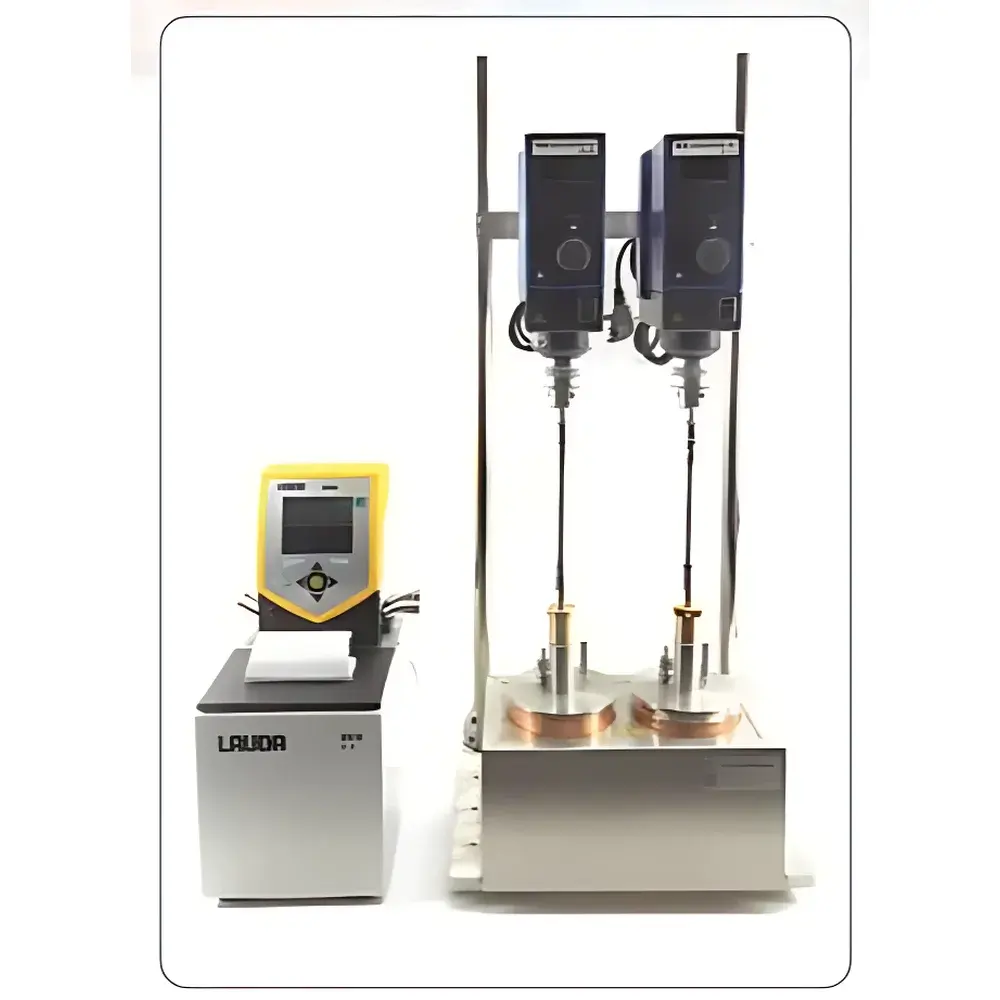
Lynsys Series PUR High-Viscosity Reaction System
| Brand | — |
|---|---|
| Origin | Shanghai, China |
| Manufacturer Type | Authorized Distributor |
| Regional Classification | Domestic |
| Model | Lynsys |
| Pricing | Upon Request |
Overview
The Lynsys Series PUR High-Viscosity Reaction System is an engineered laboratory-scale reaction platform designed specifically for the development, formulation, and process optimization of polyurethane reactive adhesives (PUR), high-solids coatings, solvent-free inks, and other shear-thinning, thermosensitive, or moisture-curing viscous systems. It operates on a controlled batch reaction principle, integrating precise temperature regulation, vacuum-assisted degassing, inert atmosphere purging (N₂ or Ar), and low-shear mechanical agitation—critical for maintaining molecular integrity during urethane prepolymer synthesis, chain extension, or crosslinking reactions. Unlike conventional jacketed reactors requiring post-reaction cleaning and disassembly, the Lynsys system employs a sealed, non-wetted drive architecture with magnetic coupling or top-mounted gearmotor transmission, eliminating shaft seals and minimizing contamination risk. Its design prioritizes reproducibility in small-batch synthesis (typically 0.5–5 L working volume), supporting R&D workflows where viscosity evolution (from 10⁴ to >10⁶ mPa·s), exotherm management, and residual moisture control directly impact final adhesive performance metrics such as open time, green strength, and thermal stability.
Key Features
- Integrated high-vacuum capability (≤10 mbar absolute) with dual-stage rotary vane pump interface for efficient solvent/moisture removal prior to and during reaction
- Programmable temperature control via external circulation bath compatibility (e.g., LAUDA RC series), enabling precise ramp/hold profiles from –20 °C to +180 °C
- Corrosion-resistant wetted materials: 316L stainless steel reactor vessel, PTFE-coated impeller blades, and FKM or perfluoroelastomer (FFKM) sealing components suitable for low-to-moderate chemical aggressiveness
- Modular agitator configuration: adjustable speed range (10–200 rpm) with torque monitoring; optional anchor, helical ribbon, or dual-blade configurations for non-Newtonian flow fields
- Hermetically sealed lid assembly with multiple standardized ports (1/4″ VCR, 1/2″ NPT) for gas inlet/outlet, pressure/vacuum transducer, PT100 probe, and optional inline viscometer or FTIR probe integration
- No internal baffles or fixed internals—facilitating full discharge without residue and eliminating cleaning between runs, thereby reducing downtime and cross-contamination risk
Sample Compatibility & Compliance
The Lynsys system accommodates formulations containing isocyanates, polyols, catalysts (e.g., dibutyltin dilaurate), latent curing agents, and fillers—common in one-component (1K) and two-component (2K) PUR systems. It complies with standard laboratory safety practices for handling moisture-sensitive reagents and exothermic reactions. While not certified to ASME BPVC Section VIII or PED 2014/68/EU, its pressure-rated vessel (up to 6 bar g) meets ISO 14001-aligned manufacturing protocols. The system supports GLP-compliant documentation when paired with validated external controllers and data loggers. All electrical components conform to IEC 61000-6-3 (EMC) and IEC 61000-6-2 (immunity) standards. For regulated environments, optional audit-trail-enabled digital controllers can be integrated to satisfy FDA 21 CFR Part 11 requirements for electronic records.
Software & Data Management
The Lynsys platform is controller-agnostic: it interfaces seamlessly with third-party PID controllers (e.g., Watlow F4T, Eurotherm 3500), PLC-based automation systems, or PC-hosted SCADA platforms via 4–20 mA analog signals or Modbus RTU over RS-485. Real-time acquisition of temperature, vacuum level, agitation speed, and motor torque is supported through standard analog inputs. Optional OEM-integrated software packages provide recipe management, trend logging, alarm history, and CSV export for traceability. Data files are timestamped and structured for compatibility with LIMS systems and statistical process analysis tools (e.g., JMP, Minitab). All firmware updates follow secure signed-binary protocols, and configuration backups are exportable to USB media for version control.
Applications
- Formulation screening of aromatic vs. aliphatic isocyanate prepolymers under controlled humidity and vacuum
- Kinetic studies of urethane bond formation using in situ FTIR or rheological monitoring
- Optimization of filler dispersion in high-viscosity hot-melt PUR adhesives without particle agglomeration
- Scale-down validation of industrial continuous PUR production parameters (residence time, shear rate, degas efficiency)
- Stability testing of shelf-life-critical 1K systems under accelerated aging conditions (elevated T, controlled RH)
- Development of bio-based polyol derivatives requiring extended reaction times at elevated temperatures
FAQ
What vacuum level can the Lynsys system achieve, and is vacuum maintained during agitation?
The system achieves ≤10 mbar absolute with a properly sized external vacuum pump and leak-tight assembly. Vacuum integrity is preserved during agitation due to magnetic drive or double mechanical seal configurations.
Can the reactor handle exothermic reactions safely?
Yes—when coupled with a thermostatically controlled external chiller (e.g., LAUDA Alpha series), the jacket enables active heat extraction; maximum recommended exotherm rate is 5 °C/min for 2 L batches.
Is the system compatible with ASTM D4290 or ISO 1133 for melt viscosity correlation?
While not a capillary viscometer, Lynsys-generated shear-rate-dependent viscosity trends correlate strongly with ASTM D3835 (rotational rheometry) and support predictive modeling for extrusion or dispensing behavior.
Does the manufacturer offer IQ/OQ documentation support?
As a distributor-integrated system, IQ/OQ templates and vendor-supplied calibration certificates for temperature and pressure sensors are available upon request for GMP-aligned installations.
What maintenance intervals are recommended for the agitator drive and seals?
Magnetic drives require no scheduled maintenance; mechanical seal variants recommend inspection every 500 operational hours or annually—whichever occurs first—using OEM-recommended FFKM kits.



