
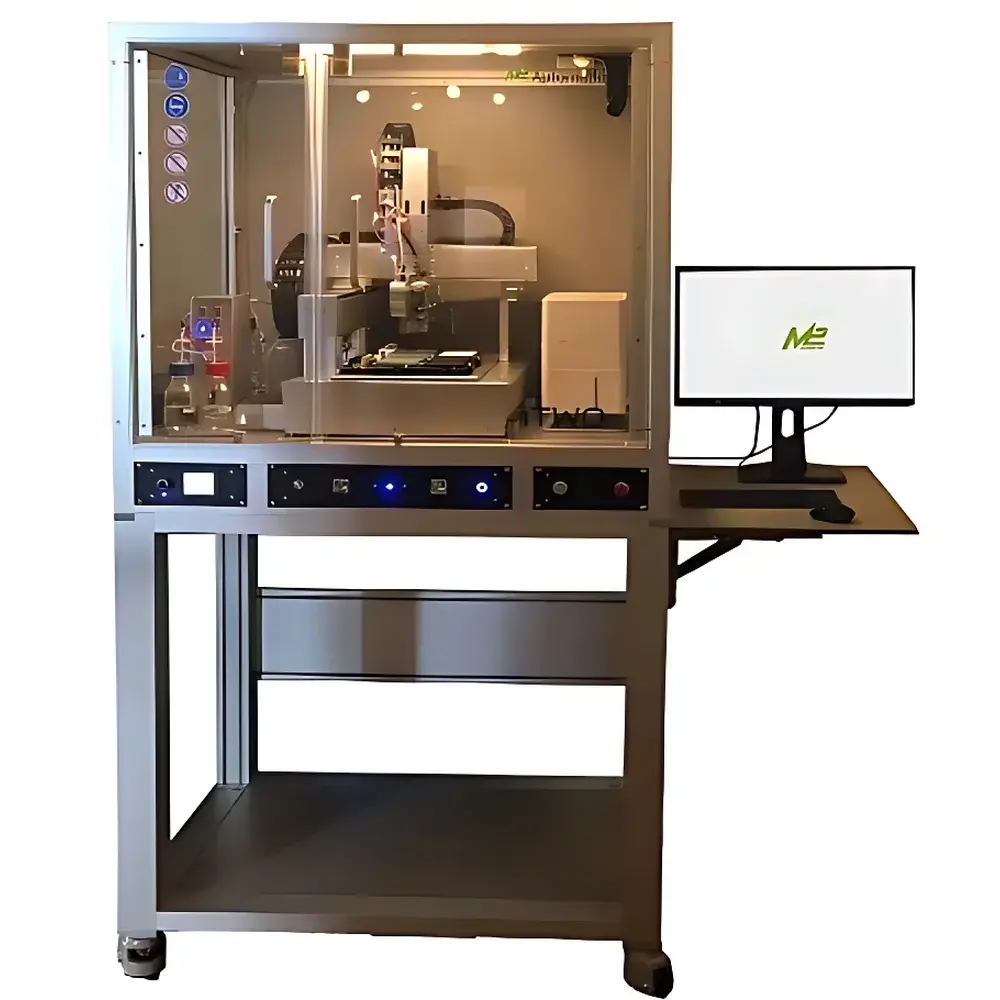
M2 Automation iTWO-300P Non-Contact Microarray Spotting Instrument
| Brand | M2 Automation |
|---|---|
| Origin | Germany |
| Model | iTWO-300P |
| Spotting Type | Non-contact piezoelectric dispensing |
| Spot Volume Range | 30 pL to 1 µL |
| Spotting Speed | Up to 1,000 droplets/sec |
| Substrate Capacity | Standard microscope slides, 96-/384-/1536-well plates, films, discs, microfluidic chips |
| Repeatability | ±5 µm |
| Minimum Feature Size | ≤1 µm |
| Maximum Stage Velocity | 75 cm/s |
| CV (Coefficient of Variation) | <2% |
| Compatible Spotting Modules | Piezo-based pL dispensers, M2MD nL dispensers, solenoid valves, multi-channel contact pins |
Overview
The M2 Automation iTWO-300P is a high-precision, non-contact microarray spotting instrument engineered for reproducible, low-volume deposition in genomics, proteomics, and diagnostic assay development. It operates on piezoelectric droplet-on-demand (DOD) dispensing principles, enabling controlled ejection of nanoliter-to-microliter volumes without physical contact between the nozzle and substrate. This eliminates cross-contamination risks, surface damage, and carryover—critical requirements for high-density nucleic acid or protein microarrays, antibody arrays, and tissue microarrays (TMAs). The system’s rigid granite base, air-bearing XY stage, and closed-loop servo control architecture ensure sub-5 µm positional repeatability across extended operation cycles. Designed and manufactured in Germany, the iTWO-300P meets stringent engineering tolerances expected in regulated life science R&D environments, including those aligned with ISO 13485–compliant device development workflows.
Key Features
- Non-contact piezoelectric dispensing platform supporting volume ranges from 30 pL to 1 µL with coefficient of variation (CV) <2%—validated using fluorescent dye calibration standards per ISO/IEC 17025 traceable protocols.
- High-throughput stage capable of processing up to 30 standard microscope slides per run; compatible with 96-, 384-, and 1536-well microplates, polymer films, glass discs, and custom microfluidic substrates.
- Integrated in-line droplet imaging system with synchronized high-speed camera (≥10,000 fps) for real-time droplet formation validation, jetting stability monitoring, and automatic rejection of malformed ejecta.
- Dual-camera quality assurance: top-view optical inspection module provides real-time substrate alignment verification and post-spot morphology assessment at ≤1 µm resolution.
- On-board de-gassing and inline filtration unit (0.22 µm PES membrane) installed upstream of all dispensing modules to eliminate microbubbles and particulate contaminants—reducing nozzle clogging frequency by >90% versus systems lacking integrated fluid conditioning.
- Modular head architecture supports rapid interchange of dispensing technologies: pL-range piezo printheads, nL-scale M2MD electrostatic actuators, solenoid-driven valve nozzles, and multi-channel contact pins—all controlled via unified firmware abstraction layer.
Sample Compatibility & Compliance
The iTWO-300P accommodates diverse biological and synthetic sample matrices—including aqueous DNA/RNA solutions, glycerol-stabilized antibody suspensions, hydrophobic peptide formulations, and viscous polymer blends—without requiring solvent-specific hardware reconfiguration. Its sealed, HEPA-filtered enclosure option (optional) enables Class 100 cleanroom integration. The instrument complies with IEC 61000-6-2 (EMC immunity) and IEC 61000-6-4 (EMC emission) standards. Firmware supports audit trail generation, electronic signatures, and user-access-level controls required for GLP and GMP-aligned workflows. Full 21 CFR Part 11 compliance is achievable when deployed with validated third-party LIMS or ELN platforms supporting digital signature enforcement and immutable log archiving.
Software & Data Management
Controlled via M2 SpotSuite v4.x—a Windows-based application built on .NET Framework with deterministic real-time scheduling. The GUI features drag-and-drop layout design, dynamic spot pattern generation (grids, serpentine, custom ROI mapping), and automated calibration routines for nozzle response profiling and Z-height optimization. All acquisition metadata—including environmental logs (temperature, humidity), stage position timestamps, droplet ejection statistics, and QC image hashes—are embedded into proprietary .SPOT binary files. Export formats include TIFF (QC images), CSV (spot coordinates/intensities), and MIAME-compliant MAGE-TAB templates. API access via RESTful endpoints allows integration with enterprise data lakes and automated pipeline orchestration tools (e.g., Nextflow, Snakemake).
Applications
- High-density oligonucleotide microarrays for gene expression profiling and SNP genotyping.
- Antibody and recombinant protein arrays for biomarker discovery and immunoassay validation.
- Tissue microarray (TMA) construction with precise core placement and orientation control.
- Surface-immobilized aptamer libraries for SELEX-based target screening.
- Deposition of CRISPR guide RNA complexes onto functionalized substrates for spatially resolved genome editing studies.
- Preparation of calibration standards for MALDI-TOF MS imaging and digital ELISA platforms.
FAQ
What substrates are supported beyond standard glass slides and microplates?
The system accepts custom-cut silicon wafers, PDMS microfluidic chips, PET films, polycarbonate discs, and porous nitrocellulose membranes—provided substrate flatness deviation remains within ±25 µm over 75 mm × 25 mm area.
Is remote diagnostics and firmware update capability available?
Yes—via secure TLS 1.2 encrypted connection to M2 Automation’s authorized service portal; updates require dual-factor authentication and generate versioned, timestamped audit entries.
Can the instrument be integrated into an automated liquid handling workflow?
Fully supported through standardized SLIM (Standardized Lab Instrument Messaging) protocol over Ethernet/IP; includes handshake signals for plate presence detection, status reporting, and emergency stop coordination.
What maintenance intervals are recommended for the piezo dispensing modules?
Nozzle cleaning cycles every 8 operational hours; full fluid path flush and filter replacement every 200 hours; annual calibration verification against NIST-traceable step gauges and droplet mass standards.




