
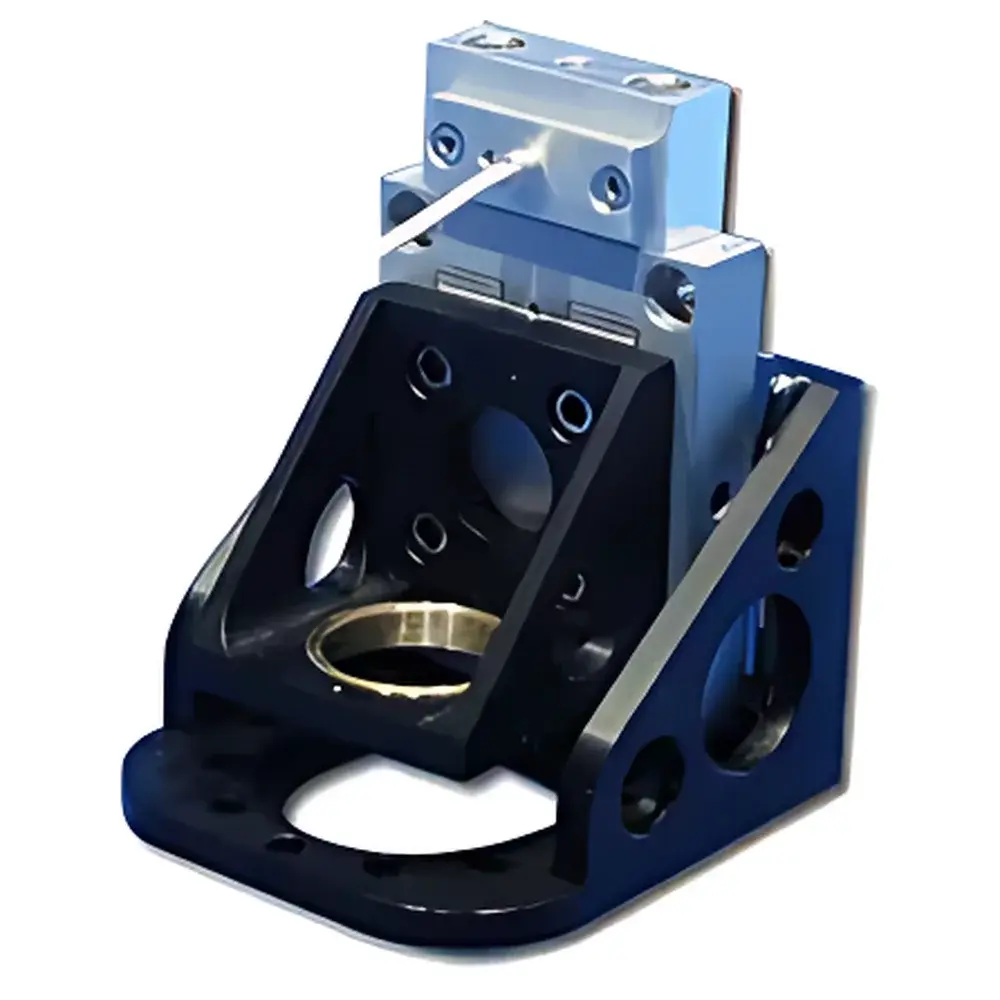
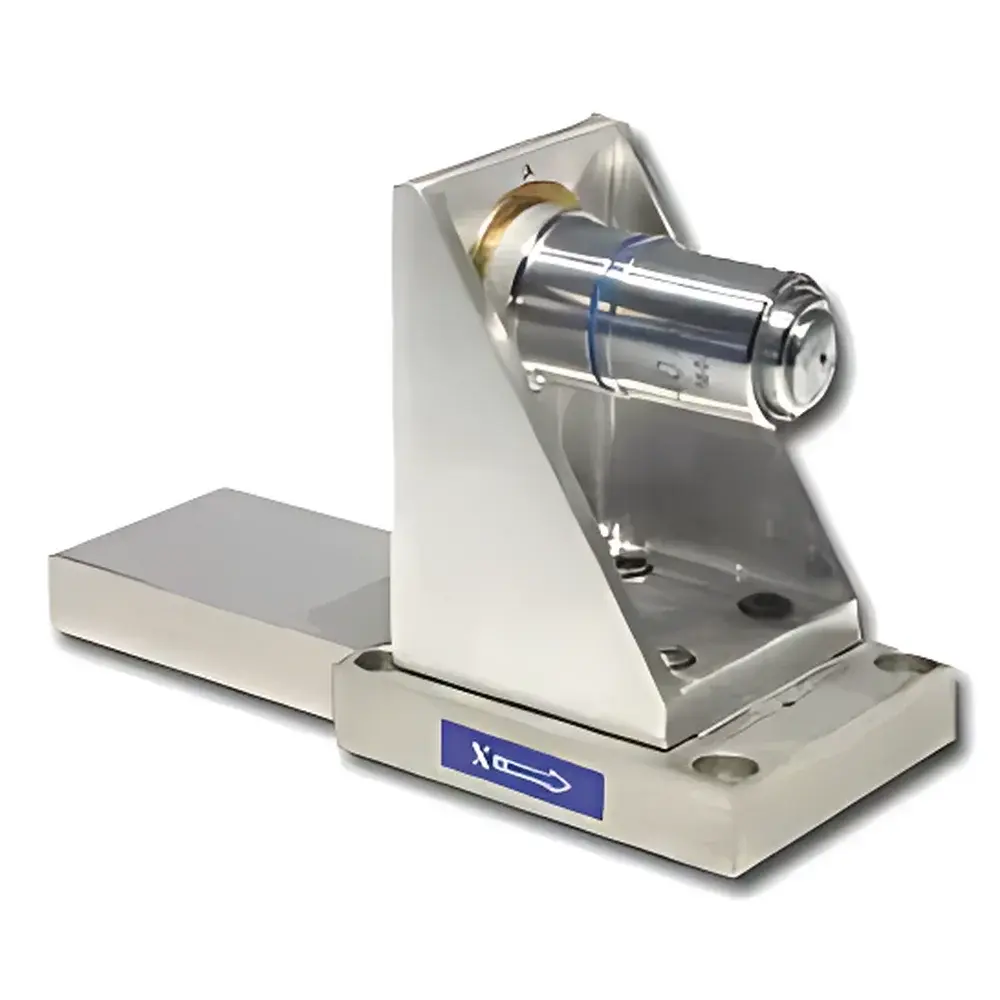
Mad City Labs Nano-OP Series High-Speed Piezoelectric Lens Positioners

| Brand | Mad City Labs (MCL) / MCL Think Nano |
|---|---|
| Origin | USA |
| Manufacturer Type | Authorized Distributor |
| Product Category | Imported |
| Model | Nano-OP30 / Nano-OP65 / Nano-OP100 |
| Product Type | Single-Axis Piezoelectric Translation Stage |
| Motion Range | 30 μm / 65 μm / 100 μm |
| Resolution | 0.06 nm / 0.13 nm / 0.2 nm |
| Resonant Frequency | 4 kHz ±20% (unloaded), 2 kHz ±20% (100 g load) |
| Stiffness | 3.0 N/μm ±20% |
| Angular Deviation (Roll/Pitch) | ≤1 μrad |
| Angular Deviation (Yaw) | ≤2 μrad |
| Max. Horizontal Load | 1.0 kg |
| Max. Vertical Load | 0.5 kg |
| Body Materials | Aluminum, Invar, or Titanium |
| Controller | Nano-Drive® |
Ask about pricing, availability and specifications.
Overview
The Mad City Labs Nano-OP Series is a family of single-axis, high-bandwidth piezoelectric lens positioners engineered for sub-millisecond optical focusing and dynamic axial alignment in demanding microscopy and laser-based instrumentation. Unlike conventional motorized or voice-coil translation stages, the Nano-OP leverages direct-drive capacitive-sensed piezoelectric actuation to deliver nanometer-level resolution, closed-loop positional stability, and resonant dynamics optimized for rapid step-and-settle motion. Its core design principle centers on minimizing mechanical compliance and inertial lag—critical parameters when synchronizing focus adjustments with high-speed imaging modalities such as confocal line scanning, light-sheet microscopy, or adaptive optics wavefront correction. The stage operates via electrostrictive displacement within a monolithic ceramic stack, coupled with integrated strain gauge or capacitive position feedback, enabling real-time trajectory tracking without hysteresis-induced drift. This architecture ensures repeatable performance across thermal gradients and long-term operation—attributes essential for GLP-compliant optical validation workflows and automated QC inspection systems.
Key Features
- Direct-drive piezoelectric actuation with no gear trains, belts, or lead screws—eliminating backlash and wear-related drift
- Closed-loop control with <0.1 nm typical noise floor and <0.05% linearity error over full travel range
- Three standard travel options: 30 μm (Nano-OP30), 65 μm (Nano-OP65), and 100 μm (Nano-OP100), each calibrated and certified per ISO 230-2 Annex B
- Sub-10 ms step response time under 350 g payload (lens + mounting bracket), validated using high-speed photodiode edge-detection methodology
- Ultra-low angular deviation: ≤1 μrad roll/pitch and ≤2 μrad yaw—preserving beam collimation and optical axis integrity during Z-scanning
- Modular body construction available in aluminum (lightweight integration), Invar (thermal stability <0.5 ppm/°C), or titanium (high stiffness-to-mass ratio)
- Compatible with Mad City Labs’ Nano-Drive® controller platform, supporting analog voltage input (±10 V), digital USB/Ethernet command sets, and real-time waveform streaming at up to 100 kHz sample rate
Sample Compatibility & Compliance
The Nano-OP Series is designed for integration into OEM optical subsystems and research-grade platforms where deterministic, low-latency axial positioning is required. It supports standard C-mount, SM1-threaded, and custom-machined lens brackets with kinematic mounting interfaces. While not intended for direct insertion into commercial microscope nosepieces (a role fulfilled by the Nano-F and Nano-F25HS series), the Nano-OP serves as the primary actuator in custom-built high-speed focus modules—including those deployed in FDA-regulated ophthalmic imaging devices and ISO 13485-certified diagnostic analyzers. All units undergo 100% functional testing per MIL-STD-883H Method 5005 for piezoelectric reliability, and controller firmware complies with IEC 62304 Class B software safety requirements. Traceable calibration certificates (NIST-traceable interferometric verification) are available upon request for GxP environments requiring audit-ready documentation.
Software & Data Management
Nano-OP systems interface natively with Mad City Labs’ Nano-Drive® software suite, which provides both GUI-driven commissioning and programmable API access via Python, MATLAB, LabVIEW, and C/C++. The software implements full 21 CFR Part 11-compliant audit trail logging—including user login events, parameter changes, motion profile uploads, and timestamped position history—with optional encrypted database storage. Real-time data acquisition supports synchronized multi-channel capture (e.g., position + photodetector signal + TTL trigger), exportable in HDF5 or CSV formats for downstream analysis in Igor Pro, OriginLab, or custom Python pipelines. Firmware updates are digitally signed and validated prior to installation, ensuring integrity across distributed lab networks operating under ITAR-controlled infrastructure.
Applications
- Dynamic focus stabilization in two-photon and STED microscopy
- Z-stack acquisition acceleration for high-throughput tissue sectioning and slide scanning
- Real-time aberration compensation in adaptive optics systems for retinal imaging
- Precision lens phasing in multi-aperture interferometers and metrology sensors
- Active alignment of fiber-coupled laser diodes in photonic packaging test stations
- Feedback-controlled depth modulation in optical coherence tomography (OCT) engines
FAQ
What is the maximum recommended payload for vertical orientation?
The Nano-OP Series supports up to 0.5 kg in vertical configuration; loads exceeding this threshold require engineering consultation to evaluate creep behavior and thermal derating.
Can the Nano-OP be operated in vacuum environments?
Yes—models with titanium bodies and vacuum-rated cabling (option VAC) are rated for 10⁻⁶ Torr; outgassing profiles comply with ASTM E595 for space-qualified optical hardware.
Is third-party controller compatibility supported?
While Nano-Drive® is the reference platform, analog voltage control (±10 V, 0–100% full scale) enables integration with standard motion controllers from Thorlabs, Newport, or PI—provided external amplification and noise shielding meet ≥70 dB SNR specifications.
How is linearity verified across the full travel range?
Each unit undergoes interferometric calibration using a Zygo Verifire™ HD interferometer; raw data and residual error maps are included in the shipped calibration report.
Are custom travel ranges or mounting interfaces available?
Yes—MCL’s engineering team supports bespoke designs including asymmetric ranges, multi-axis stacked configurations, and integrated fiducial markers for machine-vision alignment.