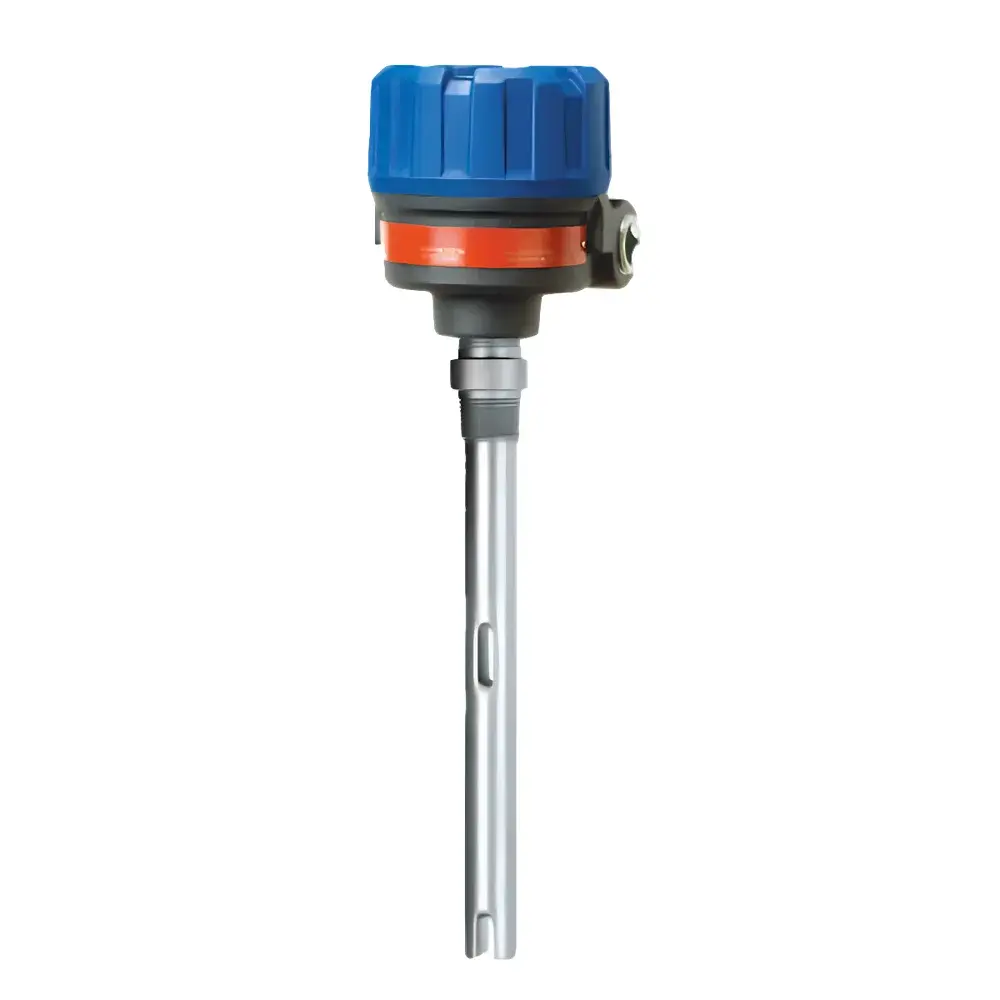
MAGNETROL Echotel® 961/962 Series Ultrasonic Level Switches
| Brand | MAGNETROL |
|---|---|
| Model | Echotel® 961 (Single-Point) / Echotel® 962 (Dual-Point) |
| Measurement Principle | Pulse-Echo Ultrasonic |
| Safety Certification | SIL 2 per IEC 61508 |
| Installation Options | Integral or Remote Mount |
| Probe Materials | Stainless Steel 316L or FDA-Compliant PTFE-Coated Polymer |
| Operating Voltage | 24 VDC (±15%) or 115/230 VAC (50/60 Hz) |
| Output Signal | SPDT Relay (Configurable Fail-Safe) |
| Environmental Rating | IP67 / NEMA 4X |
| Temperature Range | –40 °C to +85 °C (Process Side), –20 °C to +60 °C (Electronics) |
| Pressure Rating | Up to 10 bar (145 psi) |
| Compliance | ATEX II 2G Ex db IIC T6 Gb, IECEx DBI22.0027X, UL/cUL Class I Div 1 Groups B, C, D, FM Class I Div 1 Groups B, C, D |
Overview
The MAGNETROL Echotel® 961 and 962 Series Ultrasonic Level Switches are engineered for reliable, maintenance-free point-level detection in demanding industrial process environments. Utilizing pulse-echo ultrasonic technology, these devices emit short-duration, high-frequency acoustic pulses (typically 1–2 MHz) from a transducer mounted directly on the vessel wall or immersed in the medium. The time-of-flight between emission and echo return is analyzed to determine presence or absence of material at the sensor’s active detection zone—without mechanical moving parts, contact with the process fluid, or dependence on conductivity, dielectric constant, or density. This principle ensures consistent performance across non-polar liquids, viscous slurries, foaming media, and aerated tanks where traditional float, capacitance, or conductivity switches often fail. Designed for continuous operation under variable temperature, pressure, and vapor conditions, the Echotel® 961/962 series meets the functional safety requirements of SIL 2 (IEC 61508) and is certified for use in hazardous areas worldwide.
Key Features
- Pulse-echo ultrasonic sensing with adaptive signal processing to suppress false triggers from foam, turbulence, coating buildup, or vapor condensation
- Configurable alarm delay (0–30 seconds) to accommodate rapid level fluctuations, agitation, or intermittent splashing
- End-point sensing slot design that isolates the active transduction zone, minimizing sensitivity to mounting orientation and vessel geometry
- Integrated self-diagnostics continuously monitor transducer integrity, signal amplitude, temperature drift, and electronic health—triggering a dedicated fault relay output upon anomaly detection
- Flexible configuration options: Echotel® 961 for single-point detection; Echotel® 962 for independent high/low dual-point monitoring within one housing
- Choice of integral (all-in-one) or remote-mounted electronics with flexible cable lengths (standard up to 10 m, extended options available)
- Probe construction options include 316L stainless steel for general corrosion resistance or FDA-compliant polymer-coated variants for sanitary applications in food, beverage, and biopharma
Sample Compatibility & Compliance
The Echotel® 961/962 series is validated for use with a broad range of process media—including water, acids, alkalis, solvents, hydrocarbons, dairy products, fermentation broths, and wastewater—provided acoustic impedance permits sufficient echo reflection. It is not recommended for dry powders, low-density granular solids, or highly attenuating media such as heavy bitumen or thick polymer gels. All units comply with international safety and electromagnetic compatibility standards: IEC 61000-4 (EMC), IEC 60079-0/-11 (Explosive Atmospheres), UL 61010-1 (Safety), and RoHS/REACH. SIL 2 certification covers both hardware fault tolerance and systematic capability, supporting integration into safety instrumented systems (SIS) per IEC 61511. Documentation includes full FMEDA reports, proof test procedures, and traceable calibration records aligned with ISO/IEC 17025 practices.
Software & Data Management
Configuration is performed locally via push-button interface with LED status indicators or remotely using MAGNETROL’s free Echotel® Configuration Tool (Windows-based PC software). The tool enables parameter setup—including switch logic (NO/NC), delay timing, fault response mode, and diagnostic sensitivity—while logging configuration history and firmware revision. Audit trails are retained internally and exportable for GLP/GMP compliance. No cloud connectivity or proprietary network protocols are required; all communication remains isolated to local HART® (optional on 4–20 mA models) or discrete relay outputs. Firmware updates follow secure, signed binary verification to ensure integrity during field upgrades.
Applications
These switches serve critical overfill prevention, pump protection, and batch control functions across multiple regulated industries. In chemical processing, they safeguard reactors and storage tanks handling aggressive solvents and monomers. In water/wastewater treatment, they manage lift station sump levels and clarify effluent overflow conditions. Food and beverage installations leverage FDA-compatible probes for CIP/SIP validation and hygienic tank level interlocks. Power generation facilities deploy them in boiler feedwater deaerators and cooling tower basins. Refineries and petrochemical plants rely on their ATEX/IECEx certifications for flare knockout drum and amine regenerator level monitoring—where reliability under thermal cycling and hydrocarbon exposure is non-negotiable.
FAQ
Can the Echotel® 961/962 detect interface levels (e.g., oil/water)?
No—this device is designed exclusively for point-level detection, not continuous level measurement or interface discrimination.
Is it suitable for vacuum applications?
Yes, provided the absolute pressure remains above 10 kPa; performance may degrade below this threshold due to reduced acoustic coupling.
Does it require periodic recalibration?
No—pulse-echo ultrasonic switching is inherently stable and does not drift with time; only functional verification per site-specific proof test intervals is required.
Can it be installed in plastic or fiberglass tanks?
Yes, but wall thickness and acoustic transmission properties must be verified; ultrasonic energy attenuation increases significantly in non-metallic vessels, potentially requiring probe repositioning or sensitivity adjustment.
What is the maximum allowable coating thickness on the probe face?
Up to 3 mm of uniform, non-porous deposit (e.g., dried latex, sugar syrup residue) is tolerated without loss of detection reliability; thicker or cracked coatings necessitate cleaning per maintenance schedule.
Related Products